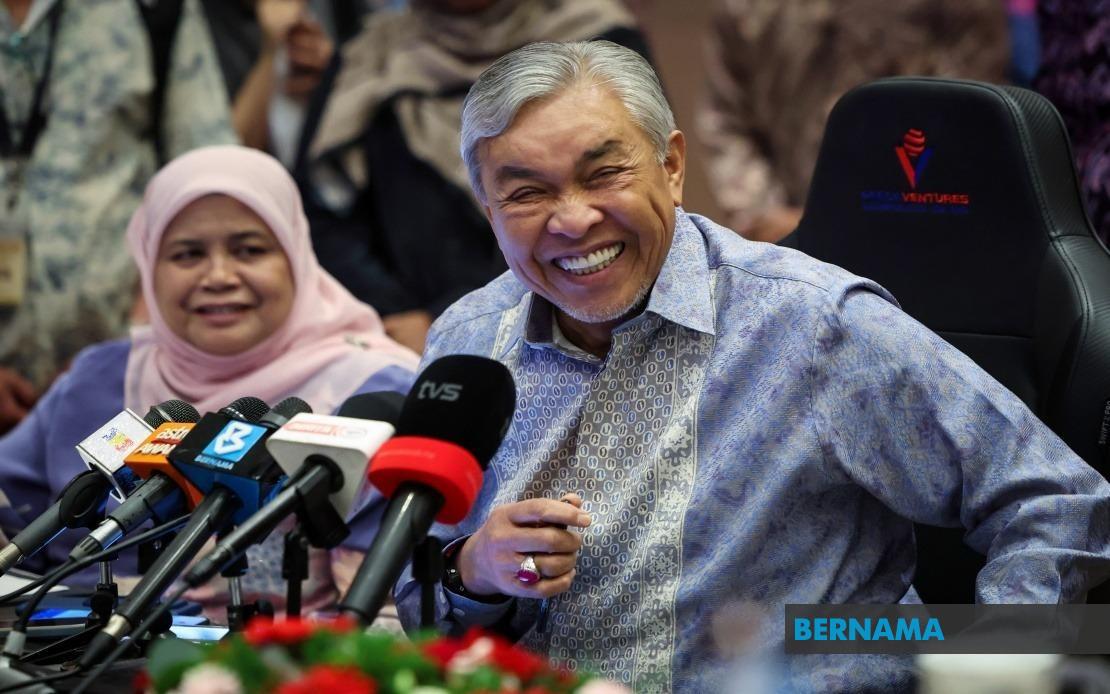
Barisan Nasional has moved to quash persistent rumours of political instability by reiterating its steadfast backing for the incumbent Unity Government administration led by Prime Minister Datuk Seri Anwar Ibrahim. Deputy Prime Minister and BN chairman Datuk Seri Dr Ahmad Zahid Hamidi delivered the reassurance during a visit to Penang, where he presided over the 61st Coordination Meeting between the Minister of Rural and Regional Development and State Executive Councillors for Rural Development. The declaration comes amid ongoing speculation in political circles about potential shifts in coalition dynamics and the stability of Malaysia's power-sharing arrangement.
Ahmad Zahid's remarks represent a direct response to a persistent undercurrent of conjecture surrounding BN's intentions within the Unity Government framework. He explicitly dismissed possibilities of what he termed "Bangkok Move" or "Dubai Move" — oblique references to alleged schemes for orchestrating government changes or leadership transitions through unconventional political means. Such terminology has circulated in Malaysian political discourse as coded language for attempts to engineer political upheaval outside formal parliamentary procedures. By naming and dismissing these possibilities with categorical finality, Ahmad Zahid signalled that BN leadership views such speculation as not merely unfounded but potentially corrosive to the broader political consensus.
The coalition's commitment to the Unity Government, according to Ahmad Zahid, traces its origins to the constitutional framework established following the 2022 General Election. The formation of the power-sharing arrangement came at the behest of the Yang di-Pertuan Agong, whose decree effectively mandated cross-party cooperation to ensure governmental stability and prevent political fragmentation. Ahmad Zahid framed BN's participation not as a temporary tactical expedient but as a principled acceptance of the constitutional authority's guidance. This framing is significant because it positions BN's continued participation as fundamentally a matter of loyalty to constitutional governance rather than mere political calculation, thereby elevating the commitment beyond ordinary coalition dynamics.
The Deputy Prime Minister's insistence that BN remains bound to the Unity Government "until the end of the 15th Parliament" places a temporal boundary on the commitment that carries both reassurance and implicit negotiating position. The parliamentary term extends several years into the future, providing sufficient runway for government initiatives and policy implementation. However, the specificity of the endpoint also implicitly acknowledges that BN's participation remains contingent on the current parliamentary cycle, leaving open questions about the coalition's stance in any potential election scenario. This formulation allows BN to appear loyal to current arrangements while subtly preserving its strategic flexibility for future political realignment.
Ahmad Zahid's comments carry particular weight given his dual roles as Deputy Prime Minister and UMNO president, which positions him as simultaneously a senior government figure and the architect of BN's internal consensus. His personal reputation has undergone considerable rehabilitation following past controversies, and his elevation to the Deputy Prime Minister position represents a significant indication of BN's integration into the power structure. The authority with which he could dismiss toppling speculation reflects his consolidated position within both UMNO and the broader coalition. His willingness to use unambiguous language—"Full stop"—underscores that BN leadership views such rumours as sufficiently damaging to warrant explicit, emphatic denial.
The Deputy Prime Minister also addressed friction within BN's grassroots machinery, specifically regarding operational challenges in the Negeri Sembilan state election. A polling district centre in Klawang had suspended operations in protest after BN declined to field a candidate for a particular state seat, opting instead to allow competing coalitions to contest the position. This episode illustrated the tensions inherent in BN's state-level operations and the capacity of local party structures to express dissent through administrative means. Ahmad Zahid acknowledged the complaint and indicated that Negeri Sembilan UMNO leadership, under Datuk Seri Jalaluddin Alias, was actively resolving the issue. His confidence that resolution was achievable within the nine-day window before polling day suggested that party machinery could manage such grievances without allowing them to spiral into broader intra-coalition conflict.
Significantly, Ahmad Zahid categorically stated that no formal discussions had occurred between BN and Perikatan Nasional regarding a proposed "Perikatan Barisan Nasional" alliance. While such proposals have surfaced in campaign rhetoric and public commentary, he emphasised that genuine political cooperation of this magnitude requires careful, deliberative consideration by the relevant party leaderships rather than opportunistic invocation during campaign season. His distinction between campaign speech rhetoric and formal political engagement highlights the Malaysian political culture's recognition that not all public political speculation translates into actionable coalition dynamics. This restraint also signals that BN's leadership retains sufficient discipline to avoid being drawn into premature alliance commitments that could undermine current governing arrangements.
The Deputy Prime Minister's relationship with Prime Minister Anwar Ibrahim, despite campaigning on opposing sides in the Negeri Sembilan election, remained demonstrably cordial and functional. Ahmad Zahid responded in kind to Anwar's pantun—a traditional Malay poetic form expressing the importance of unity and discipline—by composing his own verse. This cultural exchange, though light-hearted in tone, carried symbolic weight as a public demonstration that coalition partners could contest elections vigorously while maintaining the personal rapport necessary for stable governance. The exchange also exemplified how traditional cultural forms continue to carry diplomatic significance in Malaysian political communication, enabling leaders to express substantive political messages through culturally resonant mediums that carry less formal weight than policy pronouncements.
Malaysian political observers have long recognised that statements about commitment to existing governments often function as much as reassurance to nervous coalition partners and international observers as to the general public. BN's explicit reaffirmation at this juncture, coming as it does amid the Negeri Sembilan state election campaign, serves multiple audiences simultaneously. For BN's own members and supporters, it reinforces that the coalition's senior leadership remains unified and committed to the current governmental arrangement. For government partners within the Unity Government, it provides assurance that BN is not hedging its bets or positioning itself for alternative alignments. For international investors and observers, it signals political continuity and reduced uncertainty around Malaysia's governance stability.
The broader context of BN's positioning within the Unity Government reflects the complex mathematics of Malaysian parliamentary politics in the post-2022 election landscape. The fractionalised electoral outcome left no single coalition with overwhelming parliamentary majorities, necessitating power-sharing arrangements that fundamentally reshaped traditional opposition-government dynamics. BN's transformation from the long-dominant ruling force to a partner in a broader coalition represents one of the most significant realignments in Malaysian political history. Ahmad Zahid's statements about unwavering commitment must be understood against this backdrop of adjustment, repositioning, and the psychological recalibration required of a coalition accustomed to dominance as it adapts to partnership roles within a more pluralistic political framework.

