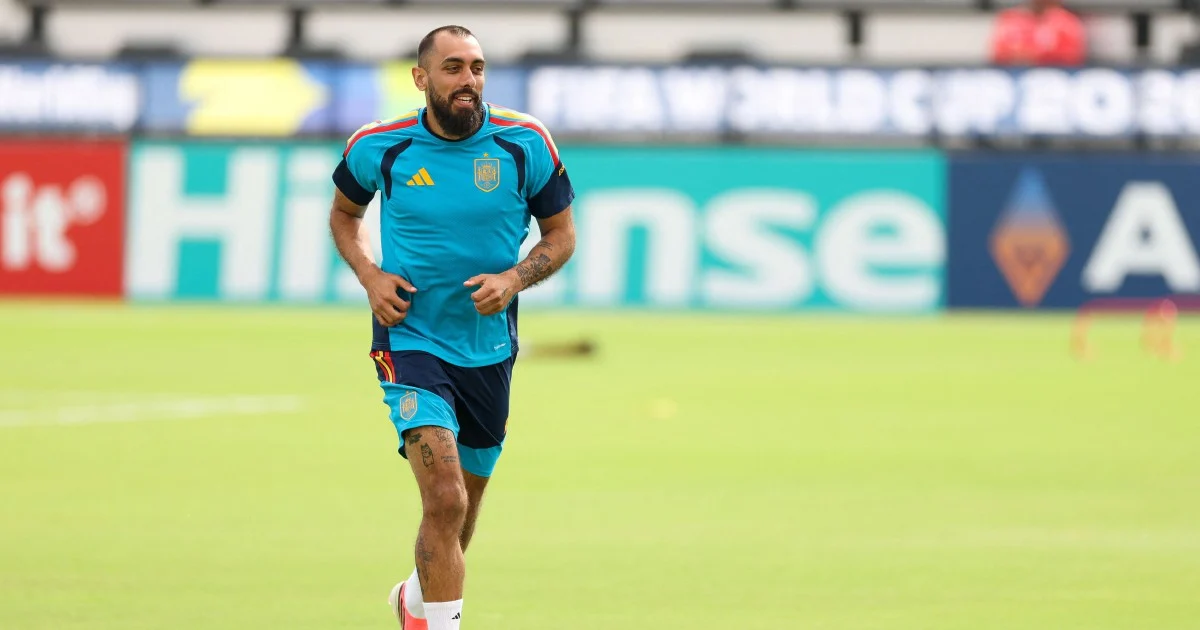
Borja Iglesias, Spain's World Cup striker, has emerged as one of professional football's most unconventional voices, unafraid to address contentious social issues with a directness that distinguishes him from his contemporaries. The player's willingness to speak publicly about matters ranging from the Israeli-Palestinian conflict to LGBTQ+ rights has earned him the nickname "the alien of football"—a moniker that reflects both his distinctiveness and the sport's relative reluctance to engage with such topics.
In an environment where many athletes tread carefully around sensitive subjects, Iglesias has chosen a different path. He paints his nails as a personal expression and uses his platform to advocate for justice and human rights, demonstrating that footballers need not conform to rigid expectations of masculinity or political silence. This approach has resonated with supporters who view him as authentic and principled, even as it has occasionally drawn criticism from those who believe athletes should focus solely on their performance on the pitch.
The Spanish striker's activism extends beyond symbolic gestures. His public statements about Gaza reflect a growing awareness within professional sports of global humanitarian concerns, particularly among younger athletes who view their prominence as carrying social responsibility. For Southeast Asian readers, Iglesias's stance is notable because it mirrors emerging patterns in the region, where athletes from Indonesia, Malaysia, and Thailand increasingly use their platforms to address issues affecting their communities, from environmental concerns to workers' rights.
Football's traditional culture has historically discouraged players from speaking out on controversial matters. Club management and governing bodies have often preferred that athletes maintain a politically neutral public image, viewing activism as a distraction from their primary role. Iglesias's willingness to challenge this convention signals a potential shift in how professional athletes might engage with society. His approach suggests that authenticity and outspokenness need not undermine on-field performance—he remains a valued member of Spain's squad despite, or perhaps because of, his distinctive public persona.
The homophobia component of Iglesias's advocacy work carries particular significance in football, a sport that has struggled historically with LGBTQ+ inclusion. Major leagues across Europe have implemented campaigns against discrimination, yet deeply entrenched attitudes persist among some sections of fan communities and within certain club cultures. An athlete of Iglesias's profile speaking openly about these issues helps normalise conversations that remain taboo in many footballing circles, particularly in more conservative regions.
His decision to express himself through nail painting, while seemingly cosmetic, functions as a deliberate statement about self-determination and rejecting arbitrary restrictions on how male athletes should present themselves. This form of non-conformity opens space for other players to express their individuality without fear of institutional or social backlash. The cumulative effect of such personal choices can gradually reshape what is considered acceptable within professional sport's rigid hierarchies.
For Malaysian football fans and athletes, Iglesias's example presents an interesting case study in navigating activism within competitive sports environments. Malaysia's own footballing tradition emphasises discipline and deference to authority, making figures who openly challenge norms particularly striking. Yet younger Malaysian athletes increasingly demonstrate interest in social engagement, suggesting potential evolution in how the nation's sporting culture might develop in coming years.
The broader implications of Iglesias's approach extend to questions about power and responsibility in professional sports. When elite athletes remain silent on major humanitarian crises or social injustices, they implicitly endorse the status quo. Conversely, those who speak out risk controversy and potential backlash. Iglesias has chosen principle over convenience, accepting that his outspokenness may complicate his career even as it enhances his credibility and resonance with audiences seeking authenticity.
Spain's acceptance of Iglesias within its national squad, despite his unconventional nature, reflects a maturity in the Spanish footballing establishment that extends beyond purely sporting considerations. The federation's willingness to select and support a player who refuses to compartmentalise his identity suggests confidence that a team can accommodate diverse personalities and political viewpoints. This stands in contrast to some other international programmes where conformity remains more rigidly enforced.
The phenomenon of Iglesias being labelled "the alien of football" encapsulates a central problem within the sport: the expectation that athletes should be somehow less fully human than the general population, stripped of complexity, conviction, and personal expression. His resistance to this diminishment challenges the sport to evolve, to recognise that athletes can be both excellent competitors and engaged citizens with meaningful perspectives on the world beyond the pitch.
Looking forward, Iglesias's trajectory may influence how future generations of footballers approach their public roles. If his example demonstrates that activism and sporting excellence are compatible—indeed, that they can reinforce one another through the credibility that comes with consistency—then others may feel emboldened to speak authentically about their values. For Southeast Asian football, where talent development traditionally emphasises discipline over individuality, such examples from international figures could prove transformative.
Ultimately, Iglesias represents something increasingly rare in elite sport: a person willing to be fully himself, convictions intact, consequences accepted. Whether one agrees with any particular position he takes, his commitment to speaking truthfully about matters he deems important offers a counterpoint to the carefully managed, media-trained blandness that characterises much of professional athletics. In doing so, he suggests that football need not be a realm separate from moral reality, but can instead serve as a platform where athletes and fans collectively grapple with the questions that matter most.

