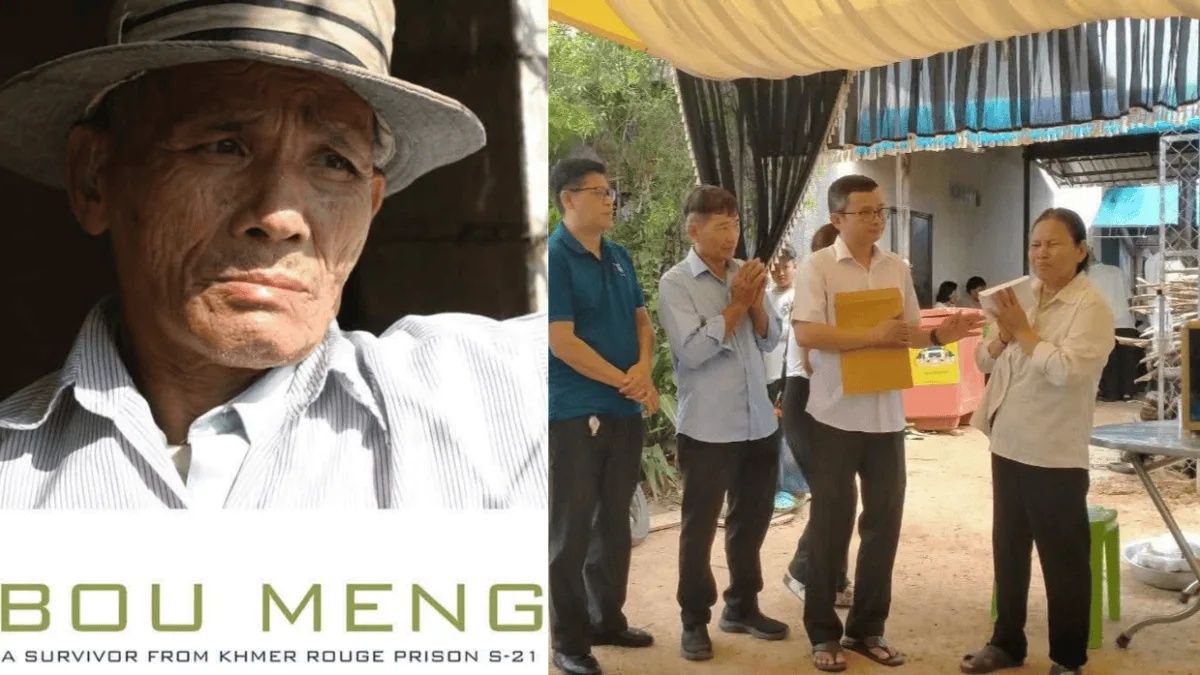
Bou Meng, one of fewer than a dozen known survivors of the Khmer Rouge's fearsome Tuol Sleng prison complex, has died at the age of 85 in Cambodia. The Tuol Sleng Museum, which oversees the former S-21 detention facility, confirmed his death on Friday, August 14, 2026, at 11pm. His passing marks the loss of a direct human link to one of the twentieth century's darkest chapters and removes from the world a man whose testimony helped secure justice for thousands of victims killed within those prison walls.
Tuol Sleng, also known as S-21, operated as the Khmer Rouge regime's principal torture and interrogation centre during the catastrophic 1975-1979 period. An estimated 17,000 people passed through its gates; roughly 7,000 were executed on the grounds or shortly after. The facility's very name has become synonymous with systematic cruelty and the industrial scale of Cambodia's genocide. That Bou Meng survived at all, let alone endured long enough to tell his story decades later, places him among an extraordinarily rare group—fewer than ten individuals who escaped the prison's machinery of death.
Bou Meng's survival owed less to fortune than to circumstance. While imprisoned alongside his wife in 1977, their children were separated and sent to labour camps, a separation he never overcame and from which his family never returned. He himself underwent relentless torture, yet his fate diverged sharply from that of most S-21 inmates because of a single, lifesaving skill: he was an accomplished painter. The Khmer Rouge's leadership, despite its ideological brutality, valued artisans and craftspeople for propaganda purposes and regime aesthetics. Bou Meng's ability with brush and canvas granted him marginal utility to his captors, and this utility, however tenuous, extended his life when nearly everyone around him perished.
The distinction between survival and mere existence blurs in accounts of S-21. Prisoners endured systematic torture designed not merely to extract information but to psychologically devastate and dehumanise. Bou Meng's emergence from that crucible into the daylight following the Vietnamese liberation of Cambodia in 1979 was itself a form of resurrection—a reawakening to a transformed landscape where millions had died and Cambodia's social fabric had been shattered. That he chose to remain engaged with his trauma rather than retreat into silence distinguished him further from many survivors, who understandably sought distance from their past.
Decades after the regime's collapse, when Cambodia established mechanisms for historical accountability and justice, Bou Meng became a cornerstone witness. He testified before the Extraordinary Chambers in the Courts of Cambodia (ECCC), the hybrid tribunal designed to prosecute senior Khmer Rouge leaders. His most significant testimony came during the trial of Kaing Guek Eav, known as Comrade Duch, the commandant who directly oversaw S-21's operations and orchestrated its machinery of death. Such testimony was invaluable: it placed a human voice and lived experience before judges and the public record, transforming archival documentation and bureaucratic records into narrative testimony about suffering, loss, and survival.
Beyond the courtroom, Bou Meng became an educator and living archive. The Tuol Sleng Museum, which now operates the preserved S-21 complex as a memorial and research institution, benefited immeasurably from his presence. In recent years, he spent considerable time welcoming and guiding visitors through the prison's cells, interrogation rooms, and execution grounds, narrating his own journey and the broader history of what occurred there. His role transformed the museum from a collection of artefacts into a space of moral witness, where visitors encountered not merely the physical remnants of atrocity but the embodied testimony of someone who lived through it.
The generational significance of such direct testimony cannot be overstated. As Cambodia moves further from 1979, fewer individuals remain who can speak from personal experience about S-21's horrors. Written accounts, photographs, and video testimony preserve knowledge, yet something irreplaceable departs when the last voices of direct witnesses fall silent. Bou Meng understood this weight; his dedication to sharing his story reflected a conscious commitment to ensuring that future Cambodians, Southeast Asians, and global audiences would understand what occurred and why vigilance against such regimes remains essential.
His work carried particular resonance for Malaysia and the broader region. Cambodia's descent into genocide occurred within living memory, and the structural fragility that enabled such catastrophe—weak institutions, ideological extremism, external interference, and factional violence—remains relevant to contemporary Southeast Asian political debates. Bou Meng's testimony, by preserving detailed knowledge of how totalitarian systems operationalise terror, offered an implicit warning about the consequences of authoritarianism and the value of pluralism and accountability.
The Tuol Sleng Museum's statement on his death acknowledged that his passing represents a profound loss to historical memory and ongoing justice efforts. The institution noted his active participation in Cambodia's pursuit of accountability through the ECCC, underscoring that survivors' testimonies constitute not merely historical documentation but essential components of post-conflict justice mechanisms. His absence will be felt not only by the Cambodian public but by researchers, educators, and institutions globally dedicated to preventing genocide and memorialising its victims.
Bou Meng's life after Tuol Sleng exemplified a particular form of courage—not the dramatic heroism of armed resistance but the quieter bravery of bearing witness, of speaking painful truths, and of choosing to engage with trauma rather than be consumed by it. His death closes a chapter in Cambodia's collective effort to comprehend and account for its recent past, even as it underscores the urgency of recording and preserving survivor narratives before this living link to history is severed entirely.

