A busy afternoon at a hospital in northwest England became the catalyst for a deeply personal realisation about the ways families and communities nurture one another. A doctor, running on an empty stomach after a demanding clinic session, casually mentioned hunger to a team secretary, only to receive an offer that would trigger memories of home stretching back decades. The secretary's willingness to peel a mandarin orange—a gesture so simple it might easily be overlooked—suddenly illuminated how food serves as humanity's most eloquent dialect, one spoken fluently across Malaysia and indeed across the world.
For many Malaysians, the preparation and sharing of food carries meanings that extend far beyond simple nutrition. Growing up in Malaysia, this doctor experienced firsthand how culinary gestures encoded messages of devotion and concern that words alone could never quite capture. From early childhood through adulthood, family members demonstrated affection through meticulous food preparation—peeling, cutting, seasoning and presenting dishes with deliberate care. A paternal grandmother once faithfully prepared salted green apples after each meal, a ritual her mother seamlessly inherited and continues to this day. Such acts, performed without fanfare or expectation of gratitude, communicate a wordless pledge: your wellbeing matters to me, and I am invested in your comfort.
The personal food memories accumulate into a rich tapestry woven through Malaysian life—both the everyday and the ceremonial. A father's patient labour over crabs, extracting sweet flesh with meticulous precision, left an imprint so deep that the doctor never learned to perform the task independently, still relying on that cherished childhood memory decades later. A grandmother's unconventional solution to a child's habit of reading during meals—hand-feeding the young reader so she could remain absorbed in storybooks without choking—demonstrates how food becomes intertwined with parental love and creative problem-solving. The blue packet of Hup Seng Teddy biscuits purchased in childhood continues to appear on every homecoming, a mother's quiet insistence that distance and time have not diminished the bonds of affection.
These gestures extend beyond the nuclear family into the broader rhythms of Malaysian multicultural society. Deepavali celebrations become occasions for demonstrating attention to individual preferences—an aunt ensuring extra potatoes accompany the chicken curry because she understands which elements truly nourish the heart. A colleague's legendary chocolate moist cake materialises each festive season not from obligation but from genuine regard. The annual exchange of cookies and mandarin oranges between families of different faiths transforms neighbourhoods into networks of reciprocal care, where the language of food facilitates understanding and connection across religious and cultural boundaries. Even a long-retired colleague maintains the tradition, arriving with mandarin oranges during Chinese New Year while the doctor's mother reciprocates with cookies, a decades-long conversation conducted entirely through shared meals and gifted containers.
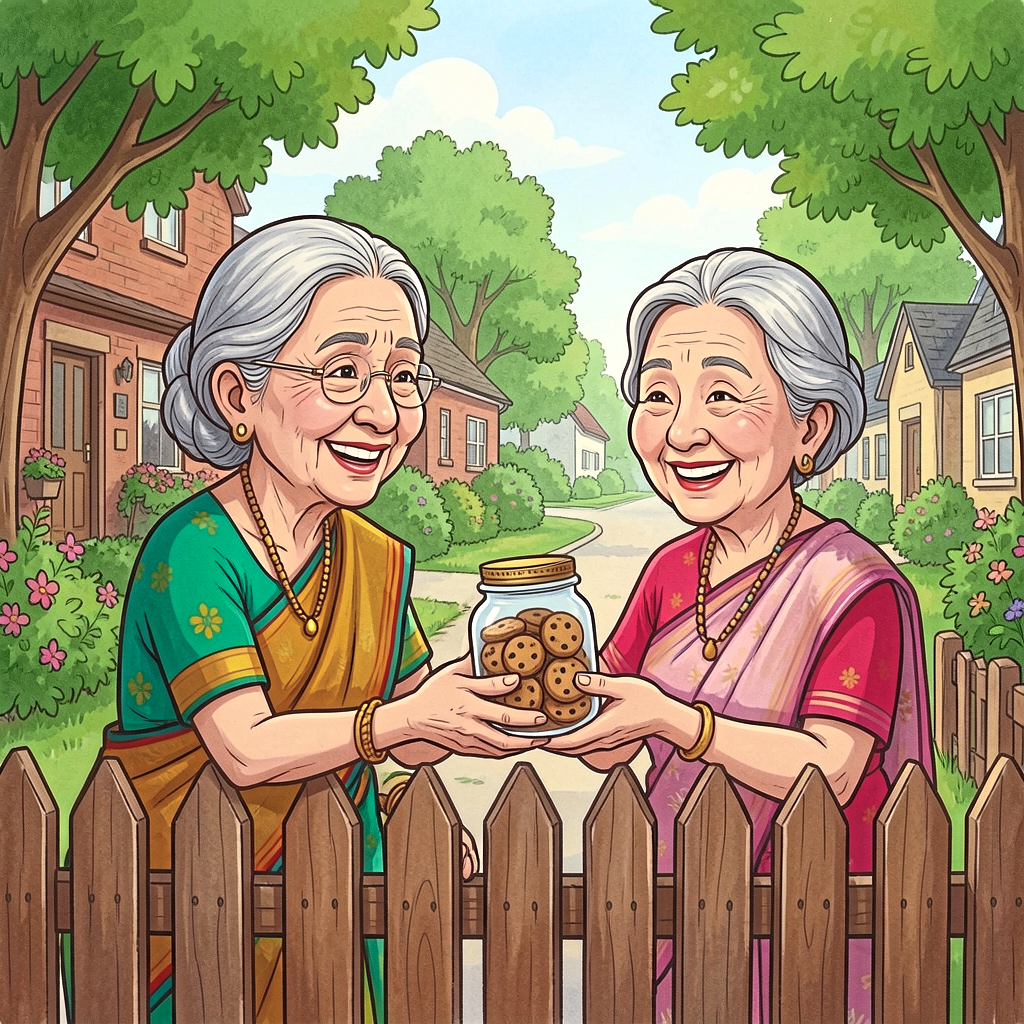
The relationship with a neighbour of more than five decades crystallises how profoundly food cements community bonds. Across a dividing stone fence, regular deliveries of savoury dishes—sweet upma at breakfast, crispy onion cucur in afternoons—created a rhythm of care that structured the doctor's childhood memories. The containers always returned with something equally thoughtful inside, establishing a pattern of reciprocal generosity that transcends mere courtesy. Even now, years after this neighbour suffered a stroke and relocated, the memory that endures most vividly is not the person's physical presence but the taste of her sweet upma, suggesting how food encodes relationships in memory more durably than other markers.
What makes these Malaysian experiences particularly resonant is their multicultural dimension. The doctor's mother, a teacher, shares deepavali celebrations with her Malay colleague, while Chinese New Year brings cookies from neighbours. The garbage collectors receive festival treats, and the neighbourhood becomes a permeable space where different communities acknowledge one another's celebrations through culinary exchange. This pattern, deeply embedded in Malaysian social fabric, represents something precious: a framework for coexistence built on small acts of nourishment and recognition. Food becomes the medium through which diverse Malaysians say to one another: I acknowledge your joy, I respect your traditions, I am part of this community.
The revelation that prompted this reflection came unexpectedly in a foreign hospital office. A colleague's automatic response—the offer to peel fruit for someone in need—proved that this language is not distinctly Malaysian, though Malaysians speak it with particular fluency. The gesture transcends geography and culture, suggesting that food's association with care taps into something fundamentally human. Whether peeling mandarin oranges in England or preparing elaborate festival dishes in Malaysia, the underlying message remains constant: someone has noticed your hunger, considered your wellbeing, and decided to act on that concern.
This recognition carries implications for Malaysian society as it becomes increasingly urbanised and globalised. The rituals of food preparation and sharing that characterised previous generations—grandmothers hand-feeding grandchildren, neighbours exchanging dishes over fences, mothers remembering favourite biscuits across years—may face pressure from busier lifestyles and smaller households. Yet the persistence of these practices across distances and decades suggests their deep cultural roots. Even living abroad, the doctor's mother continues purchasing specific biscuits for homecomings. The neighbour, despite being unable to cook after her stroke, remains cherished primarily for the memory of what she created. These patterns suggest that Malaysians instinctively understand what modern psychology increasingly validates: that food given with care becomes a primary language through which humans express love, mitigate loneliness and build community.
For younger Malaysians navigating globalised careers and international relocation, understanding food as a cultural carrier takes on new importance. The small acts performed by Malaysian parents and grandparents—the peeling, the preparing, the remembering of preferences—constitute a form of cultural transmission as significant as any explicit instruction. When a mother continues buying childhood biscuits for an adult child living overseas, she maintains a thread connecting generations and geographies. When neighbours exchange festival foods across religious boundaries, they reinforce the social glue that makes Malaysia's multicultural model functional in practice, not merely in principle.
The doctor's reflection ultimately returns to something deceptively simple yet profoundly true: food represents perhaps humanity's most universal language, older than written word, preceding formal diplomacy, transcending the barriers of nationality and belief. Malaysia, with its intricate weaving of Malay, Chinese, Indian and other communities, has developed particular eloquence in this language. The casual exchanges at festival times, the small containers of prepared dishes moving across neighbourhoods, the automatic impulse to ensure someone hungry receives nourishment—these constitute a form of social communication as sophisticated as formal dialogue. Sitting in that English hospital office, watching a colleague prepare to peel a mandarin orange, the doctor recognised that the care learned across a Malaysian childhood had been decoded and understood by someone from an entirely different culture. The language needed no translation.

