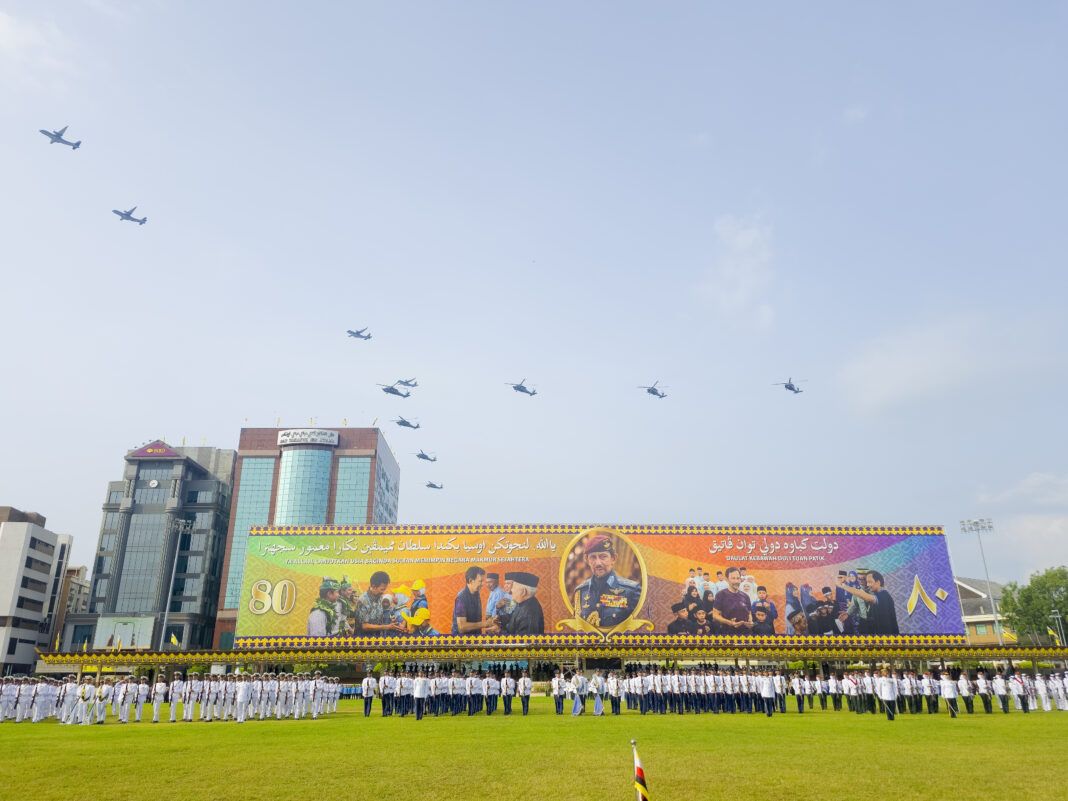
Brunei Darussalam has entered the final countdown to one of its most significant state occasions in recent memory: the 80th birthday celebration of His Majesty Sultan Hassanal Bolkiah, Sultan and Yang Di-Pertuan of Brunei Darussalam. A full dress rehearsal for the centrepiece ceremonial guard of honour parade took place on Saturday at Taman Haji Sir Muda Omar 'Ali Saifuddien, with senior government officials and ceremonial dignitaries overseeing the intricate choreography that will mark the occasion on Wednesday morning.
The gathering of high-ranking state officials underscored the ceremonial importance placed on the milestone birthday. Yang Amat Mulia Pengiran Indera Setia Diraja Sahibul Karib Pengiran Anak Idris Pengiran Maharaja Lela Pengiran Muda Abdul Kahar, who holds the position of Chief of Adat Istiadat Negara and serves as a co-adviser to the National Committee for His Majesty's 80th Birthday Celebration for 2026, presided over the rehearsal. His presence reflected the deep integration of traditional protocols with modern state administration in orchestrating such nationally significant events.
The National Committee coordinating the entire celebration drew representation from across Brunei's governmental apparatus, demonstrating how comprehensively the sultanate mobilises its institutional resources for royal occasions. Datuk Seri Setia Awang Ahmaddin Abdul Rahman, who oversees social policies and manpower, joined peers coordinating national security, defence, public service governance, health services, and cultural affairs. This multi-ministerial involvement reflects how birthday celebrations in Brunei function not merely as ceremonial markers but as opportunities to demonstrate governmental unity and organisational capacity.
For Malaysian observers, Brunei's meticulous attention to ceremonial protocol offers insights into how smaller Southeast Asian monarchies maintain statecraft traditions while navigating contemporary governance demands. The rehearsal process itself—rather than proceeding directly to the live event—signals a commitment to precision that characterises Brunei's approach to official functions. This deliberate preparation contrasts with some regional approaches and underscores how sultanates view such occasions as reflections of national competence and stability.
Taman Haji Sir Muda Omar 'Ali Saifuddien, the venue for both rehearsal and the Wednesday ceremony, carries historical significance as a space intertwined with Bruneian national identity and royal pageantry. Selecting this location for the 80th birthday celebration connects contemporary festivities to established traditions of state commemoration. The choice of venue itself communicates continuity between Brunei's past and present, a particularly resonant message as the nation reflects on its ruler's eight decades of life and leadership.
The ceremonial guard of honour parade represents the formal, visible dimension of birthday celebrations that captures public attention and international observation. Such parades serve multiple functions within Southeast Asian monarchical systems: they demonstrate civil-military coordination, provide platforms for displaying national symbols and regalia, and create shared moments of collective national acknowledgement. Wednesday morning's parade will likely draw dignitaries from regional nations and serve as a diplomatic opportunity for Brunei to reaffirm its international standing.
From a regional perspective, Sultan Hassanal Bolkiah's 80th birthday assumes additional significance given his long tenure as Brunei's ruler and his role as chairman of the Association of Southeast Asian Nations. His leadership has spanned decades of regional transformation, and the celebrations provide occasions for reflecting on Brunei's trajectory within ASEAN frameworks. Malaysian audiences, particularly those monitoring Southeast Asian diplomatic dynamics, will view the occasion as an opportunity to observe how Brunei positions itself institutionally and ceremonially.
The involvement of the Defence Ministry and security coordination ministers in ceremonial preparations illustrates how Southeast Asian states integrate national security considerations into even traditionally ceremonial functions. In Brunei's context, such coordination ensures that large public gatherings maintain the security protocols expected of modern state ceremonies while preserving their ceremonial dignity. This balancing act between openness and protection represents a persistent challenge for monarchical systems throughout the region.
The National Committee's 2026 designation in multiple ministerial titles suggests that birthday celebrations in Brunei operate within extended timeframes of planning and coordination rather than last-minute arrangements. This forward-planning orientation, evident in Saturday's comprehensive rehearsal, reflects institutional maturity and suggests that Brunei views such occasions as opportunities to refine governmental procedures and validate inter-ministerial communication protocols.
For those tracking Southeast Asian governance and statecraft, Brunei's ceremonial preparations offer windows into how sultanates maintain traditional protocols whilst managing contemporary administrative complexity. The Wednesday morning parade will represent the culmination of months of planning and Saturday's meticulous rehearsal. The success of such occasions depends largely on precisely the kind of detailed preparation that the dress rehearsal exemplified, ensuring that ceremonial elements align seamlessly with security requirements, logistical considerations, and diplomatic protocols that characterise modern state occasions in the region.

