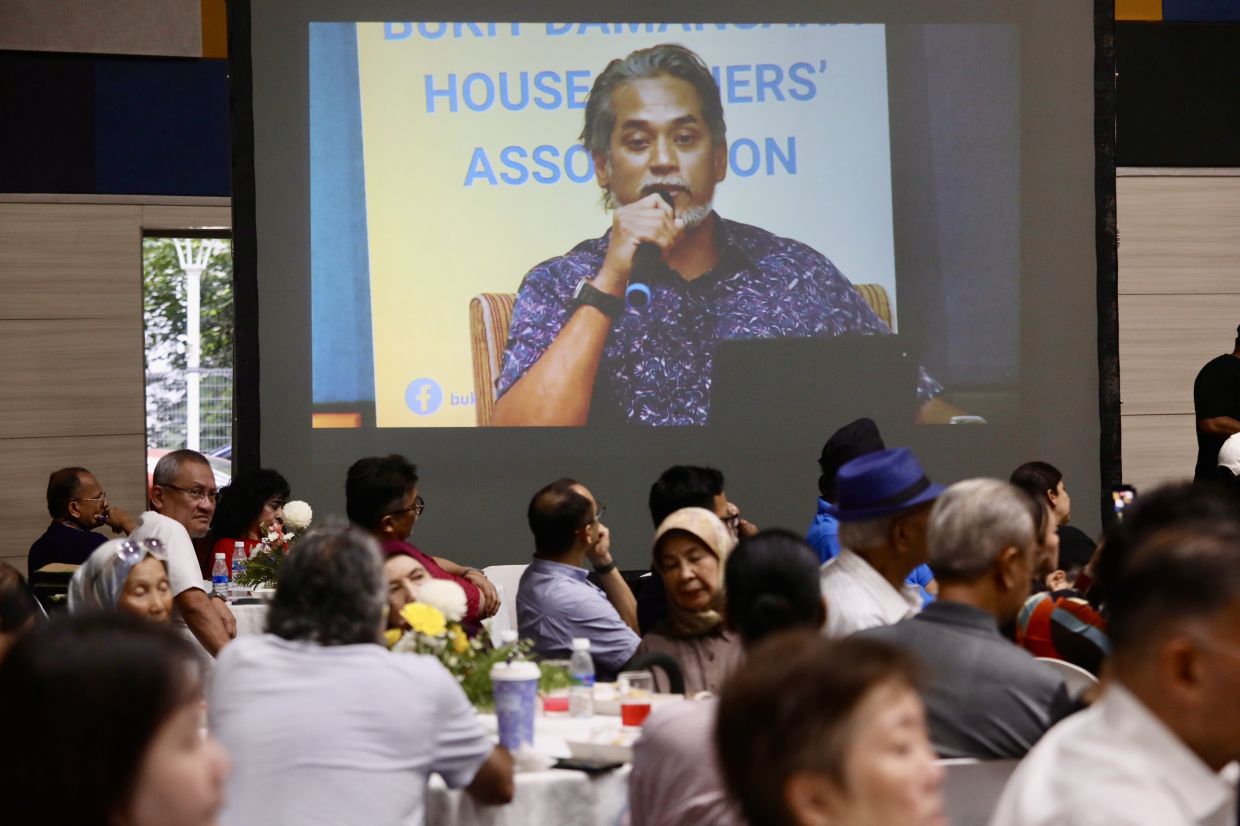
Residents of Bukit Damansara have escalated their campaign against a contentious renovation project that would transform a double-storey semi-detached house into a three-storey structure, with nearly 400 community members packing a town hall dialogue to demand that Kuala Lumpur City Hall withdraw the construction permit. The gathering marked the inaugural town hall of the neighbourhood's association under newly elected president Khairy Jamaluddin, reflecting growing tensions within one of Kuala Lumpur's established residential enclaves over development decisions that residents feel have proceeded without adequate community input.
The project at the centre of the dispute began as a simple renovation plan when City Hall granted approval in December 2025 for the property owner to add an extra floor, fundamentally altering the architectural uniformity that has historically defined the semi-detached row. However, the proposal generated swift and organised opposition, with residents gathering 19 signatures from immediate neighbours voicing their objections to the undertaking. When construction commenced, the controversy intensified, prompting a stop-work order in January 2026 that temporarily halted the project. Yet by June 2026—roughly two months before the town hall—City Hall reversed course and reinstated the permit, allowing work to resume. The structure now stands approximately ten percent complete, with supporting pillars already visible at the site.
Resident A. Zakki, speaking on behalf of the opposition movement, articulated the community's core grievance: that the renovation fundamentally compromises the residential character of Bukit Damansara by introducing architectural discord into a carefully designed streetscape. He emphasised that the double-storey design had maintained harmony with neighbouring properties, and that the proposed expansion to three storeys breaks that visual continuity. Beyond aesthetic concerns, Zakki raised safety issues, noting that construction vibrations and activities have caused visible cracks to appear in the walls of adjacent homes, raising questions about proper engineering practices and structural safeguards. The resident group's position is unambiguous: City Hall must reverse its June approval immediately and withdraw the permit entirely.
City Hall's handling of the application has created a procedural quandary that cuts to the heart of planning governance in Kuala Lumpur. The fact that a stop-work order was issued in January, suggesting planners had identified grounds for concern, only to have approval reinstated months later without apparent public consultation, has left residents questioning the decision-making process. Rosli Nordin, the City Hall Planning Department's town planner executive director, acknowledged at the dialogue that the local authority takes note of resident grievances stemming from the project, but stopped short of committing to any change in the permit status. This cautious response suggests City Hall may believe it lacks legal grounds to reverse an approval, or alternatively that the property owner possesses development rights that override community opposition.
The renovation project represents a broader tension emerging across Kuala Lumpur's residential neighbourhoods, where ageing double-storey homes increasingly attract investors and developers seeking to unlock additional commercial value through vertical expansion. For established communities like Bukit Damansara, such developments threaten the demographic stability and visual character that have attracted residents to the area for decades. Unlike new townships where mixed-use development is anticipated from inception, infill projects in mature neighbourhoods can generate unexpected disruption, from construction noise and traffic congestion to structural impacts on neighbouring properties. The lack of a formal consultation mechanism—apparent in this case where residents learned of the permit's reinstatement only after work recommenced—leaves communities reacting defensively rather than engaging proactively in planning decisions.
The town hall, moderated by Khairy himself, also surfaced secondary concerns reflecting the cumulative stress points within the neighbourhood's infrastructure and services. Traffic congestion, particularly during school drop-off and pick-up hours around SK Bukit Damansara and Stella Maris International School Damansara, has worsened, with congestion recorded from 7am to 7.30am and again from 2pm to 4pm. While Brickfields deputy police chief Supt Ahmad Firdaus Mustafia Kamal indicated that the matter is receiving attention, the school's Parent-Teacher Association chairman Ameirul Azraie Mustadza revealed that the parent body lacks funds to engage Rela volunteers for traffic management, and that police patrols occur sporadically rather than daily. This suggests that traffic management remains ad hoc and reactive rather than systematically addressed.
Water infrastructure has emerged as another vulnerability, with Air Selangor facing repeated complaints about pipe bursts affecting the neighbourhood's aging pipeline network. The utility company's representative acknowledged the problem and indicated plans to replace the deteriorating pipes, but provided no timeline. For residents already experiencing construction disruption and traffic chaos, the prospect of water supply interruptions compounds frustration with the pace of local governance. These overlapping service deficiencies paint a picture of a neighbourhood struggling with the strain of aging infrastructure and contemporary development pressures simultaneously.
Khairy's role as both the association's president and a prominent national political figure adds a layer of political significance to the dispute. By personally moderating the town hall, he has positioned himself as an intermediary between residents and the municipal bureaucracy, signalling that he views his role as extending beyond symbolic leadership into active advocacy for neighbourhood concerns. His undertaking to follow up on resident grievances and "fast-track problem resolution" suggests he may leverage his political standing to pressure City Hall into reconsidering the permit. However, his past experience as a minister and his current political profile also create expectations among residents that he will deliver concrete outcomes—a standard against which the success or failure of this town hall will be measured.
The framing of the town hall as "Your Voice Matters" reflects contemporary trends in governance that emphasise participatory democracy and community engagement, yet the fact that such high-level dialogue was necessary to air resident concerns indicates that routine channels for community input have proven insufficient. A genuinely inclusive planning process would have sought neighbourhood input before—not after—granting initial approval, and would have maintained formal mechanisms for community objection before project commencement. The town hall's convening represents an attempt to salvage legitimacy around a decision that many residents view as already flawed.
The resolution of the Bukit Damansara dispute will carry implications beyond this single street. If City Hall ultimately maintains the permit despite organised opposition and demonstrated impacts on neighbouring properties, it signals that development approvals are difficult to reverse even when communities mobilise effectively and present documented evidence of harm. Conversely, if pressure from Khairy and coordinated resident action successfully forces a reversal or negotiated compromise, it establishes a precedent that could embolden residents elsewhere to challenge similar projects. The outcome will test whether consultation is a genuine early-stage mechanism for shaping development, or merely a performative exercise after decisions have crystallised into physical reality.

