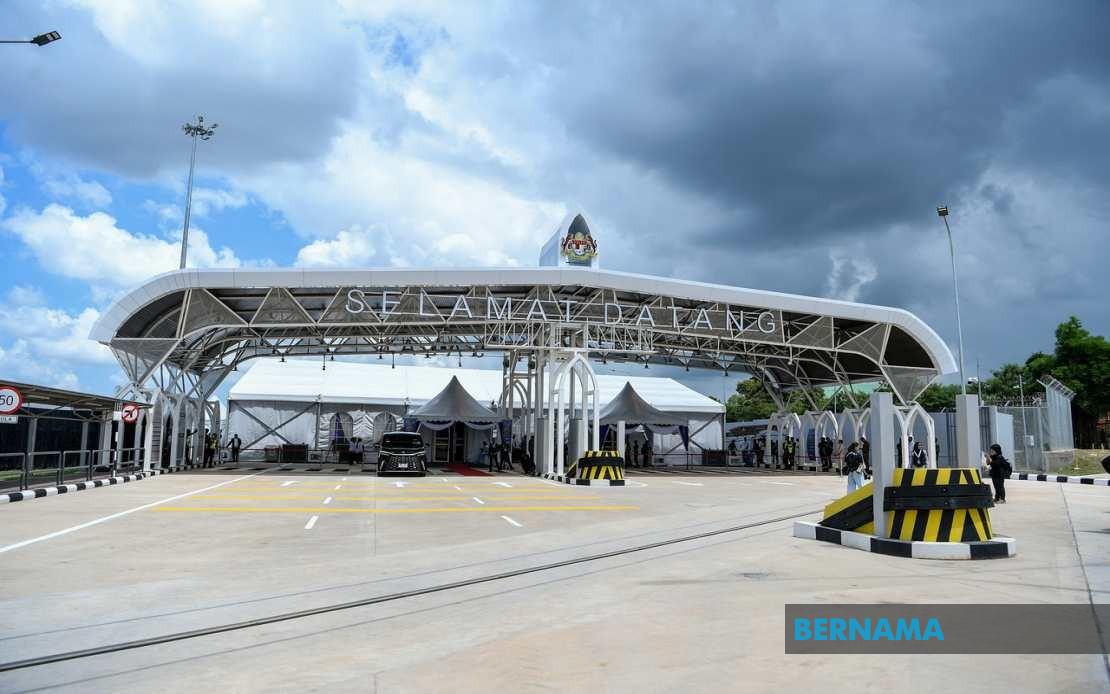
The Bukit Kayu Hitam-Sadao border crossing has delivered tangible economic benefits during its initial month of operation, signalling a meaningful improvement in how Malaysian and Thai officials manage one of Southeast Asia's busiest land trade corridors. The 900-metre facility, which links Malaysia's Kedah state directly with Thailand's Songkhla province, represents a substantial infrastructure investment aimed at reducing friction in a relationship that annually channels tens of billions of ringgit in cross-border commerce.
Thailand's Sadao Customs director, Buntoon Oucharoen, reported that the facility has achieved near-complete adoption among commercial transport operators. Virtually all lorries, buses, and vans have shifted to the new route, abandoning the congested pathways that characterised the old border crossing. This unprecedented concentration of traffic on a single, purpose-built corridor has proven manageable, contrary to initial concerns about bottlenecks at the freshly commissioned facility.
The success rests principally on technological modernisation that has fundamentally altered inspection procedures. The deployment of advanced X-ray scanning systems, branded as "Fast Scan" equipment, has compressed container examination from a five-minute undertaking to under sixty seconds. This represents roughly an 80 per cent reduction in processing duration, a dramatic efficiency gain that compounds across thousands of daily movements. Coupled with digital cargo verification systems that eliminate the need for physical queue accumulation, the technological architecture has created conditions for uninterrupted vehicle flow.
Daily logistics traffic through the crossing now exceeds 1,000 lorries, reflecting both the pent-up demand for faster clearance and operational confidence among transport companies. For Malaysian manufacturers dependent on Thai intermediate goods and Thai businesses relying on Malaysian components and raw materials, this throughput capacity represents a competitive advantage. The reliability of transit times has immediate implications for production planning and inventory management, factors that determine whether firms choose to deepen regional integration or pursue alternative sourcing strategies.
The facility's opening on July 11, following the joint inauguration by Thai Prime Minister Anutin Charnvirakul and Malaysian Prime Minister Datuk Seri Anwar Ibrahim on July 10, came with considerable political symbolism. Both governments positioned the crossing as emblematic of deepened bilateral commitment, a narrative reinforced by subsequent trade performance. Within three weeks of operation, the underlying data demonstrated measurable economic acceleration.
Import values recorded at the Sadao facility between July 11 and 31 reached 19 billion baht, equivalent to approximately RM2.35 billion, substantially surpassing the 12 billion baht (RM1.48 billion) registered during the corresponding period in 2024. Export figures proved even more impressive, climbing to over 24 billion baht (RM2.97 billion), compared with 13 billion baht (RM1.61 billion) one year earlier. These increases, whilst partly attributable to seasonal factors and economic growth trajectories, nonetheless reflect the crossing's capacity to facilitate additional transaction volumes that previously experienced congestion-related delays.
Beyond freight logistics, the facility has enhanced passenger mobility, a dimension critical to tourism and regional integration. The commissioning of eleven inbound and eleven outbound lanes dedicated to non-cargo traffic has reduced crossing times for private vehicles, coaches, and individual travellers. Hat Yai-Songkhla Hotel Association leadership has emphasised the positive impact on weekend and holiday tourism flows, suggesting that improved border efficiency feeds directly into overnight stays and service sector revenues across southern Thailand.
Malaysia-Thailand bilateral trade expanded to RM31.33 billion during the January-March 2026 period, considerably higher than the RM27.35 billion recorded during the same quarter in 2025. This represents a year-on-year increase of approximately 15 per cent, a substantial acceleration that reflects both the infrastructure improvement and broader macroeconomic conditions favouring regional commerce. Both nations have established an ambitious target of achieving US$30 billion (RM122.6 billion) in annual bilateral trade by 2027, a goal that requires sustained momentum.
The crossing's success carries implications beyond the immediate Malaysia-Thailand relationship. As Southeast Asian economies increasingly integrated through supply chains spanning multiple countries, the speed and predictability of border crossings influences whether regional production networks remain concentrated or fragment across competing geographies. A smoothly functioning Bukit Kayu Hitam-Sadao corridor strengthens the competitive positioning of the Malaysia-Thailand-Vietnam production triangle relative to alternatives centred on Indonesia, the Philippines, or South Asia.
Looking ahead to the 70th anniversary of bilateral diplomatic relations that Malaysia and Thailand will commemorate next year, the crossing represents both a practical achievement and a symbolic statement about long-term commitment. The facility's continued operational success will depend on sustained Thai and Malaysian investment in maintenance, training of customs personnel, and technological updates as cargo volumes and typologies evolve. Equally important will be political continuity and the willingness of both governments to remain aligned on border management philosophy as successive administrations assume office.
For Malaysian traders and logistics operators, the Bukit Kayu Hitam-Sadao route now constitutes a genuine competitive advantage. Companies operating in automotive components, electronics assembly, agricultural processing, and petrochemical sectors that depend on Thailand-sourced inputs or serve Thai export markets can structure operations with greater confidence in supply chain predictability. This reliability advantage, multiplied across thousands of firms, translates into regional economic competitiveness and employment creation across both nations.

