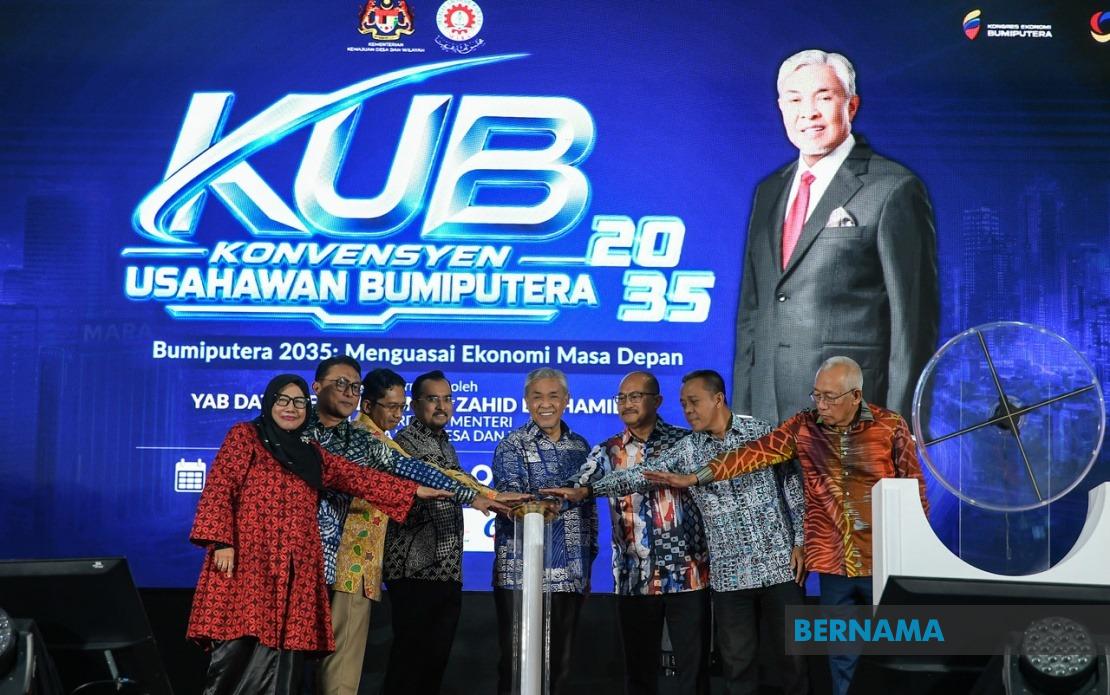
Deputy Prime Minister Datuk Seri Dr Ahmad Zahid Hamidi has articulated a strategic pivot in Malaysia's approach to Bumiputera entrepreneurship, emphasizing that the community's business leaders must graduate beyond their traditional role as participants in the broader economic value chain and instead establish themselves as owners and controllers of significant economic sectors. Speaking at the closing ceremony of the Bumiputera Entrepreneurs Convention (KUB) 2035 Declaration in Alor Setar on August 27, Ahmad Zahid outlined a vision that acknowledges decades of groundwork while signalling a fundamental shift in developmental priorities.
The Deputy Prime Minister, who also holds the portfolio of Rural and Regional Development Minister, framed the current moment as a critical juncture where established foundations must transform into structures that confer genuine economic power. He articulated that after an extended period dedicated to fostering participation across various economic sectors, the time has arrived to concentrate efforts on building actual ownership stakes and enabling entrepreneurs to exercise meaningful control over their operational domains. This conceptual reorientation represents a recognition that participation alone—however widespread—does not necessarily translate into wealth creation or economic resilience for the Bumiputera community.
Central to Ahmad Zahid's address was the acknowledgement that government institutions remain committed to facilitating this transition through continued financial support, institutional development, and market access expansion. However, he equally stressed that these external enablers must be complemented by entrepreneurial resolve and willingness to take calculated risks. The Deputy Prime Minister called upon Bumiputera business leaders to demonstrate the courage necessary to undertake business expansion, engage in direct competition with established players, and innovate to generate measurable economic value within their respective industries.
To operationalize this vision, Ahmad Zahid identified three interconnected systemic transformations required within the Bumiputera entrepreneurship ecosystem by 2035. The first involves consolidating the fragmented network of support mechanisms that currently operate in isolation from one another. The existing landscape comprises separate channels for financing, skills development and training programmes, and market facilitation, each functioning with minimal coordination or integration. This fragmentation creates inefficiencies where entrepreneurs must navigate multiple bureaucratic processes and potentially receive conflicting guidance from different institutional actors. Ahmad Zahid recognized that this structural problem undermines the collective effectiveness of government interventions and imposes unnecessary transaction costs on the entrepreneurs these programmes purport to assist.
The integration of this support ecosystem represents more than mere administrative convenience. By linking financing instruments with training initiatives and market access programmes, the government aims to create a seamless developmental pathway where entrepreneurs progress through complementary stages of business maturation. An entrepreneur seeking capital, for instance, would have concurrent access to relevant training in financial management and business scaling, alongside introductions to potential clients or supply chain partners. This holistic approach recognizes that entrepreneurial success depends not on isolated factors but on the convergence of multiple enabling conditions functioning in concert.
The second pillar of Ahmad Zahid's proposed transformation involves a fundamental reorientation away from the quantity-focused approach of producing entrepreneurs toward a quality-focused model of growing entrepreneurs. This distinction carries significant implications for how success is measured and resources are allocated. The conventional metrics emphasize the number of new business ventures established or entrepreneurs who complete training programmes, whereas the refined approach prioritizes the development trajectory of individual entrepreneurs, measuring outcomes through revenue growth, employment creation, sector consolidation, and market share expansion. This shift acknowledges that quantity without corresponding quality generates limited economic impact and may create a sustainable foundation for long-term wealth creation within the Bumiputera community.
The third transformative priority focuses on aligning economic growth outcomes with strengthened local company competitiveness. This reflects recognition that macroeconomic expansion does not automatically benefit domestically-owned enterprises, particularly if growth occurs predominantly within sectors controlled by foreign capital or non-Bumiputera actors. By explicitly linking national economic objectives to Bumiputera enterprise strengthening, Ahmad Zahid sought to establish policy coherence where prosperity translates into distributed ownership and local reinvestment of profits. This represents a departure from assuming that overall economic growth automatically generates opportunities for marginalized entrepreneurial communities.
For Malaysian observers and regional watchers, these statements carry significance beyond immediate policy announcements. The emphasis on transition from participation to ownership reflects ongoing tensions within Malaysia's economic model, where Bumiputera entrepreneurs have secured positions within value chains but retain limited control over strategic decisions or profit distribution. The proposals suggest official recognition that previous approaches, while creating visible business activity, have not fundamentally redistributed economic power toward the intended beneficiary community. The 2035 timeline indicates a decade-long implementation window, suggesting realistic acknowledgement that systemic transformation requires extended effort.
The framing also reflects international development discourse acknowledging that genuine economic inclusion requires more than market access or financing availability. Comparable experiences across developing economies demonstrate that sustainable entrepreneurial development emerges when supporting institutions evolve toward integrated ecosystem approaches and when success metrics emphasize business maturation rather than venture initiation counts. Ahmad Zahid's articulation aligns with these broader insights while attempting to translate them into Malaysian institutional context.
For Bumiputera entrepreneurs specifically, the Deputy Prime Minister's statements establish clearer expectations regarding individual agency and initiative. The concurrent emphasis on government support and entrepreneurial courage suggests that future policy implementation may increasingly distinguish between those entrepreneurs willing to undertake expansion and competition versus those preferring protected market positions. This potentially creates differentiated incentive structures where scale-oriented leaders access enhanced support while others retain traditional assistance levels. Such stratification could accelerate the emergence of anchor Bumiputera enterprises capable of competing regionally while potentially concentrating wealth among successful scaling entrepreneurs rather than distributing benefits across the broader community.

