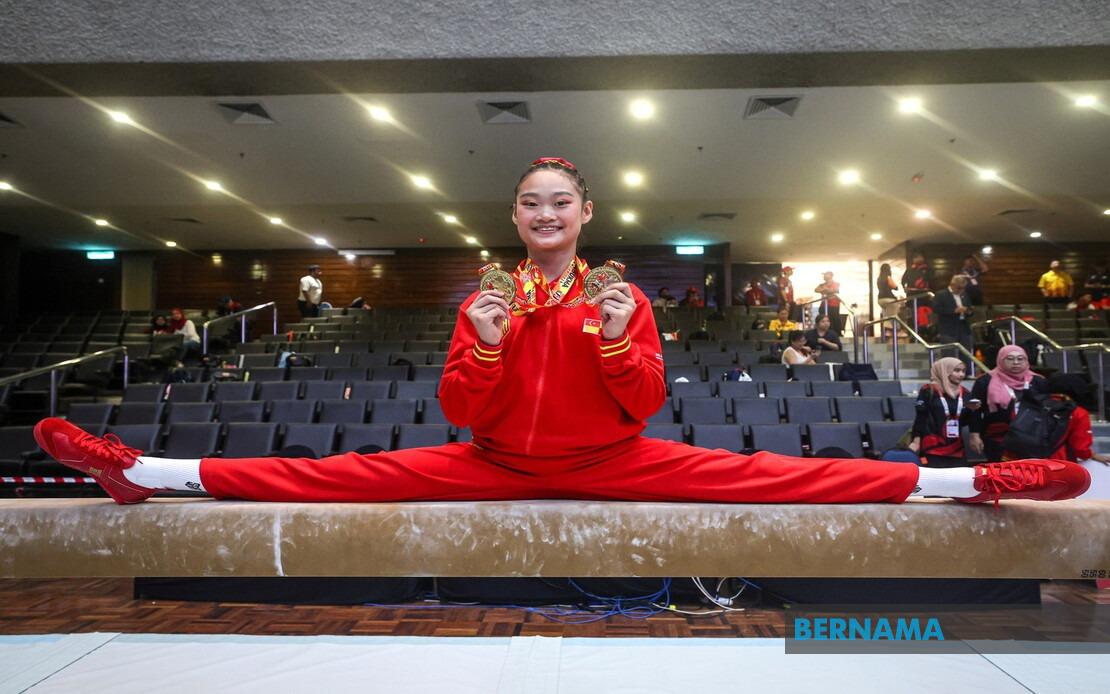
Selangor's teenage gymnastics sensation Cadence Teh Zi Qi delivered a commanding double gold performance at the Malaysia Games 2026 artistic gymnastics competition held at Dewan Canselor Tun Abdul Razak on the Universiti Kebangsaan Malaysia campus in Bangi. The 17-year-old national representative successfully retained her women's individual all-around crown while simultaneously securing victory in the team event, cementing Selangor's position as the dominant force in Malaysian artistic gymnastics.
Teh's successful title defence came with an impressive cumulative score of 48.550 points across all four apparatus disciplines. Her performance showcased consistency across the apparatus rotation, beginning with a vault score of 12.050 points, followed by 11.400 on the uneven bars, a commanding 13.350 on the balance beam, and a floor exercise score of 11.750 points. The balance beam apparatus proved to be her strongest discipline, where she demonstrated the technical precision and execution that has become her hallmark in the sport.
The competition for the individual all-around title reflected the current competitive landscape of Malaysian women's gymnastics. Sarawak's Aurin Zulkarnain secured the silver medal with a respectable 44.500 points, finishing approximately four points behind Teh's winning total. The bronze medal was shared between two athletes who registered identical scores: Federal Territories' Annabelle Ho Syin Yee and Penang's Amanda Ching Lee Wern both accumulated 42.250 points, highlighting the relatively tight competitive margins in the national elite gymnastics tier.
Beyond her individual success, Teh played a crucial role in Selangor's dominant team performance. She competed alongside teammates Nicole Wong Ziyi, Airisha Zuraidi, Wong Zi Qi, Leong Yee Shean, and Haifa Izzazi Mohd Faizul to produce a winning team aggregate of 169.300 points. This substantial margin of victory underscored Selangor's superior depth and consistency across the team roster. Federal Territories managed to secure the silver medal in the team competition with 166.300 points, while Johor rounded out the podium with a bronze-medal-winning total of 157.000 points.
Reflecting on her all-around performance, Teh provided insight into the mental and physical challenges she navigated during the competition. She disclosed that her opening apparatus, the uneven bars, did not commence ideally, as she experienced a fall during her routine. She attributed this misstep to pre-competition anxiety and a loss of bodily awareness that affected her execution on that particular apparatus. However, rather than allowing this early setback to derail her performance, she demonstrated the mental resilience and adaptive capacity expected of elite athletes, recovering progressively across the remaining apparatus.
The trajectory of her performance illustrated a characteristic pattern of improvement as the competition progressed. Following the uneven bars disappointment, Teh elevated her execution significantly on the balance beam, where she produced what she herself described as a notably strong result. Her floor exercise performance met her own expectations, suggesting she executed the routine according to her established benchmark standards. On vault, her final apparatus, Teh made a strategic reduction in the difficulty rating of her selected skill, opting for a Tsukahara pike rather than attempting a more challenging variant.
Looking beyond the immediate competition, Teh outlined her progressive approach to skill development and mental preparation. She revealed that she had deliberately increased the technical difficulty of her balance beam routine to align with the requirements and demands of the 2026 Asian Games, indicating that SUKMA serves as a developmental milestone rather than an endpoint for national gymnasts pursuing regional and continental competition. This deliberate calibration of difficulty levels demonstrates the structured pathway through which Malaysian elite gymnasts prepare for international competition calendars.
When discussing areas requiring further refinement, Teh identified two interconnected aspects of her performance requiring continued attention: managing competitive nervousness and maintaining sustained focus throughout multi-apparatus competitions. These psychological dimensions of elite sport performance represent ongoing challenges that many gymnasts navigate, particularly in individual all-around formats that demand consistent excellence across diverse apparatus disciplines over an extended competition window. Her candid acknowledgment of these development areas reflects a mature and realistic approach to athletic self-assessment.
Teh's competition schedule at SUKMA 2026 extends beyond the all-around conclusion, with apparatus-specific finals still forthcoming. She will compete in the uneven bars, balance beam, and floor exercise apparatus finals scheduled for the subsequent two days of competition. These apparatus finals provide opportunity for her to pursue additional individual medal accolades, potentially expanding her medal haul across the games. Her performances in these apparatus-specific events will further shape the overall gymnastics medal distribution among participating states and influence the final gymnastics medal standings.
The performances demonstrated at SUKMA 2026 reflect the current trajectory of Malaysian women's artistic gymnastics. Selangor's commanding position across both team and individual categories suggests the state program maintains strong development pipelines and coaching resources. The competitive emergence of other state representatives, particularly Aurin Zulkarnain from Sarawak, indicates that competitive depth is gradually expanding beyond traditional powerhouse states, a positive indicator for the sport's overall growth trajectory in Malaysia.
For Malaysian gymnastics development more broadly, Teh's progression toward international competition standards carries significant implications. Her deliberate preparation for the Asian Games within SUKMA demonstrates how domestic competition serves as a stepping stone toward continental representation. Success at regional games like SUKMA builds the competitive experience and confidence required for athletes to perform effectively at the Asian Games and beyond, establishing a clear development pathway for the sport within Malaysia's athletic system.

