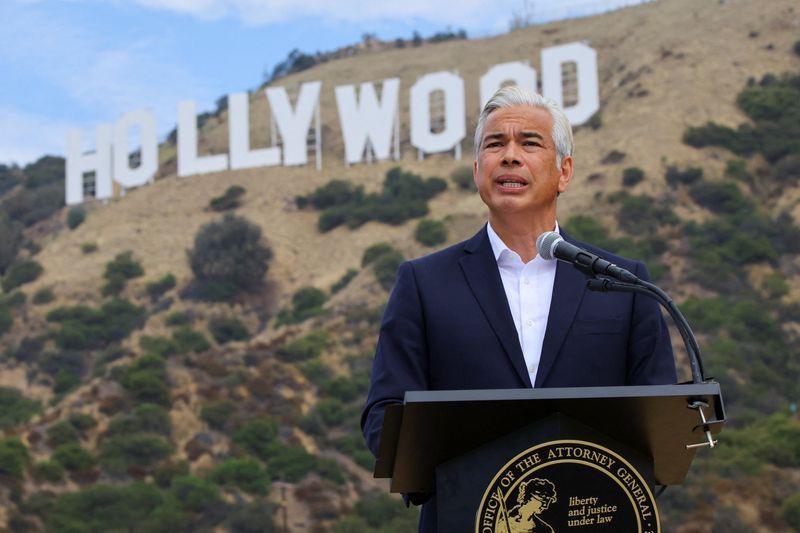
A coalition of twelve American states, spearheaded by California, has initiated legal proceedings in federal court to prevent Paramount's acquisition of Warner Bros Discovery, valued at $110 billion. The plaintiffs contend that the transaction would fundamentally reshape the entertainment landscape by creating an oversized conglomerate with excessive market control and pricing power across filmed content and television distribution. The lawsuit, filed in Oakland, directly threatens Chief Executive David Ellison's strategic ambition to establish his company as a formidable competitor against Netflix and Disney in an increasingly consolidating media industry.
The state attorneys general argue that the combined entity would command extraordinary market dominance. According to their legal filings, the merged company would control approximately 27 percent of film distribution channels serving American cinemas, 30 percent of blockbuster film releases, and 27 percent of the basic cable channel marketplace. This concentration of power would enable the combined firm to extract disproportionate revenues from theatrical releases and cable programming, effectively capturing more than a quarter of every dollar generated in those sectors nationally. The states characterise this as creating precisely the kind of market-distorting monopolistic behaviour that antitrust law is designed to prevent.
The cascade of competitive harms would ripple through multiple stakeholder communities, the lawsuit contends. Movie theater operators would face diminished negotiating leverage over film access and screen allocations, potentially allowing the merged company to demand higher licensing fees or restrict content distribution. Television distributors and cable subscribers would similarly experience reduced competitive alternatives when selecting programming packages, creating conditions for price increases. Beyond these direct market effects, the states identify broader economic consequences affecting creative workers, including screenwriters, actors, production crews, and others throughout Hollywood's ecosystem who depend on competition between major studios to sustain robust employment opportunities.
Paramount's response dismisses the legal challenge as misapplying established antitrust doctrine and fundamentally mischaracterizing competitive dynamics within modern entertainment. The company maintains that the combined operation would enhance rather than diminish production capacity, with Ellison publicly committing to release thirty films annually from consolidated studios. To achieve efficiency gains necessary for this expanded output, Paramount has outlined plans to eliminate approximately $6 billion in redundant infrastructure, marketing expenses, and corporate overhead. The company argues these operational improvements would strengthen its competitive position rather than concentrate market power harmfully.
However, state authorities dismiss Paramount's efficiency commitments as inadequately binding and insufficient to offset monopolistic concerns. They contend that even if the company honoured production quotas, the underlying market structure would still enable systematic price increases and quality degradation across film and television offerings. The states argue that commitments dependent on voluntary corporate compliance lack enforceability mechanisms to protect consumers or prevent the parent company from prioritising profits over quantity or artistic merit. This fundamental disagreement about remedial effectiveness reflects broader uncertainties surrounding merger oversight and the practical limitations of behavioural remedies in concentrated markets.
The litigation carries significant political dimensions reflecting deepening partisan divisions over antitrust enforcement. All state attorneys general participating in the lawsuit are Democrats, while critics have suggested that the Department of Justice's earlier approval reflected political considerations rather than rigorous competitive analysis. Specifically, observers have noted that Paramount CEO David Ellison's father, Oracle co-founder Larry Ellison, has cultivated substantial political relationships with Republican President Donald Trump. California Attorney General Rob Bonta explicitly framed the lawsuit as challenging a Trump administration that is, in his characterisation, tolerant of corporate consolidation enabling market manipulation.
The politicisation of merger enforcement extends beyond this particular transaction. Democratic attorneys general have increasingly weaponised antitrust authority to oppose deals they view as undermining economic fairness and consumer welfare, particularly when federal regulators have approved transactions they consider harmful. Notably, some Republican state attorneys general have joined Democratic counterparts in recent antitrust actions targeting live entertainment promoter LiveNation and broadcaster Nexstar's acquisition of Tegna, suggesting that antitrust concerns transcend simple partisan divisions. Bonta appealed to Republican colleagues to join the current action, implying that competitive harm should supersede political allegiance.
The economic stakes for Paramount are substantial and will intensify with litigation delays. The company has committed to paying approximately $650 million in quarterly fees to Warner Bros Discovery shareholders if the transaction fails to close before October. Extended legal proceedings create cascading financial burdens, including uncertainty affecting Paramount's stock valuation, pressure to renegotiate transaction financing, and potential deterrence of alternative strategic options. Historical analysis of comparable merger disputes indicates that federal courts typically require approximately eight months to render determinations, establishing baseline expectations for timeline extensions that could accumulate hundreds of millions in additional costs even if Paramount ultimately prevails legally.
Stock market reactions immediately following the litigation announcement offer partial insight into investor perspectives on transaction prospects. Paramount shares appreciated 2.9 percent while Warner Bros Discovery stock advanced 2.6 percent, suggesting that markets may not be fully pricing in litigation risks or may assess the state challenge as facing substantial legal obstacles. Nevertheless, industry analysts characterise the lawsuit as representing the most credible threat to transaction completion since regulatory approval, introducing genuinely material uncertainty regarding deal probability and timing.
For Malaysian and Southeast Asian business observers, this litigation illuminates evolving patterns in global antitrust enforcement and the increasing politicisation of merger regulation in major markets. Multinational entertainment companies operating across jurisdictions must now navigate not only federal regulatory frameworks but also coordinated state-level opposition that can impose significant delays and transaction costs. The lawsuit demonstrates how antitrust has transformed from a technical legal discipline into a political tool reflecting broader societal anxieties about corporate consolidation, income inequality, and diminished consumer choice. These dynamics carry implications for any significant cross-border transactions involving American media assets or content distribution networks that Southeast Asian entities might contemplate.
The fundamental question remains whether state authorities can overcome the initial federal approval and establish sufficient competitive harm to block or meaningfully modify the transaction. Paramount's strategy will likely involve challenging whether states possess standing to contest a merger that federal regulators have already authorised, potentially creating jurisdictional conflicts. The uncertainty surrounding this outcome, combined with escalating financial and operational pressures, creates genuine possibilities that Paramount might recalibrate its strategic ambitions or accept modified deal structures to avoid protracted litigation. For the entertainment industry globally, the case will establish important precedents regarding state power to override federal merger clearance and the enforceability of production commitments in antitrust consent agreements.

