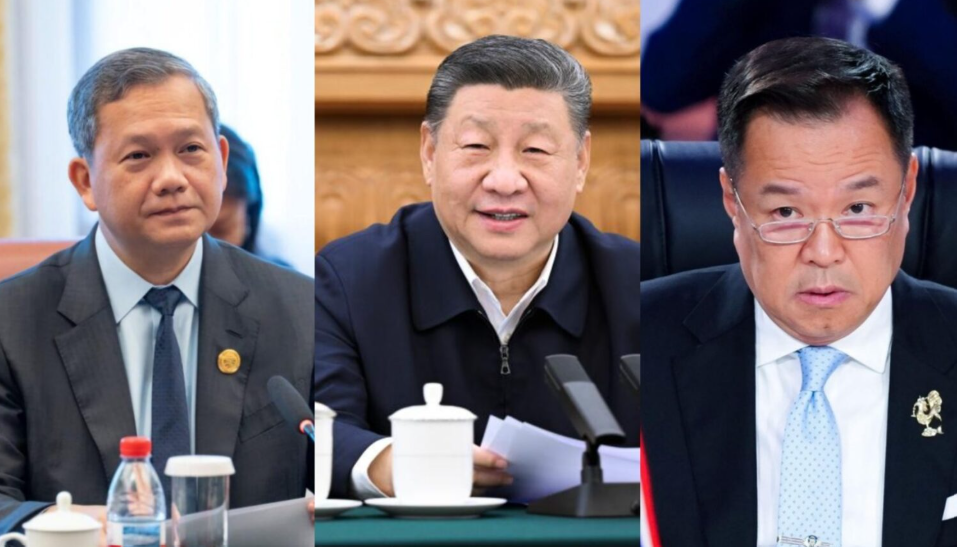
Prime Minister Hun Manet of Cambodia and his Thai counterpart Anutin Chanvirakul are preparing to travel to Shanghai next month for the World AI Conference 2026, marking a significant diplomatic occasion that observers believe could influence progress on the longstanding territorial tensions between the two Southeast Asian neighbours. Both leaders have been invited by Chinese President Xi Jinping to attend the July 17 opening session of the conference, with Manet's visit scheduled for July 15-17. The timing and composition of their respective delegations suggest that substantive bilateral engagement with Beijing may extend beyond the formal conference proceedings.
Manet's delegation will be notably comprehensive, reflecting the seriousness Cambodia attaches to the visit. Accompanying the prime minister will be Foreign Minister Prak Sokhonn and Defence Minister Tea Seiha, indicating that security and diplomatic matters feature prominently on the agenda. The inclusion of Sun Chanthol, first vice-chairman of the Council for the Development of Cambodia, further underscores the government's intent to leverage the visit for broader strategic purposes. Thailand's contingent, whilst not yet fully detailed, is expected to include Foreign Minister Sihasak Phuangketkeow, signalling similar diplomatic weight from Bangkok's side.
Cambodia's foreign ministry has characterised the trip as reinforcing the "long-standing friendship" between Phnom Penh and Beijing, with emphasis placed on deepening cooperation through existing frameworks. The official statement references the Comprehensive Strategic Partnership of Cooperation and the Diamond Cooperation Framework, whilst highlighting aspirations for an "all-weather" bilateral relationship reflective of broader regional positioning. Thailand has similarly framed its participation as an opportunity to strengthen its Comprehensive Strategic Cooperative Partnership with China, focusing on mutual benefits for both populations. Such language, whilst conventional in diplomatic discourse, reflects each nation's desire to position itself advantageously within China's strategic orbit at a moment of regional uncertainty.
The critical subtext to these visits, however, centres on whether China will leverage its substantial economic and political influence to pressure Cambodia and Thailand toward resolving their border impasse. The two nations have maintained no formal negotiating sessions since December, despite their leaders' brief encounter at the Asean Future Forum in Hanoi during early June. That handshake, captured for media consumption, occurred without substantive discussion of the territorial dispute that continues to destabilise their relationship. As the world's largest trading partner for both countries, China possesses considerable leverage to encourage movement on this intractable issue.
The border dispute remains deeply entrenched, with approximately 20,000 Cambodian civilians displaced from their homes in occupied territories. Several regions of Cambodia remain under Thai control, a situation that has persisted despite international concern and bilateral discussions. The humanitarian dimension of the dispute cannot be understated—families separated from their ancestral lands and community assets represent not merely a legal question but a social wound affecting tens of thousands of people. Thailand's apparent reluctance to resolve the matter through negotiation has prolonged the instability, with the Royal Academy of Cambodia's Kin Phea suggesting that structural obstacles within Thailand's political system impede progress.
Phea, who serves as director of the International Relations Institute at the academy, has articulated a crucial constraint on Thai compliance with previous agreements. He contends that whilst Thailand's civilian government has reached consensus with Cambodia on resolving disputes, the Thai military's autonomous decision-making authority undermines implementation of such commitments. The military's capacity to undertake unilateral actions, including territorial encroachment, creates a situation where civilian-negotiated agreements lack binding force. This institutional fragmentation within Thailand's governance structure explains why previous diplomatic initiatives, including the December 2025 Fuxian Consensus brokered by China, have failed to produce tangible territorial withdrawal or renewed formal negotiations.
The Fuxian Consensus itself represents an important reference point for evaluating Beijing's role as a potential mediator. That agreement, reached specifically through Chinese diplomatic intermediation, established principles for peaceful resolution through dialogue and adherence to international law. The fact that Thailand has neither honoured the consensus nor resumed formal talks with Cambodia's Joint Boundary Commission suggests that Chinese pressure, while present, has proven insufficient to overcome Thai institutional resistance. Phea's observation that "China should play a more actively[e] role as arbitrator" indicates that current diplomatic efforts remain inadequate to the task.
China's interest in resolving the Cambodia-Thailand dispute extends beyond humanitarian concern or regional stability, though both matter. Beijing benefits from a peaceful, cooperative Southeast Asia where its influence can expand without competition from regional conflicts that might invite external intervention. A destabilised border area between two important Southeast Asian nations, both within China's sphere of influence, creates unpredictability that undermines Beijing's strategic planning. Additionally, unresolved territorial disputes can become flashpoints for great-power competition, particularly if neighbouring countries develop alternative alliances or if external actors perceive opportunities to expand influence through offering mediation services.
The Shanghai conference visit thus represents a potential inflection point for bilateral Cambodian-Thai relations, though whether it will prove transformative remains uncertain. If China chooses to deploy its full diplomatic arsenal—combining incentives for cooperation with consequences for non-compliance—the meeting could catalyse movement toward renewed negotiations and territorial adjustments. Conversely, if the conference devolves into largely ceremonial interactions focused on broader strategic partnerships, the border dispute may remain frozen in its current impasse. Observers will scrutinise the outcomes and any statements emerging from bilateral meetings between the prime ministers and Chinese leadership to discern whether substantive pressure on the border question has been applied.
For Malaysian observers and broader Southeast Asian audiences, the Cambodia-Thailand border situation exemplifies the complex interplay between bilateral disputes, great-power diplomacy, and regional stability. Malaysia itself has navigated maritime boundary questions with several neighbours, making the underlying issues comprehensible to local audiences. The question of whether China will prioritise active mediation over passive facilitation carries implications for the entire region, as it suggests either a more interventionist approach to regional conflict resolution or a continuation of the current pattern where bilateral disputes smoulder without resolution. The Shanghai summit will provide early indicators of which trajectory is likely.

