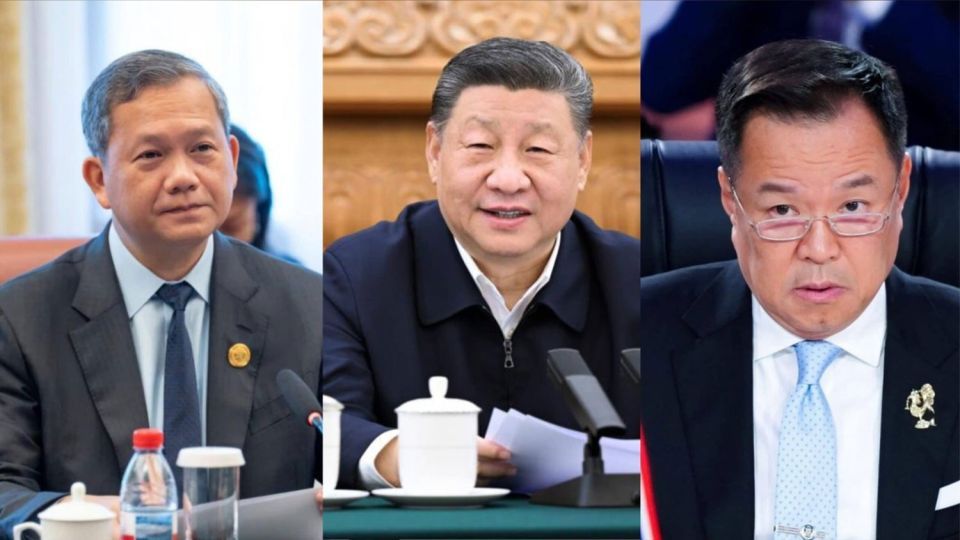
Prime Ministers Hun Manet of Cambodia and Anutin Chanvirakul of Thailand are set to converge in Shanghai next month for the opening of the World AI Conference 2026, responding to a personal invitation from Chinese President Xi Jinping. The dual attendance on July 17 marks a carefully choreographed diplomatic moment that carries implications extending far beyond discussions of artificial intelligence technology. Both leaders will conduct separate bilateral meetings with Xi and Chinese Premier Li Qiang during Manet's July 15-17 visit, creating a forum where major power interests and bilateral grievances could be addressed through quiet diplomacy.
The Cambodian delegation will be substantial in composition, reflecting the strategic significance of the visit. Accompanying Manet are Foreign Minister Prak Sokhonn, Defence Minister Tea Seiha, and Sun Chanthol, the first vice-chairman of the Council for the Development of Cambodia. Thailand's Anutin is expected to bring Foreign Minister Sihasak Phuangketkeow. The breadth of representation underscores that these are not ceremonial visits but substantive working engagements where multiple government portfolios require presence and coordination.
Cambodian officials have framed the Shanghai visit as part of a broader deepening of ties with Beijing. A statement from Cambodia's foreign ministry emphasized the visit as reinforcing "the shared commitment between Cambodia and China to deepen their long-standing friendship and promote mutually beneficial cooperation." The language specifically referenced advancing the Comprehensive Strategic Partnership of Cooperation and enhancing what Phnom Penh calls the Diamond Cooperation Framework—terminology that signals Cambodia's intent to position China as its paramount strategic partner. Thai counterparts offered similarly calibrated messaging about strengthening the Thailand-China Comprehensive Strategic Cooperative Partnership.
Yet beneath this veneer of routine diplomatic ceremony lurks a more pressing and unresolved issue. Cambodia and Thailand have not conducted formal border negotiations since December, a silence that reflects deepening tensions over territorial disputes affecting thousands of civilians. The last time the two premiers crossed paths was in early June during the 3rd ASEAN Future Forum in Hanoi, where they managed a handshake for photographers but conducted no substantive discussions regarding the boundary impasse. This pattern of ceremonial acknowledgment coupled with substantive avoidance characterizes a relationship in stasis.
Regional analysts and think-tank specialists increasingly view China as the pivotal actor capable of breaking this deadlock. As the dominant trading partner for both nations and an investor with massive infrastructure interests throughout mainland Southeast Asia, Beijing possesses considerable leverage. The logic holds that China would benefit from stability along its southern borders and within Southeast Asia more broadly, creating incentives for it to mediate between Phnom Penh and Bangkok. Yet the effectiveness of any such mediation remains uncertain given the complex domestic political dynamics within Thailand itself.
Kin Phea, director of the International Relations Institute at Cambodia's Royal Academy, has articulated a nuanced analysis of the underlying obstacles to resolution. According to Phea, the fundamental barrier transcends the official positions held by either prime minister; rather, it reflects fractures within Thailand's power structure. "The Thai military has not implemented the measures that their civilian government agreed with their Cambodian counterparts," Phea noted, suggesting that Thai military institutions operate with significant autonomy from civilian oversight when it comes to border operations. This institutional independence permits what Phea characterizes as arbitrary military actions, including what Cambodia views as encroachments on its sovereign territory.
This military-civilian disconnect within Thailand's governance represents perhaps the most significant impediment to any negotiated settlement. Even if Thai civilian authorities and Cambodian leadership reach consensus on border arrangements, implementation depends upon military compliance—a mechanism that Phea's analysis suggests cannot be assumed. The Thai military's historical role in politics, combined with its institutional interests in maintaining control over strategic border regions, creates structural resistance to compromise regardless of civilian government preferences.
Phea has called for more active Chinese intervention as a mediating arbiter. His prescription extends beyond passive observation to aggressive facilitation: China should compel both nations to return to negotiations and pursue resolution through diplomatic and legal frameworks. This reflects broader Southeast Asian sentiment that Beijing, given its economic weight and diplomatic standing, bears responsibility for regional stability. The appeal for China to enforce adherence to the December 2025 Fuxian Consensus—a Chinese-brokered agreement outlining principles for boundary resolution—suggests that earlier diplomatic efforts lack sufficient enforcement mechanisms.
The specific grievances underlying the dispute carry humanitarian dimensions that amplify diplomatic urgency. Approximately 20,000 Cambodian civilians remain displaced from their homes in areas that Thai forces occupy or control. These communities exist in a state of protracted limbo, unable to return to ancestral lands and livelihoods pending resolution of territorial questions. The longer negotiations remain stalled, the more entrenched these displacement situations become and the more complex any eventual resolution becomes. What might have been negotiable five years ago grows harder as psychological and economic separations harden into new realities.
The Joint Boundary Commission, the institutional mechanism designed to manage border demarcation and dispute resolution, has become paralyzed. Phea explicitly demands that Thailand return to this body and engage without further delay, suggesting that Thai disengagement represents a deliberate choice rather than logistical difficulty. This strategic withdrawal from established mechanisms compounds the substantive territorial disagreements with procedural obstruction. Reactivating the Joint Boundary Commission would constitute a necessary first step, yet even this preliminary measure remains elusive.
Shanghai therefore presents a crucial juncture. The conference provides cover for bilateral discussions and offers Chinese leadership an opportunity to privately communicate expectations to both prime ministers. Whether China will seize this moment to advance concrete border resolution mechanisms remains unclear. The diplomatic signals from both capitals emphasize friendship, cooperation, and strategic partnership—language that typically masks harder negotiations occurring behind closed doors. For the tens of thousands of displaced Cambodian civilians and for Southeast Asian stability more broadly, the outcome of these Shanghai conversations may prove far more consequential than any artificial intelligence conference deliberations.

