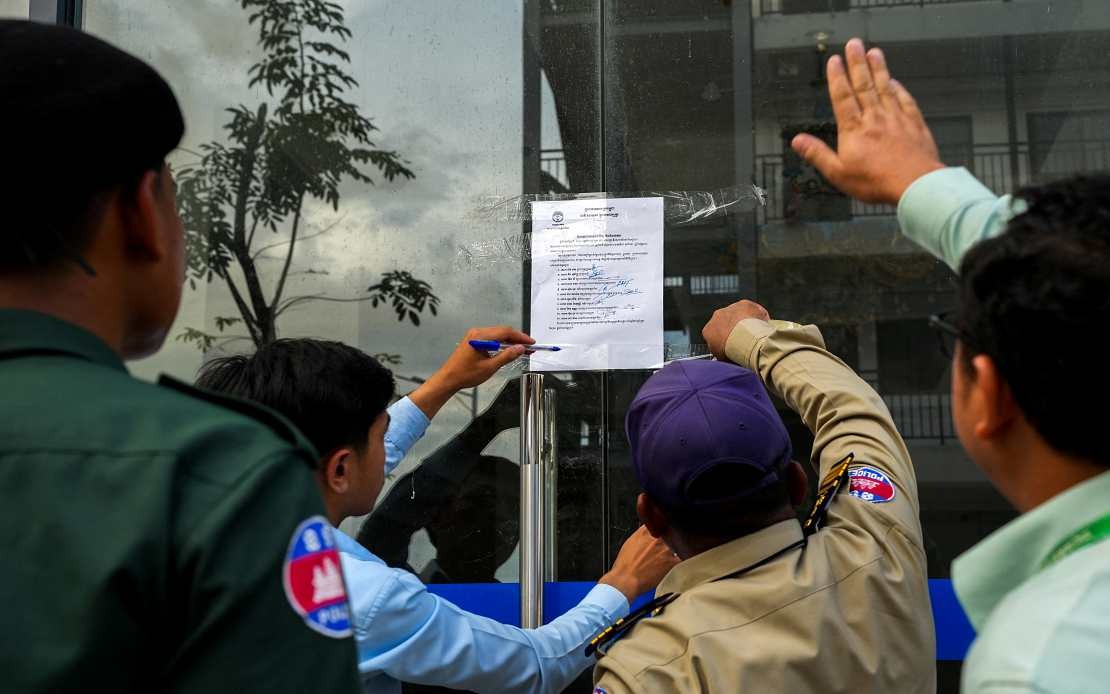
Cambodia has intensified its fight against transnational cybercrime by expelling over 16,000 foreign nationals suspected of running online scams during the first half of 2026, according to Police Lieutenant General Sok Veasna, the director general of the General Department of Immigration. The sweeping deportation campaign, which saw more than 45,000 foreigners removed from the country in total during this period, underscores the Cambodian government's determination to tackle what has become a significant threat to both national security and the kingdom's standing on the international stage.
The surge in enforcement operations against online fraud has been particularly pronounced since the start of January, with immigration authorities ramping up surveillance, arrests, and deportation procedures at an unprecedented scale. Veasna disclosed these figures during a mid-year review meeting on Tuesday, emphasising that the crackdown represents a watershed moment in Cambodia's response to organised cybercrime. All individuals deported under this operation face permanent entry bans, a measure designed to prevent recidivism and signal the authorities' zero-tolerance stance on foreign criminal networks operating within Cambodian borders.
The momentum behind these deportations has been strengthened by legislative action at the national level. In April, Cambodia enacted the Law on Combating Online Scams, which establishes severe penalties for those orchestrating and leading fraudulent operations. This legal framework provides authorities with the statutory tools necessary to prosecute not only lower-level operatives but also the senior organizers who profit most handsomely from these schemes. The legislation marks a critical turning point in Cambodia's institutional capacity to address cybercrime systematically rather than through ad-hoc interventions.
However, according to analysts and observers, the mass deportations, while symbolically important and operationally significant, represent only a partial solution to a deeply embedded problem. Thong Mengdavid, deputy director at the China-ASEAN Studies Centre of the Cambodia University of Technology and Science, characterises the current approach as necessary but incomplete. He acknowledges that removing thousands of foreign scammers serves to disrupt the networks and helps rehabilitate Cambodia's tarnished international reputation, which has suffered considerable damage from reports of the kingdom hosting sophisticated cyber-scam operations.
Yet Mengdavid's analysis points toward a more troubling reality that mere deportations cannot solve. To achieve lasting success in eliminating these criminal networks, Cambodia must target the organisational apex where the highest-level decision-makers orchestrate operations across multiple countries. More critically, the underlying ecosystem of local protection networks that enables these criminal enterprises to flourish must be dismantled. These networks include corrupt officials, local facilitators, and enablers who provide safe havens, launder proceeds, and shield operations from law enforcement scrutiny.
The analysis becomes even more complex when considering the intersection of cybercrime with human trafficking and exploitation. Many of those deported were not merely computer operators but individuals trapped or coerced into participating in scam operations, either through debt bondage or direct threats. Addressing the root causes therefore requires confronting the human trafficking dimension alongside institutional corruption that permits such activities to persist. Without tackling these foundational issues, Cambodia risks simply cycling through waves of deportations without achieving systemic change.
For Malaysia and other Southeast Asian nations, Cambodia's situation carries important implications. The region has become a focal point for internationally organised cybercrime syndicates that exploit loose regulatory environments and corrupt officials to establish operational bases. Malaysia itself has been targeted by similar networks, and the techniques used by Cambodia's scammers often overlap with those troubling Malaysian law enforcement. Observing how Cambodia's approach unfolds could provide valuable lessons about what strategies prove effective and which approaches require refinement.
The campaign also reflects broader regional concerns about sovereignty and criminal jurisdiction. Cybercrime transcends borders seamlessly, with victims in Malaysia, Singapore, Thailand, and beyond suffering losses to operations based in other ASEAN countries. The unprecedented scale of Cambodia's deportations suggests growing regional pressure on individual nations to take unilateral action. However, this approach risks becoming counterproductive unless coordinated through regional mechanisms like INTERPOL and ASEAN frameworks for mutual legal assistance and extradition.
Cambodia's legislative response through the Law on Combating Online Scams also signals a shift in how Southeast Asian governments conceptualise cybercrime response. Rather than treating it primarily as an immigration or border security matter, the new law positions online fraud as a serious criminal offence warranting severe penalties comparable to those for trafficking or organised violence. This reframing could influence how neighbouring countries structure their own responses and may accelerate development of more harmonised regional standards for prosecution and punishment.
The sustainability of Cambodia's anti-cybercrime drive will ultimately depend on whether the political will translating into these enforcement operations persists over the medium to long term. Initial crackdowns often generate impressive statistics but lose momentum as institutional attention shifts elsewhere. Moreover, the criminal networks may adapt by relocating to alternative havens or operating with greater sophistication to avoid detection. The true test will be whether Cambodia's authorities can progress from tactical deportations to strategic dismantling of the organisational and institutional structures enabling these operations to flourish.

