The Cambodia-Thailand border dispute has entered a new phase where independent international observation is becoming central to Phnom Penh's strategy of challenging Bangkok's territorial assertions. Speaking on Monday, Cambodian Information Minister Neth Pheaktra directly responded to Thailand's Joint Information Center director Air Chief Marshal Prapas Sornchaidee, who had previously dismissed allegations of Thai military encroachment as inaccurate. Rather than engage in a purely bilateral argument, Pheaktra's counter-assertion strategically shifts the conversation from a two-sided disagreement to a matter now subject to external verification and documentation by credible third parties.
Pheaktra's central argument rests on a straightforward but powerful observation: the physical infrastructure deployed across disputed border areas—shipping containers, razor wire barriers, military fortifications and trenches—cannot be hidden from scrutiny, particularly when international monitors are actively inspecting the sites. By emphasising that "the eyes of third parties" are now seeing these conditions, the Cambodian minister attempts to elevate evidence from the realm of contested claims into the sphere of documented facts. This framing implicitly suggests that Thailand's repeated denials become less credible once foreign observers have personally verified the presence of physical barriers and military infrastructure in zones Cambodia considers its sovereign territory.
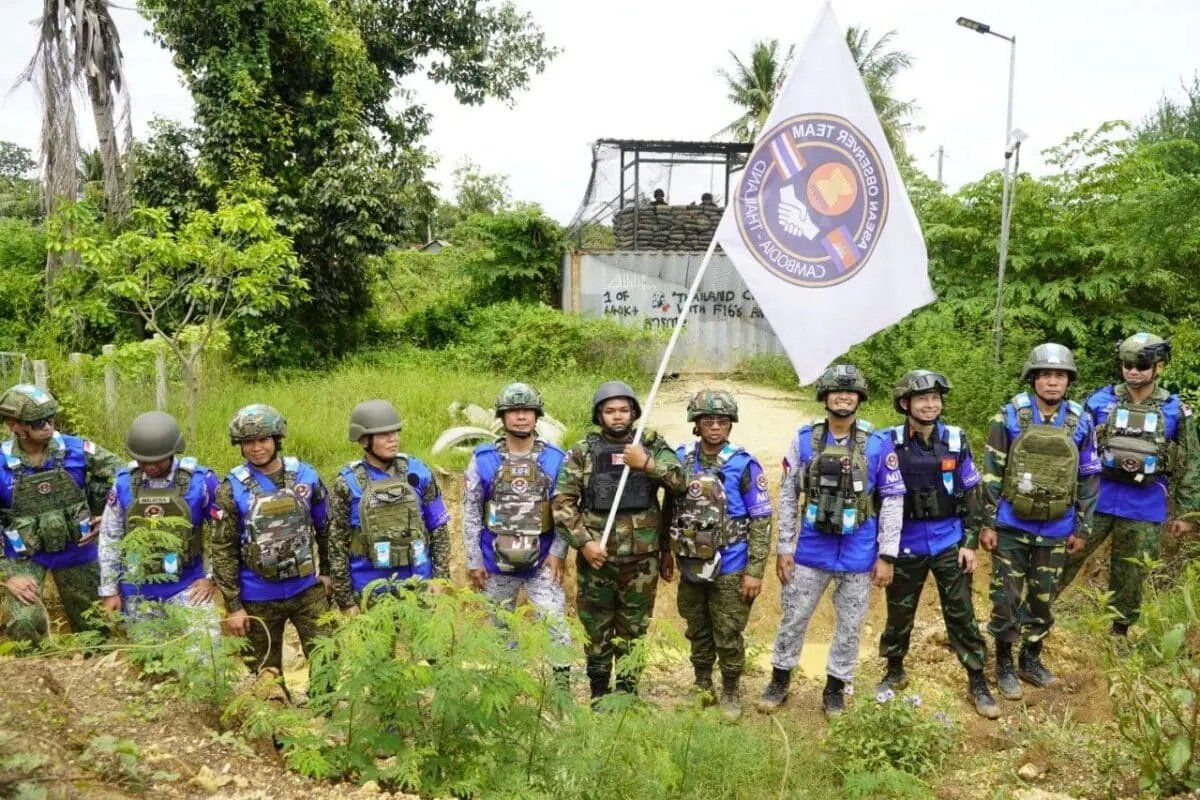
The concrete focus of these claims lies in Banteay Meanchey province, where ASEAN's Observer Team in Cambodia (AOT-KH) has recently conducted inspections. At Boeung Trakuon in Kouk Romiet commune, the team documented 44 shipping containers at 14 separate locations, with Cambodia asserting that approximately 7,873 residents from 1,869 households—nearly 1,847 of them children—remain displaced and unable to access their homes. Additional inspections at Chouk Chey and Prey Chan villages revealed another 72 containers spread across 10 locations. Combined, these three areas contain 116 containers at 24 locations, affecting some 13,259 people according to Cambodian figures, including more than 3,400 children.
For Malaysian and regional observers, this escalating documentation effort reflects a broader pattern in Southeast Asian border disputes: when bilateral negotiations reach an impasse, disputing nations increasingly turn to multilateral mechanisms and international witnesses to legitimise their positions. The AOT-KH, headed by a Philippine official, serves as ASEAN's institutional mechanism for monitoring the ceasefire conditions established between the two nations. However, its role—observing and verifying ceasefire compliance—technically differs from determining territorial sovereignty, a distinction that matters legally even if it complicates the political messaging around these inspections.
Pheaktra also cited observations by UN Special Rapporteur on human rights in Cambodia Tom Andrews, who visited displaced communities and the border region during a July mission. Andrews subsequently reported that approximately 650,000 Cambodians were displaced at the peak of the conflict, with more than 20,000 still unable to return to their homes. According to Andrews' account, displaced persons he interviewed attributed their inability to return to occupation of their territories by Thai security forces, and he called for their safe repatriation. This intervention by a UN human rights mechanism adds another layer of international attention to conditions Phnom Penh characterises as unjust displacement rather than legitimate security measures.
Thailand's position, articulated through Air Chief Marshal Prapas, maintains that Bangkok has no policy of territorial invasion or occupation and that its military and security activities are designed to protect Thai troops and civilians whilst safeguarding what it considers Thai sovereignty in contested areas. Prapas acknowledged that the mere presence of troops and security infrastructure cannot alone determine international boundaries, and he agreed in principle with Cambodia that territorial questions should be resolved through maps, evidence and the Joint Boundary Commission (JBC) rather than through military fait accompli. This rhetorical alignment with Cambodia's stated methodology—emphasising legal and technical mechanisms—creates an interesting paradox: both sides claim to support boundary determination through agreed processes, yet their practical actions on the ground appear to reflect competing efforts to control territory before such determination occurs.
The fundamental disagreement centres on how to interpret the physical evidence itself. Thailand maintains it is protecting its own territory and troops, whilst Cambodia insists these security justifications are merely pretexts for establishing de facto control over Cambodian land. Pheaktra's rhetorical response—"Shipping containers are not border markers. Barbed wire is not a treaty. Trenches are not boundary maps. Planting a flag is not a title deed to territory"—attempts to delegitimise Thailand's implicit argument that security needs and military control can substitute for formal boundary agreements. This framing seeks to prevent the international community from accepting Thai security requirements as a legitimate basis for physical occupation of disputed areas.
Cambodia grounds its territorial claims in historical legal instruments including Franco-Siamese treaties and conventions, historical maps, boundary documents, the 2000 Cambodia-Thailand border Memorandum of Understanding, the 2003 Terms of Reference, and the ongoing JBC process. These references emphasise Cambodia's position that the boundary question is not a matter of contemporary negotiation but rather one of implementing pre-existing agreements and historical documentation. By invoking these frameworks, Phnom Penh situates itself as the defender of established legal instruments against Thai expansionism, a positioning that resonates particularly in regional forums where respect for historical treaties and territorial integrity remain paramount principles.
The displacement of civilians adds a humanitarian dimension that complicates the purely technical boundary question. Cambodia explicitly links the territorial dispute to Point 4 of the December 27 ceasefire agreement, which stipulates that affected civilians on both sides shall return to their homes without obstruction and in safety and dignity. From this perspective, the thousands of Cambodians unable to return home represent not merely a territorial problem but a violation of ceasefire obligations. Pheaktra's assertion that "a ceasefire is not a licence to create new facts on the ground" attempts to frame Thailand's military infrastructure and container barriers as post-conflict escalations rather than defensive measures justified by sovereignty concerns.
For Malaysia and other ASEAN members, this dispute illustrates the persistent challenge of border management in Southeast Asia, where colonial-era demarcations often remain imprecisely implemented despite modern administrative requirements. The increasing reliance on international observers and third-party documentation suggests that bilateral mechanisms have proven insufficient for resolving these disagreements. However, the presence of ASEAN monitors and UN officials does not automatically translate into binding determinations of sovereignty—it merely creates an external record that may influence diplomatic pressure and regional perceptions.
Thailand's apparent unwillingness to halt security measures in response to Cambodian demands indicates that Bangkok believes its sovereignty in the disputed areas is sufficiently established to justify continued military presence and infrastructure development. This confidence may rest on Thailand's own historical documentation, stronger military capability, or assessments that the JBC process remains unlikely to produce swift results. For Cambodia, the strategy of enlisting international observers appears aimed at internationalising the dispute sufficiently that regional and global opinion becomes a factor in Thai calculations, potentially making continued occupation diplomatically costly even if militarily feasible.
The trajectory of this dispute will likely depend on whether the JBC can reach agreements on specific boundary sections or whether international observation and humanitarian concerns eventually force both nations toward negotiated compromises. For Malaysia and other regional states, the Cambodia-Thailand border situation remains a test case for ASEAN's capacity to facilitate dispute resolution whilst respecting national sovereignty, a balancing act that will shape how the organisation addresses future border conflicts across Southeast Asia.

