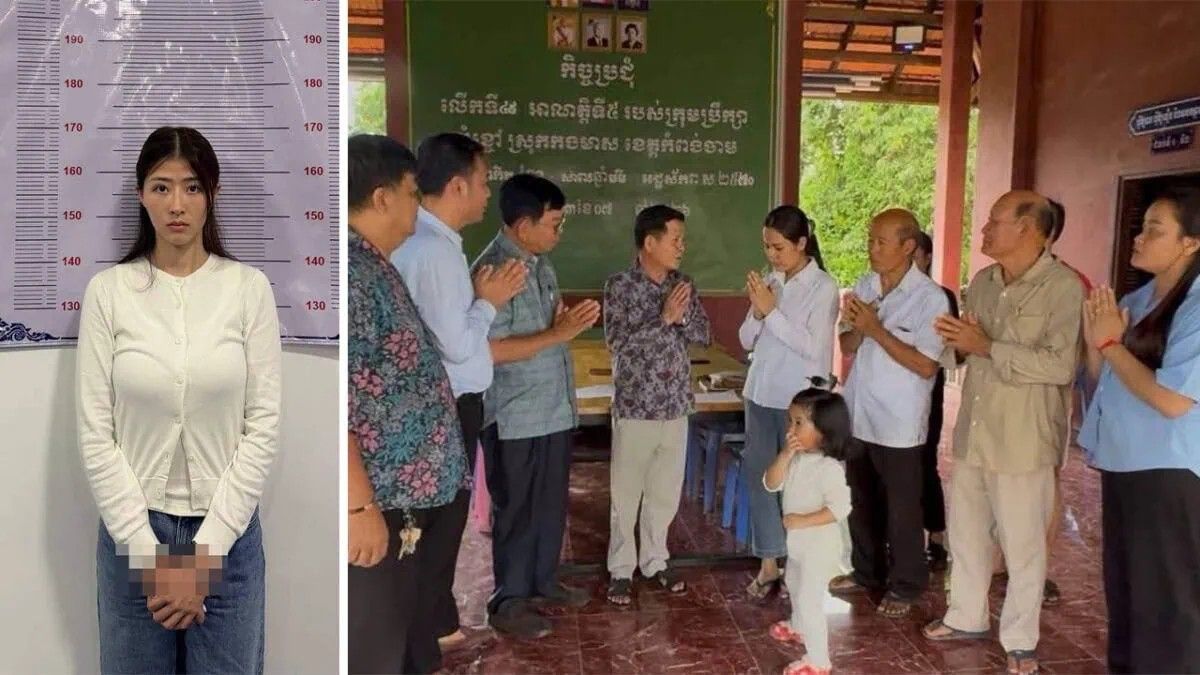
The family of Kuoch Limhan, an official at Cambodia's Ministry of Public Works and Transport, has agreed to withdraw its civil complaint following a settlement worth S$60,000, though the criminal case against the driver responsible for his death will continue unimpeded through the courts.
Limhan was fatally struck by a motorcycle on the night of July 28 in Phnom Penh's Sen Sok district. According to witness accounts and video evidence, the driver Sam Meychou crossed the centreline while attempting to overtake another vehicle, directly colliding with Limhan's motorcycle. The victim, who was returning home with milk for his young daughter, died at the scene as heavy rain fell across the street.
The out-of-court settlement was formally executed on August 6 through a written agreement signed by both parties and witnessed by commune chief Kong Sekleng and lawyer Phon Thearin. Under its terms, Oknha Tong Hok Seng, the father of the accused driver, provided the compensation payment directly to Limhan's widow. Seung Kimhor, acting as the family's representative in the civil claim, was a signatory to the arrangement.
The agreement explicitly states that both parties have resolved their dispute through mutual understanding and goodwill, with neither side pursuing any further claims or demands. This resolution covers only the civil liability aspect of the case, which relates to compensation for damages. The language of the settlement emphasises an amicable resolution, a common mechanism in Southeast Asian jurisdictions where civil and criminal proceedings are treated as parallel rather than interconnected processes.
However, the financial settlement carries no bearing on the separate criminal prosecution. Meychou remains charged with causing a fatal traffic accident and fleeing the scene of the incident. Following her arrest on July 30 after voluntarily presenting herself to authorities, the Phnom Penh Municipal Court formally charged her on July 31 under case number 4396. Video footage from the scene captured the accused and a companion departing in a tuk tuk while Limhan's body remained on the roadway, establishing the element of flight that compounds the criminal allegations.
The investigating judge, after examining evidence and conducting questioning, ordered Meychou to be held in pre-trial detention pending the progression of criminal proceedings. This detention status continues regardless of the civil settlement, as Cambodia's legal framework maintains strict separation between compensation disputes and criminal accountability for traffic offences resulting in death.
For Malaysian readers familiar with their own legal structures, this distinction reflects important differences in how Southeast Asian countries handle fatal traffic incidents. While Malaysia typically consolidates civil and criminal aspects more closely within the magistrate or high court system, Cambodia maintains more formal separation between the two tracks. A civil settlement in such matters does not constitute an admission of guilt, nor does it terminate state prosecution of the accused.
The acceptance of compensation by Limhan's family may be viewed through several lenses. From a practical perspective, it provides immediate financial relief to his widow and dependents during an extraordinarily difficult period. In the Cambodian context, where state victim compensation schemes are limited, family settlements represent a primary means through which dependents of traffic fatalities receive economic support. The S$60,000 amount, equivalent to approximately 240,000 Malaysian ringgit, likely represents a substantial sum relative to local wage standards and provides meaningful security for the victim's minor daughter.
Simultaneously, such settlements raise questions about justice and deterrence that resonate across the region. In Malaysia's more stringent traffic courts, fatal hit-and-run cases frequently result in custodial sentences regardless of civil compensation arrangements. The separation of civil and criminal processes in Cambodia allows accused drivers to potentially resolve financial liability while still facing imprisonment for causing death, a structure that maintains the principle of state prosecution for public safety violations.
The case underscores broader challenges in managing road safety across Southeast Asia, where motorcycles constitute primary transportation for millions yet face disproportionate injury and fatality rates in collision scenarios. Limhan's death during a routine commute illustrates how quickly ordinary travel can turn tragic, particularly when overtaking manoeuvres are executed without adequate precautions. The incident occurred in urban Phnom Penh, where congestion and mixed traffic flows create hazardous conditions.
As the criminal case progresses through Cambodia's judicial system, prosecutors will need to establish the circumstances of the collision, the accused's responsibility, and the decision to flee. The video evidence already gathered appears substantial in documenting what occurred immediately after impact. Meychou's own decision to turn herself in, while notable, does not negate the serious nature of the allegations.
The criminal proceedings are expected to continue through various stages of examination and potential trial, with the pre-trial detention order ensuring the accused remains available to the court. This parallel track operates entirely independently of the family's decision to accept civil compensation, a principle that protects the state's capacity to hold individuals accountable for fatal traffic offences regardless of financial arrangements between private parties.

