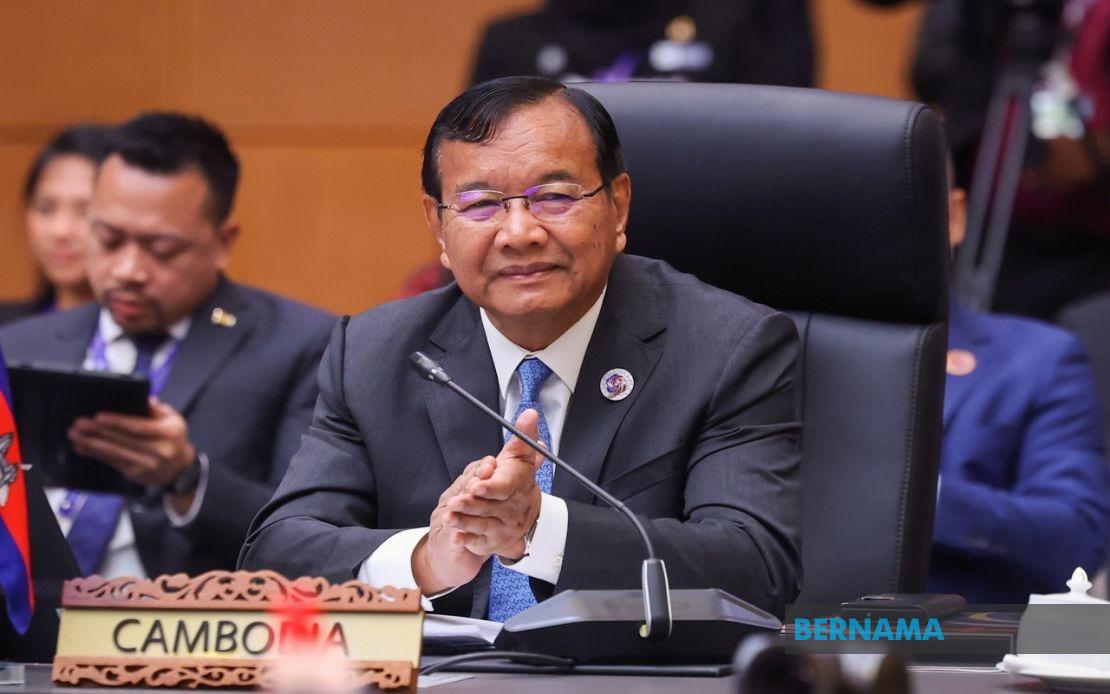
Cambodian Deputy Prime Minister and Minister of Foreign Affairs and International Cooperation Prak Sokhonn touched down at Kuala Lumpur International Airport Terminal 1 on Thursday afternoon, beginning a two-day official visit that underscores the deepening relationship between Phnom Penh and Kuala Lumpur. The high-level delegation's arrival at 1.48 pm was marked by formal ceremonies befitting the significance of the engagement, with Cambodian Ambassador to Malaysia Ouk Chandara and Malaysia's chief ceremony officer Datuk Rozainor Ramli overseeing the reception.
The timing of Sokhonn's journey reflects a broader effort to consolidate bilateral relations at a critical juncture for Southeast Asia. Both nations have signalled their commitment to advancing shared interests through institutional mechanisms, with this visit serving as a platform to breathe new vigour into a partnership that observers regard as one of stability and mutual benefit. For Malaysia, Cambodia represents both a key regional partner and a crucial node in its broader engagement with the Mekong region, where Bangkok and Hanoi have traditionally held greater strategic influence.
As is customary with such high-level visits, Sokhonn's schedule includes a courtesy call on Prime Minister Datuk Seri Anwar Ibrahim, a gesture that carries diplomatic weight beyond mere protocol. These opening meetings often set the tone for substantive discussions that follow, allowing leaders to exchange views on regional challenges and bilateral priorities before more technical deliberations commence. The courtesy call provides an opportunity for the Malaysian premier to communicate directly the country's strategic vision for the relationship over coming months.
The centrepiece of Sokhonn's visit is the third Cambodia-Malaysia Joint Commission for Bilateral Cooperation meeting, scheduled to take place in Kuala Lumpur on Friday. This commission serves as the primary institutional framework through which the two governments assess progress on implementation of previously agreed minutes and bilateral agreements. Unlike ad hoc diplomatic exchanges, the JCBC represents a structured approach to relationship management, allowing both sides to measure concrete outcomes and identify areas requiring renewed effort or course correction.
During the JCBC session, delegations from both nations will conduct a comprehensive review of advances made since the second meeting, examining whether agreed-upon projects have advanced as intended and whether implementation timelines remain on track. Such meetings often uncover bottlenecks that require political intervention to resolve, making them valuable opportunities for addressing obstacles that technical committees cannot overcome independently. The process also allows officials to align expectations and discuss new initiatives that both governments wish to pursue collaboratively.
Beyond the formal JCBC proceedings, Sokhonn is expected to hold bilateral talks with Foreign Minister Datuk Seri Mohamad Hasan. These discussions are likely to cover not only bilateral matters but also regional developments, particularly those affecting ASEAN's cohesion and Southeast Asia's strategic environment. Cambodia's perspective on issues such as South China Sea tensions, Myanmar's political crisis, and the expansion of great power competition in the region carries weight in broader regional calculations, making these conversations diplomatically significant.
The economic dimension of the Malaysia-Cambodia relationship has accelerated notably in recent years. Trade figures for 2025 reveal this dynamic, with bilateral commerce reaching RM5 billion (USD1.17 billion), representing a substantial 27.4 per cent increase year-on-year. For context, this growth trajectory suggests that the two countries are successfully diversifying their commercial engagement beyond traditional sectors, likely encompassing manufacturing, services, and infrastructure-related trade. Such growth indicates that businesses in both nations perceive genuine opportunities for profitable expansion.
Malaysia's investment posture in Cambodia further demonstrates the depth of economic integration. As of 2024, Malaysian investors had committed USD3.20 billion (RM13.07 billion) across 162 registered projects throughout Cambodia, positioning Malaysia as the kingdom's third-largest foreign investor. This ranking reflects Malaysia's competitive advantage in the region, built on geographical proximity, cultural familiarity, and established business networks. The concentration of Malaysian capital in Cambodia suggests confidence among Malaysian enterprises in the country's business environment and long-term growth prospects.
For Malaysian policymakers, the significance of the bilateral relationship extends beyond trade and investment statistics. Cambodia's strategic location in the Mekong corridor makes it a natural transit point for Malaysian businesses seeking to penetrate Vietnamese and Laotian markets. Additionally, as China deepens its economic footprint in Cambodia through Belt and Road Initiative projects, Malaysia's maintained and strengthened engagement serves as a counterbalance, ensuring that regional relationships remain multi-directional rather than dominated by a single external power.
The visit also signals Malaysia's commitment to ASEAN solidarity and intra-regional cooperation at a time when the bloc faces external pressures and internal divisions on various issues. By according high-level attention to Cambodia, Malaysia reinforces its position as a reliable regional partner invested in Southeast Asian stability and prosperity. This approach contrasts with states that might prioritise external alliances over regional bonds, a distinction that holds weight in the calculus of ASEAN members that value balanced diplomacy.
Looking forward, observers will monitor the outcomes of the JCBC meeting for signals regarding the trajectory of Malaysia-Cambodia relations over the coming two to three years. Whether both nations expand cooperation into emerging areas such as digital economy partnerships, renewable energy, or skills development in critical sectors will indicate whether the relationship is evolving to meet contemporary challenges or remains anchored to traditional sectors. The visit provides both governments an opportunity to recalibrate their approach and demonstrate to their respective populations that bilateral engagement yields tangible benefits.
The broader context of this visit merits attention from Malaysian stakeholders. As regional competition for influence intensifies and great powers vie for strategic advantage in Southeast Asia, countries that maintain strong intra-regional ties create buffers against external manipulation and preserve space for autonomous decision-making. Sokhonn's visit to Kuala Lumpur underscores that despite external pressures and competing interests, Cambodia and Malaysia continue to see value in deepening a partnership that serves both nations' long-term interests and reinforces ASEAN's collective resilience.

