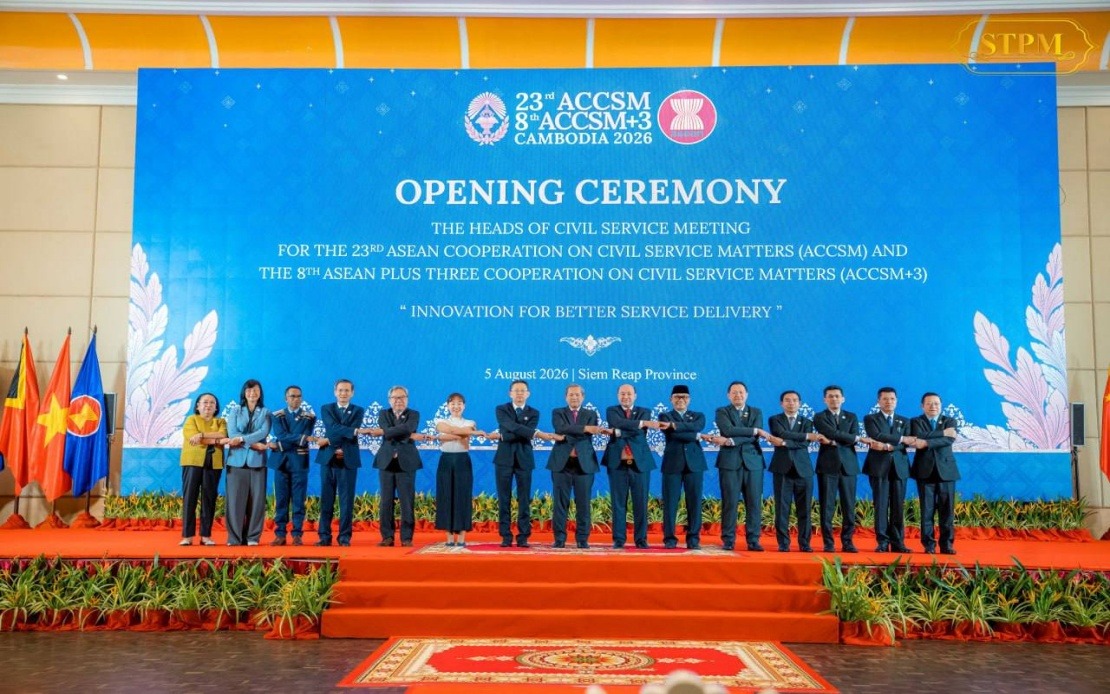
Cambodian Prime Minister Hun Manet has pressed ASEAN to adopt artificial intelligence and digital innovation as tools for strengthening public service delivery across the bloc, whilst maintaining a focus on citizen needs rather than technology for its own sake. Speaking at the 23rd ASEAN Cooperation on Civil Service Matters (ACCSM) and 8th ASEAN Plus Three Cooperation on Civil Service Matters (ACCSM+3) conference held in Siem Reap from August 3 to 5, Hun Manet outlined a vision for regional modernisation that balances technological advancement with inclusive governance. His intervention comes at a moment when Southeast Asian governments are actively exploring ways to harness digital tools to streamline administration, enhance efficiency, and respond more effectively to citizen demands.
Hun Manet emphasised that ASEAN's digital transformation cannot be reduced to a simple technology adoption exercise. Instead, he argued, innovation must be anchored in the development of institutional capacity and strengthening of human resources across member states. This distinction is critical for the region: Southeast Asia comprises economies at vastly different stages of digital maturity, ranging from advanced urban centres to rural areas with limited infrastructure. A one-size-fits-all approach to AI implementation risks leaving behind less developed economies and deepening the technological divide that already threatens regional cohesion.
The Cambodian leader stressed that any innovation agenda must recognise and accommodate the heterogeneous development landscape characterising ASEAN. He called for a measured, sustainable pace of technological adoption, allowing each member state to integrate AI and digital solutions in ways appropriate to its existing capacity. This pragmatic stance addresses a real concern across the region: rapid digitalisation without adequate foundational infrastructure, training, and institutional preparation can create inefficiencies rather than solve them, and may disadvantage countries with lower baseline digital readiness.
Beyond improving individual nation's service delivery, Hun Manet articulated a broader vision of innovation as a tool for strengthening collective regional resilience. ASEAN faces interconnected challenges that transcend national borders: climate-related disasters threaten all member states; economic development remains unevenly distributed across the region; and poverty continues to affect hundreds of millions. No single country, however advanced, can effectively address these systemic challenges in isolation. Innovation, therefore, must serve not merely bureaucratic efficiency but also regional solidarity and mutual capacity-building.
The prime minister explicitly advocated for ASEAN institutions to facilitate knowledge-sharing, mutual support systems, and collaborative adaptation mechanisms among member states. He positioned the ACCSM framework—which brings together civil service leaders from across ASEAN and its partner nations—as a critical platform for cross-national learning. By creating spaces where governments can harmonise policies, exchange best practices, and jointly develop solutions to common problems, ASEAN can leverage its collective intelligence and experience.
Hun Manet's emphasis on institutional capacity and human resources reflects lessons learned from digital transformation efforts across Asia. Countries that have succeeded in using technology to improve governance have typically invested heavily in training civil servants, establishing robust institutional frameworks, and ensuring that technology serves clearly identified policy objectives rather than driving strategy. Malaysia, Singapore, and other advanced ASEAN economies have demonstrated that sustained public sector capability-building is essential to realising the benefits of digital innovation.
The conference itself represents an important moment for regional governance. By bringing together civil service officials from ASEAN member states alongside representatives from China, Japan, and South Korea through the ACCSM+3 mechanism, the event enables broader discussion of how public administration can evolve to serve citizens more effectively in an era of rapid technological change. The theme "Innovation for Better Service Delivery" reflects recognition across the region that technology must ultimately be judged by its impact on ordinary people's interactions with government.
For Malaysia specifically, Hun Manet's framing has particular relevance. As a middle-income economy with reasonably advanced digital infrastructure but also significant development disparities between urban and rural areas, Malaysia faces similar questions about how to distribute the benefits of digital innovation equitably. The emphasis on institutional capacity and sustainable adoption aligns with Malaysia's own policy priorities in recent years, which have increasingly focused on digital inclusion and ensuring that technological advancement does not exacerbate existing inequalities.
The broader regional context highlights why Hun Manet's intervention matters. ASEAN's economic dynamism and geopolitical importance hinge partly on its ability to compete in the digital economy whilst maintaining social cohesion. If AI adoption and digital transformation widen gaps between and within nations, the consequences could be destabilising. By framing innovation as a vehicle for inclusive development and regional cooperation, Hun Manet has articulated a vision that could help guide ASEAN's technology strategy in coming years. The challenge now lies in translating these principles into concrete policies and investment priorities that actually narrow development gaps rather than merely acknowledging them.

