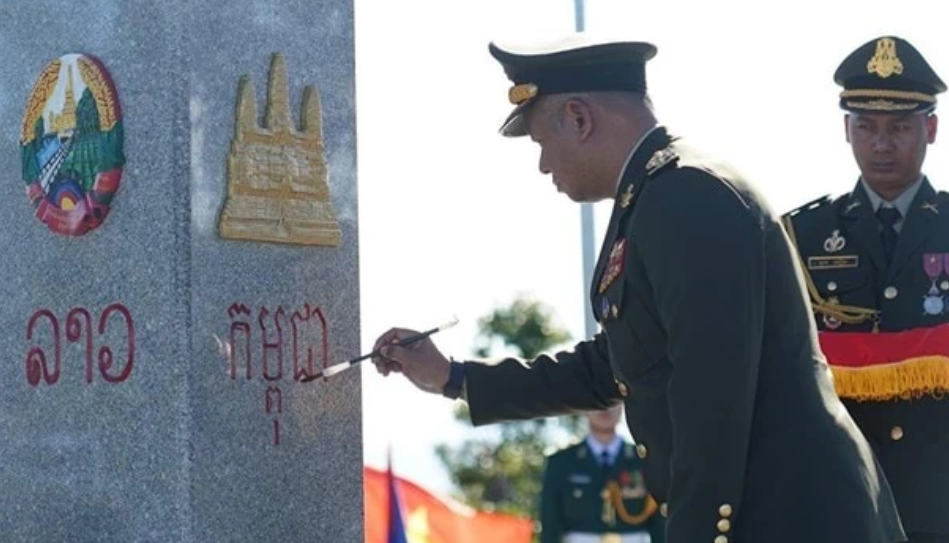
Prime Minister Hun Manet has doubled down on Cambodia's determination to construct a direct road connection to the Dragon's Tail, the remote tri-border junction where Cambodia, Laos and Vietnam meet, casting the infrastructure project as a matter of national sovereignty and territorial integrity. Speaking during an official visit to Stung Treng province on 12 August, Manet articulated a broader vision linking transportation networks to Cambodia's ability to exercise control over its remote northeastern territories, signalling that the government views road development not merely as an economic undertaking but as a geopolitical imperative.
The proposed Route 78½ represents the centrepiece of this effort, intended to connect Banlung in Ratanakiri province with Cambodia's northeastern frontier at the Dragon's Tail. Currently, access to this isolated region remains arduous, with overland travel from the Cambodian side hampered by rugged terrain and dense forest cover. Manet acknowledged this geographical challenge candidly, yet insisted that difficulty should not deter the state from establishing its own direct passage. He highlighted an uncomfortable reality: some Cambodians currently reach the tri-border area only by transiting through Vietnamese territory, a situation he portrayed as unacceptable from a sovereignty perspective. The prime minister's rhetoric elevated the road from a practical infrastructure need to a symbol of Cambodia's capacity to control its own borders and territory, a particularly resonant message given historical sensitivities in Phnom Penh regarding Vietnamese influence in the region.
During his speech in Stung Treng, Manet employed a striking metaphor to explain his infrastructure philosophy, comparing roads to blood vessels within a human body. This organic imagery framed connectivity not as a technical matter but as essential to regional vitality and life. In Manet's formulation, roads represent the circulatory system through which economic prosperity and social development flow to previously dormant areas. Where infrastructure reaches, he argued, communities can flourish; investment follows; livelihoods multiply. The metaphor worked to legitimise substantial capital expenditure by anchoring it in basic human necessity rather than luxury or political whim. For remote populations in Stung Treng, Ratanakiri, Mondulkiri and Kratie—the four northeastern provinces comprising his development focus—this philosophy promises transformation from geographical isolation to economic integration.
The infrastructure initiative gains particular significance against Cambodia's withdrawal from the Cambodia-Laos-Vietnam Development Triangle Area (CLV-DTA) in September 2024, marking a pivotal shift in the kingdom's approach to regional cooperation. The CLV-DTA, established in 1999, had functioned as a trilateral framework encompassing thirteen provinces across the three nations, with Cambodia's contribution comprising the four northeastern provinces now central to Manet's development strategy. The framework ostensibly aimed to improve infrastructure, facilitate trade, and raise living standards across remote border communities, yet within Cambodia it became increasingly controversial, attracting fierce public criticism and street protests centred on fears that participation might compromise territorial sovereignty or expand Vietnamese influence. Opposition voices depicted the arrangement as a potential mechanism for territorial loss, though government officials consistently dismissed such assertions as misguided.
During his August speech, Manet directly addressed the political turbulence surrounding the CLV-DTA withdrawal, using it as a platform to reframe the development narrative. He rejected characterisations of the initiative as a scheme through which Cambodia might lose its four northeastern provinces, describing such interpretations as distortions of the framework's original intent. Manet recontextualised the withdrawal not as abandonment of development ambitions but as a recalibration that would allow Cambodia to pursue progress on its own terms, unencumbered by multilateral arrangements that had become domestically toxic. The timing mattered: by personally overseeing northeastern development immediately following the CLV-DTA exit, Manet positioned himself and his government as credible custodians of Cambodian territorial integrity and nationalist aspiration, effectively reclaiming the development agenda from its association with international cooperation structures that Cambodian public opinion had come to distrust.
The road project to Dragon's Tail thus serves multiple strategic purposes simultaneously. Practically, it addresses genuine infrastructure deficits that have perpetuated economic marginalisation in remote regions where isolation has constrained agricultural productivity, limited market access for local goods, and restricted employment opportunities for rural populations. Economically, improved connectivity could catalyse business formation, attract investment capital, and facilitate the transfer of goods to urban markets, potentially raising incomes across remote provinces. Demographically, Manet argued that better roads would encourage settlement and population retention in areas that have experienced outmigration as young people have sought opportunities in urban centres. Yet the geopolitical dimension appears equally significant: a state-controlled Cambodian road to the tri-border area would symbolically and practically assert Phnom Penh's administrative reach into territory that had relied on external routes for access, thereby cementing Cambodian sovereignty in a region where such assertions carry historical weight.
This sovereigntist framing reflects broader regional dynamics that Malaysian and Southeast Asian observers should recognise. Cambodia's northeastern provinces have historically occupied an ambiguous position within the Khmer nation-state, their remoteness and ethnic diversity creating periodic anxieties among central authorities regarding territorial control and national cohesion. Vietnam's historical influence in these areas, rooted in French colonial administrative arrangements and Cold War geopolitics, has periodically triggered Cambodian nationalist concerns about absorption or subordination. The CLV-DTA, despite its development rationale, inadvertently triggered these dormant anxieties, as Cambodian civil society interpreted multilateral frameworks as potentially threatening to sovereign prerogatives. Manet's pivot towards unilateral infrastructure development represents a recalibration that privileges nationalist assurance over multilateral efficiency, suggesting that in contemporary Cambodia, public perception of sovereignty matters more than the economic benefits of cooperative arrangements.
The Dragon's Tail road project also illuminates Cambodia's broader strategic positioning within Southeast Asia. As Myanmar navigates civil conflict, Thailand manages complex great-power relationships, and Vietnam and Laos maintain close ties to China, Cambodia has increasingly emphasised national autonomy and resistance to external determination of its affairs. Manet's insistence that Cambodians should travel to their own tri-border territory without Vietnamese transit appears designed to demonstrate capacity for independent action and territorial management. It signals to both domestic audiences and regional neighbours that Cambodia, despite its vulnerability to external pressure, retains agency over its development trajectory and territorial integrity. For Malaysian policymakers observing regional trends, Cambodia's prioritisation of nationalist symbolism over multilateral efficiency offers instructive lessons about public sentiment's capacity to constrain governments' regional integration ambitions.
Implementing Route 78½ presents formidable practical challenges that should not be underestimated. The terrain that Manet acknowledged remains prohibitively difficult—dense jungle, monsoon-induced flooding, limited construction capacity—means that cost will be substantial and completion timelines uncertain. Whether Cambodia possesses the technical expertise, financial resources, and sustained political commitment to complete such an ambitious project remains unclear. Previous infrastructure initiatives in remote regions have frequently encountered delays, cost overruns and incomplete implementation. Nevertheless, the project has acquired symbolic importance that transcends practical feasibility; it has become a test of governmental will and nationalist commitment. Whether successfully completed or not, Route 78½ will likely remain central to Cambodia's development narrative and regional positioning for years to come.

