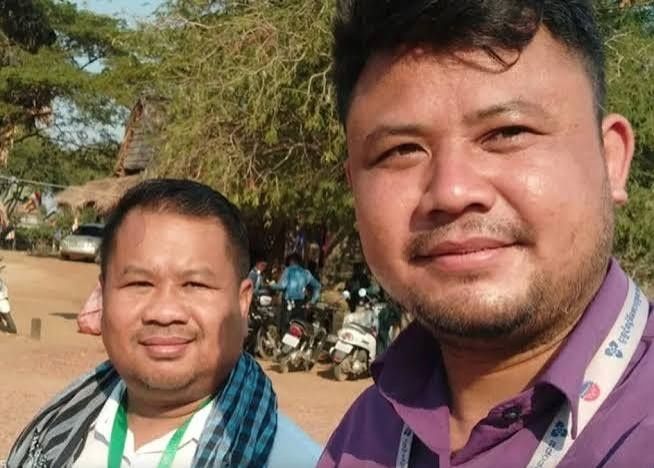
Cambodia's Supreme Court was set to deliver a consequential ruling on the appeal of two journalists convicted of treason for documenting photographs from the kingdom's disputed border region with Thailand. The decision on the cases of Phorn Sopheap from Battambang Post TV Online and Pheap Pheara of TSP 68 TV Online held significance far beyond their individual circumstances, as it would test the court's willingness to challenge a government narrative that frames sensitive reporting as a threat to national security.
The two men had been arrested in July the previous year after returning from assignment trips to the border area. Authorities alleged they had entered a restricted military zone without authorisation and subsequently posted photographs on Facebook, violating national security statutes. Both journalists maintained they possessed legitimate permission to access the location where they conducted their documentation work. They appealed to the Supreme Court to overturn verdicts imposed by lower courts, which had sentenced each to fourteen years imprisonment on treason charges.
The photographs themselves became weaponised in the broader regional dispute. One particular image depicting landmines circulated widely through Thai media organisations and became central to Bangkok's assertions that Phnom Penh had deployed newly laid mines along the frontier, resulting in casualties among Thai military patrols. Cambodia's government issued categorical denials regarding any offensive use of mines, contending that the kingdom complied with international conventions prohibiting such weapons. Officials instead attributed any mines discovered in the border region to residual ordnance from the decades-long conflict that concluded in the late nineteen nineties.
The underlying military conflict that prompted the journalists' detention had inflicted substantial humanitarian costs across the region. Clashes erupting in July and December displaced approximately one million civilians across Thai and Cambodian communities and resulted in approximately one hundred military and civilian fatalities. Since a ceasefire took hold in December, no further combat operations materialised, though underlying tensions persisted throughout the region.
Siem Reap Provincial Court's December conviction of the two men had rested on findings that they committed the crime of supplying foreign nations with information detrimental to national defence. This framing proved particularly troubling for international press freedom organisations. The Committee to Protect Journalists, based in New York, characterised Cambodia's approach as instrumental deployment of ambiguous national security legislation to criminalise routine professional journalism. More than a dozen journalism associations, spanning national and international reach, petitioned the government to withdraw prosecution following an appeals court's March confirmation of the convictions.
The Supreme Court hearing arrived amid an intensifying pattern of judicial decisions that critics contended revealed systematic suppression of dissent. Just days earlier, the same institution had upheld the incitement conviction of Rong Chhun, a fifty-six-year-old opposition politician found guilty of inciting social disorder following his meetings with villagers displaced by development initiatives sanctioned by the government. International observers widely interpreted the prosecution as illustrative of Prime Minister Hun Manet's broader strategy to neutralise political opponents through the courts.
Hun Manet assumed power in August twenty twenty-three, succeeding his father Hun Sen, who had governed Cambodia for nearly four decades under what international observers characterised as an authoritarian system marked by systematic human rights violations. The elder Hun Sen's tenure was documented extensively for suppressing fundamental freedoms of expression and assembly. Despite Hun Manet's American education and initial hopes that his succession might signal political opening, the government has demonstrated minimal commitment to liberalisation. Instead, legal mechanisms inherited from the previous administration continue functioning as instruments for constraining critical voices.
Human Rights Watch examined the Rong Chhun decision as revealing evidence of Cambodian courts' fundamental absence of separation from the ruling party's interests. Cambodia's government countered such characterisations with assertions that its Supreme Court operated with complete institutional independence. However, such official denials carried diminished credibility given the consistent pattern of convictions targeting political opponents and critical journalists.
Cambodia's position in global press freedom rankings underscored the severity of the deterioration. The Paris-based Reporters Without Borders organisation placed Cambodia at one hundred sixty-first among one hundred eighty territories assessed in its twenty twenty-five World Press Freedom Index, situating it within the category of states where press freedom conditions merit classification as very serious. This standing reflected Cambodia's trajectory from a post-conflict period characterised by tentative democratic opening toward an increasingly consolidated system restricting information flows and public discourse.
The Supreme Court's decision on the journalists' appeal would signal whether Cambodia's highest judicial institution retained any capacity or willingness to impose restraint on government overreach. For Malaysia and other Southeast Asian nations monitoring Cambodia's governance trajectory, the ruling would illuminate the region's broader democratic prospects. Should the court uphold the convictions, it would effectively acknowledge that documentation of military activities in border zones constitutes prosecutable treason, establishing a chilling precedent for conflict reporting across Southeast Asia. Conversely, should judges overturn the sentences, Cambodia would demonstrate marginal judicial independence—a modest but significant counterbalance to executive power.

