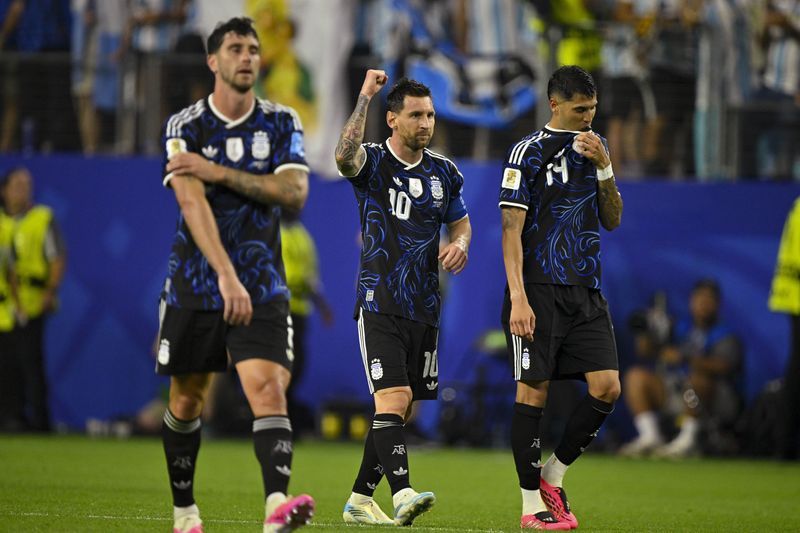
Cape Verde's remarkable first World Cup campaign faces its ultimate test on Friday when the African nation confronts world champions Argentina in a last-16 decider that will determine whether this improbable World Cup story continues or comes to an end. Coach Bubista, a former centre-back, has steered his unfancied squad through the group stage with a refreshingly bold philosophy that refuses to treat bigger opponents with deference, and he is adamant that mindset will remain unchanged when facing Lionel Messi and his star-studded Argentine teammates.
The small island nation from West Africa, ranked 67th in the FIFA world rankings at the tournament's start, has already exceeded expectations by reaching the knockout phase. Their passage to the last 16 came courtesy of finishing second in a competitive group containing some of world football's traditional heavyweights, a feat that has transformed perceptions of what Cape Verde can achieve at the international level. Bubista's confidence in his team's ability is rooted in tangible evidence gathered over their opening three matches, where they produced performances suggesting they genuinely belong on this stage.
Cape Verde's group-stage results illustrate the depth of their tactical improvement and mental resilience. Draws against Spain, Uruguay, and Saudi Arabia represent more than mere mathematical points; they represent a statement that the islanders can compete with established football nations without resorting to defensive hibernation or playing for a fortunate result. Each encounter demonstrated an understanding of how to execute their system against different styles of play, adapting their approach while maintaining the core principles that have defined their campaign. Bubista's consistency in messaging throughout the tournament has been vindicated by these results, suggesting that the team's fearless approach is neither recklessness nor bravado but rather a calculated reflection of genuine competitive capability.
When discussing the Argentina encounter, Bubista framed it as a continuation rather than a departure from Cape Verde's established methodology. Speaking to reporters at Miami Stadium, he articulated a clear objective: to perform well enough to secure passage to the next round, emphasising that his team earned the right to be in this competition through the qualifying tournament and then reinforced that claim by finishing second in their group. This framing is significant because it shifts the narrative away from Cape Verde being fortunate underdogs to being a legitimate participant whose presence is justified by merit. The qualification process involved navigating competitive African football, and their group-stage performance demonstrated they can sustain that level of play across multiple matches.
Bubista's respectful yet confident tone reflects the diplomatic balance required when facing a behemoth like Argentina. He acknowledged the quality of Lionel Scaloni's coaching and the exceptional talent possessed by Messi and his teammates, yet he did not permit that acknowledgement to undermine his own conviction in Cape Verde's potential. The coach insisted that respect must be mutual, that Cape Verde has earned consideration as serious competitors rather than makeweight participants included merely to fill tournament slots. This perspective, while confident, avoids the trap of arrogance; instead, it represents a coach asserting his team's dignity and right to compete at this elevated level.
An interesting tactical dimension emerged in Bubista's discussion of how to approach Messi. Rather than devising specific schemes to neutralise the Argentine superstar, Bubista indicated that Cape Verde would focus on understanding and countering Argentina as a complete unit. This approach suggests maturity in the coaching staff's thinking; attempting to build an entire game plan around stopping one player, however extraordinary, risks leaving other threats inadequately addressed and disrupting team shape. By maintaining their identity and organisational structure while respecting Argentina's collective threat, Cape Verde can remain true to the principles that carried them this far while still acknowledging the challenge posed by world-class opposition.
The broader context for Southeast Asian observers lies in understanding how smaller football nations can punch above their weight through proper organisation and tactical discipline. Cape Verde's progression offers a template for how nations outside the traditional football establishment can compete effectively when they combine genuine talent with intelligent coaching and unwavering self-belief. The parallel to how regional teams might approach matches against traditional powers becomes apparent when viewing Cape Verde's philosophy: they are not attempting to become Argentina, nor are they attempting to park the bus and hope for penalties, but rather playing their own game with conviction.
Bubista's emphasis on humility, organisation, and courage as Cape Verde's pillars encapsulates the approach that has brought them to this juncture. Humility prevents complacency and keeps the squad focused on collective effort rather than individual heroics. Organisation provides the tactical framework that allows a less naturally gifted squad to compete with superior talent. Courage is perhaps most essential; without it, the other two virtues collapse into timid football that squanders opportunities and invites domination. These three elements interact to create an identity that can challenge Argentina's technical superiority through structural advantage and mental fortitude.
The knockout format adds another psychological dimension to Friday's contest. This is no longer about accumulating points or managing a campaign across multiple games; it is about one performance determining everything. Cape Verde's entire World Cup participation reduces to 90 minutes against the sport's reigning champions. This concentration of stakes could either paralyse a young football nation or liberate them to perform without the weight of expectation that typically burdens favourite nations. Bubista's track record of maintaining consistent messaging suggests his squad will approach the match with the same mindset they brought to their previous encounters: competitive, organised, and genuinely attempting to win rather than hoping to survive.
For the wider football world and for African football specifically, Cape Verde's campaign has already generated value through demonstrating that competitive football at the highest level requires talent and organisation rather than merely large budgets or historical pedigree. A victory against Argentina would represent one of football's great shocks, but even should Cape Verde fall short, they have already altered perceptions about what African nations can achieve. Their journey illustrates how coaching excellence, player development, and tactical intelligence can elevate a squad beyond what raw talent alone would suggest possible.
As Cape Verde prepares to face Argentina, the narrative encompasses far more than three points or qualification status. It represents a test of whether an emerging football nation can sustain its challenge against established hierarchy, whether bold ambition without resources can compete with tradition and talent, and whether a coach's unwavering belief in his team's abilities can translate into results when everything is on the line. Bubista and his players have already written an admirable chapter in World Cup history; Friday's match offers them the opportunity to extend that story further.

