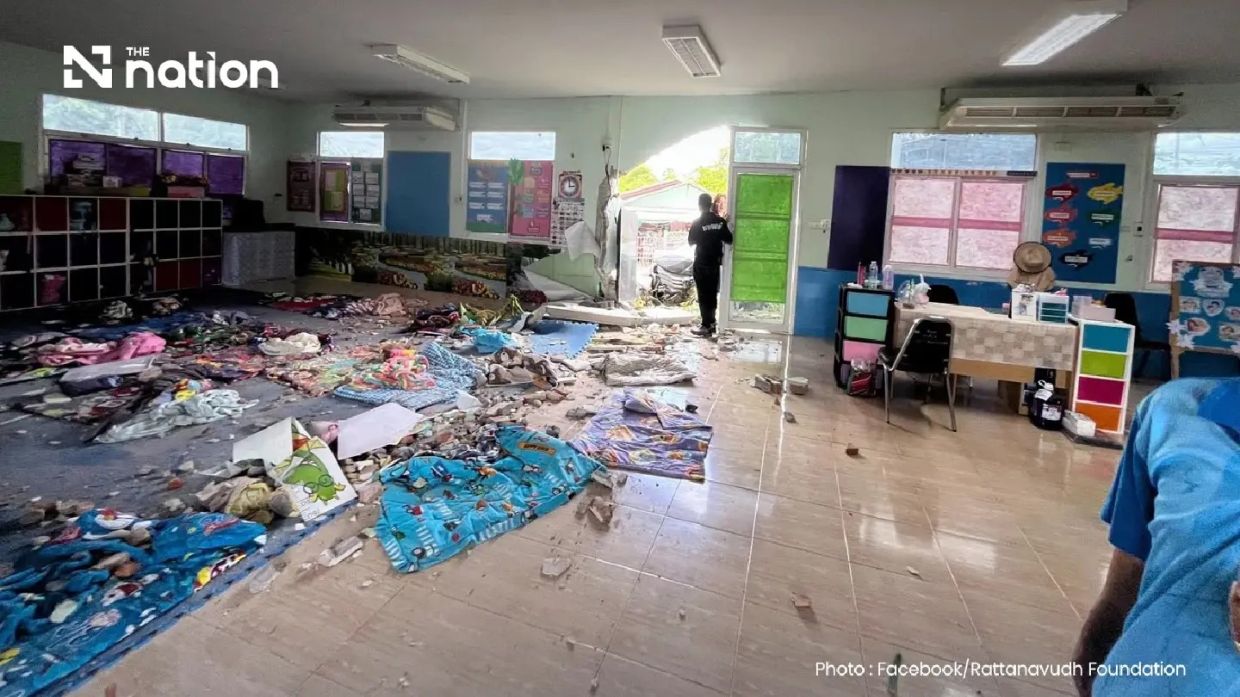
A private saloon car careened out of control and ploughed into the Ban Nong Song Ton Child Development Centre in Kanchanaburi on Friday, August 7, 2026, leaving 15 children injured in what residents described as a shocking and distressing incident. The vehicle struck a classroom inside the facility in Mueang Kanchanaburi district where young children were settling down for their afternoon nap, catching staff and caregivers off guard during what should have been a routine part of the daily schedule.
The impact was forceful enough to damage the structural integrity of the building and destroy items within the classroom where the collision occurred. Children at the facility suffered head wounds and injuries from debris and broken fragments scattered across the room. Beyond the physical trauma, many of the youngsters were severely shaken by the sudden and violent intrusion into their safe space. Emergency services responded swiftly after the Rattanavudh Foundation received an alert about the accident and immediately mobilised rescue personnel to the scene.
Among the 34 children present at the facility that afternoon, 15 sustained injuries that required immediate medical attention. The remaining 19 children escaped unharmed, though they were undoubtedly frightened witnesses to the chaotic incident. Staff members and workers from both the Rattanavudh Foundation and the Phithak Kan Foundation converged on the site to assess the situation and administer first aid to the injured children while emergency medical teams prepared for evacuation.
Rescue operations moved with urgency as transport vehicles carrying the injured children made their way to Phaholpolpayuhasaena Hospital. Local residents along the route through Mueang Kanchanaburi district cooperated with authorities by clearing the way for emergency vehicles, ensuring that the children could receive professional medical examination and treatment without delays. The coordinated response from multiple organisations and community members demonstrated the kind of rapid mobilisation that characterises responses to child welfare emergencies across the region.
Hospital assessments provided reassuring news in the aftermath of what could have been a far more catastrophic incident. Medical staff confirmed that all 15 injured children, after being examined at Phaholpolpayuhasaena Hospital, were found to be safe and stable. A teacher at the facility subsequently provided updated information confirming that while the injuries required hospitalisation, the children's conditions were not life-threatening. The psychological impact on the young victims remained a concern, however, as exposure to such traumatic events at a formative age can have lasting effects.
Childcare facility incidents of this nature raise serious questions about safety protocols and the proximity of educational institutions to areas where vehicle accidents can occur. Kanchanaburi, situated along major transport routes in western Thailand, experiences significant traffic flow, and the location of childcare centres relative to roads with regular vehicular activity becomes a pertinent issue for parents and policymakers. The vulnerability of young children, who depend entirely on adults for protection, makes such incidents particularly alarming for communities throughout the region.
Similar accidents at educational facilities have periodically occurred across Southeast Asia, prompting authorities to reconsider traffic management, building positioning, and protective barriers around schools and childcare centres. The Ban Nong Song Ton Child Development Centre, like many facilities in Thailand and across the region, may now face pressure to implement additional safety measures such as protective barriers, speed-reducing infrastructure, or modified access routes to prevent vehicles from entering areas where children gather. Such considerations reflect the broader challenge of balancing urban development with child safety in rapidly changing communities.
For parents whose children attend childcare facilities, incidents like this trigger immediate concerns about whether their youngsters are genuinely protected during the hours they spend away from home. The reassurance that the injured children were confirmed safe by medical professionals may provide some comfort, but the event itself has likely intensified anxiety among families in Kanchanaburi about the safety standards maintained at local institutions. Facility operators across the region will likely face heightened scrutiny and may be prompted to review their own risk assessment procedures.
The response by rescue workers, medical personnel, and community members in Kanchanaburi demonstrates the capacity for coordinated action during emergencies, yet such responsiveness is a reactive measure rather than a preventive one. Moving forward, attention should focus on whether the circumstances that led to the vehicle losing control can be identified and addressed. Whether the incident resulted from mechanical failure, driver error, or external factors will be important for determining what preventive measures might be implemented across similar facilities and traffic-prone areas in Thailand and neighbouring countries.

