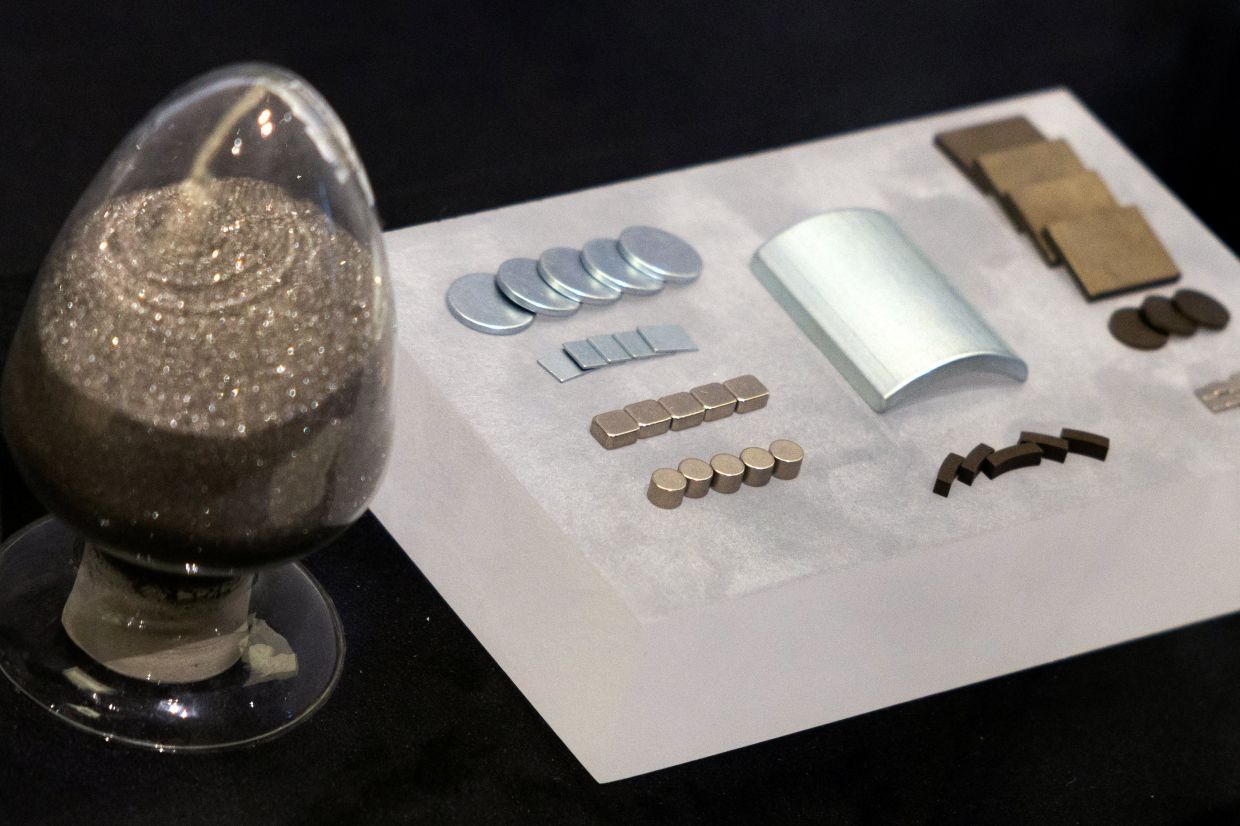
China is intensifying its scientific engagement with Iran by channelling resources into rare earth exploration and processing—a move that underscores Beijing's determination to diversify its access to these strategically vital materials as geopolitical tensions mount. The collaboration, facilitated by China's National Natural Science Foundation and Iran's National Science Foundation, represents a calculated expansion of technical cooperation into a sector fundamental to modern military and industrial capabilities.
Rare earth elements constitute a cluster of 17 metals possessing distinctive magnetic and electronic properties that have become indispensable across weapons systems ranging from advanced missiles and fighter aircraft to sophisticated radar installations and guidance systems. Their scarcity and concentrated production have made control over rare earth supply chains a flashpoint in contemporary great power competition. The decision by Beijing to focus collaborative efforts with Tehran on this particular domain reflects China's strategic assessment of Iran as a potential source of supply diversity in an increasingly contested global landscape.
The partnership structure reveals careful attention to logistics and sustainability. China's National Natural Science Foundation will allocate 30,000 yuan—approximately US$4,200—per workshop to cover operational costs encompassing meeting arrangements, accommodation, and domestic transportation. Iran's National Science Foundation will manage international travel arrangements for Iranian researchers and lodging for Chinese delegations travelling to Iran. This phased funding mechanism demonstrates a commitment to building institutional capacity rather than pursuing extractive short-term agreements.
The timing of this collaboration is particularly significant given mounting pressure on global supply chains. In recent weeks, the Trump administration committed US$3 billion toward critical mineral and battery infrastructure projects explicitly designed to replenish military stockpiles and reduce American dependence on Chinese sourcing. These investments represent Washington's recognition that technological self-sufficiency in rare earth processing has become a national security imperative. China's pivot toward Iran can be interpreted as a countermeasure to anticipated Western efforts to establish alternative supply networks.
China currently commands an overwhelming position in global rare earth markets, possessing the world's largest documented reserves while controlling the majority of extraction and processing infrastructure. Beyond its dominant market position, Beijing has systematically restricted the international transfer of rare earth processing technologies, creating a structural advantage that compounds its geological endowment. When Donald Trump initiated trade hostilities with China in 2023, Beijing weaponised this advantage by implementing rare earth export controls that rippled through American manufacturing sectors and starkly illustrated Washington's vulnerability.
Iran's rare earth potential presents both promise and uncertainty. Geological surveys have identified rare earth anomalies spanning approximately 7,000 square kilometres across central Iran, concentrated in iron ore and phosphate formations that are geologically favourable for rare earth concentration. Analysis conducted by the Hague Research Institute in February documented these deposits, yet their precise magnitude and economic viability remain incompletely assessed. Critically, Iran's current extraction and processing infrastructure operates at a nascent stage, still far removed from the industrial scale necessary for meaningful commercial production.
The bilateral relationship between Beijing and Tehran through their respective science foundations traces back to 2017, when they executed a memorandum of understanding in the Chinese capital. China has consciously positioned Iran within its Belt and Road Initiative framework, emphasising technology cooperation as a vehicle for mutual development. Since 2017, the foundation partnership has funded research initiatives spanning mathematics, biology, medical sciences, renewable energy systems, materials engineering, climate science, and artificial intelligence. This diversified portfolio creates both legitimate scientific engagement and provides institutional cover for targeted cooperation in sensitive sectors.
The joint workshop scheme itself commenced in 2024 with an initial cohort addressing climate change, artificial intelligence, advanced materials, and manufacturing processes, with individual workshop budgets of 150,000 yuan. The current iteration expands this architecture to encompass rare earth exploration and processing alongside nano materials for medical diagnostics, environmental monitoring systems, earthquake-resistant construction methodologies, and sustainable manufacturing. This expansive framing obscures the strategic prioritisation of rare earth cooperation within a broader science-and-technology partnership narrative.
For regional observers, particularly in Southeast Asia, this collaboration carries implications extending beyond bilateral Sino-Iranian relations. The acceleration of rare earth cooperation reflects Chinese strategic planning for extended supply chain disruption scenarios and potential confrontation with Western powers over technology and resource access. Malaysia, as a significant processor of rare earth materials and a regional economy vulnerable to supply chain volatility, faces both opportunity and risk. Chinese efforts to cultivate alternative rare earth sources through Iran could ultimately stabilise global supply chains, yet might simultaneously diminish the strategic value of Malaysian processing capabilities if Beijing succeeds in integrating Iranian extraction directly with Chinese downstream industries.
The deeper analytical frame reveals Beijing's multi-track approach to securing strategic resources during an era of intensifying technological competition. Rather than relying exclusively on existing reserves and market dominance, Chinese planners are systematically developing new sources while restricting rival access to processing expertise and infrastructure. Iran, isolated by Western sanctions and seeking technology partnerships, presents an attractive counterpart for Chinese expansion into underdeveloped rare earth resources. This arrangement aligns with broader patterns of Chinese strategic investment in sanctions-affected economies that possess geological or resource advantages.

