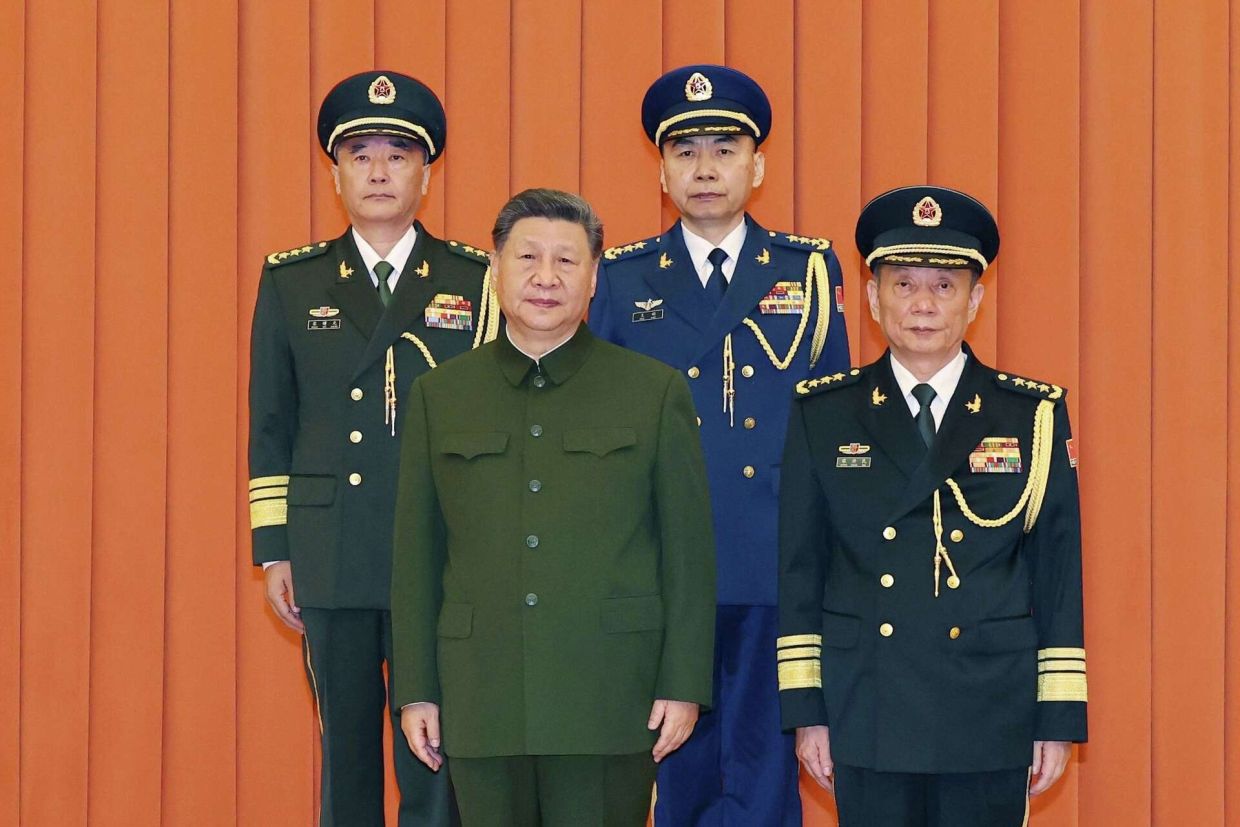
China's military establishment has advanced two senior officers to the rank of general in what appears to be strategic manoeuvring ahead of substantial reorganisation within the defence hierarchy. The promotions of Zhang Shuguang and air force commander Wang Gang, announced at a formal ceremony on Friday, July 3, signal Beijing's intention to reshape its highest command structure following several years of sweeping anti-corruption investigations that have removed prominent military leaders.
The timing and scope of these promotions carry significant implications for how Chinese President Xi Jinping consolidates control over the People's Liberation Army. As concurrent head of the Communist Party and chairman of the Central Military Commission—China's supreme military decision-making body—Xi has used the anti-corruption apparatus to systematically remove rivals and strengthen his personal authority. The two new generals are now positioned as potential candidates to fill critical vacancies created by the departures of previous leaders, fundamentally reshaping the military's upper echelon.
Zhang Shuguang's elevation proves particularly consequential given his concurrent appointment as head of the division responsible for investigating corruption within the Central Military Commission itself. This dual role underscores the integration of anti-corruption enforcement with military leadership restructuring, allowing Zhang to simultaneously oversee investigations and consolidate institutional influence. His promotion reflects the blurred boundaries between party loyalty mechanisms and formal military advancement in contemporary Chinese governance.
The composition of the Central Military Commission has been substantially transformed by ongoing investigations. The seven-member body has been reduced to functional operation by merely two active members: Xi as chairman and Vice Chair Zhang Shengmin. Two former vice chairs, including the military's highest-ranking general prior to the purge, have been removed or effectively sidelined through the investigation process. This dramatic depletion of senior leadership creates both operational challenges and opportunities for restructuring institutional hierarchies according to current political preferences.
Wang Gang's promotion as air force commander reflects the broader pattern of elevating officers whose loyalty to Xi's vision remains unchallenged by independent power bases. The Chinese air force has undergone significant modernisation initiatives over the past decade, and elevating its commanding officer to general rank signals continued emphasis on aerospace capabilities within strategic planning. However, the promotion must also be understood within the context of ensuring military institutional obedience to party directives.
The timing of these promotions suggests preparation for a comprehensive restructuring expected in autumn of the following year, when the current Central Military Commission's five-year term concludes. The announcement pattern—with vacancies now apparent and replacement candidates identified—follows established Chinese Communist Party protocols for managing elite transitions. Rather than abrupt institutional disruption, the party typically stages leadership changes across multiple phases, allowing subordinate officials time to demonstrate alignment and establish networks supporting the incoming structure.
For regional observers, particularly those in Southeast Asia and the Indo-Pacific, these military promotions warrant close attention. China's military modernisation and strategic posture directly affect regional security dynamics and maritime tensions. The anti-corruption campaign, while presented as internal housekeeping, has removed experienced senior commanders and potentially disrupted institutional knowledge and operational continuity within the PLA. Simultaneously, the elevation of Xi-aligned generals may accelerate military assertiveness aligned with party preferences regarding territorial claims and regional influence.
The anti-corruption drive that precipitated these vacancies has extended far beyond the military, touching civilian Communist Party officials, state enterprise leaders, and security apparatus personnel. This comprehensive campaign has served multiple purposes: eliminating potential rivals to Xi's authority, reducing factional competition within party leadership, and projecting an image of disciplined governance to the Chinese public. Within the military specifically, the investigations have targeted officers associated with previous power structures and those potentially sympathetic to alternative leadership factions.
The Central Military Commission's dramatic thinning raises questions about interim decision-making processes during the extended vacancy period. With only two active members managing an institution responsible for commanding approximately two million service members and directing military-industrial resources, the commission's operational capacity depends heavily on subordinate structures and the personal authority wielded by Xi as chairman. This concentration of decision-making authority within Xi's hands represents a significant consolidation of power over defence institutions.
The expected autumn reorganisation will likely introduce additional officers to the commission, but their selection appears predetermined by patterns evident in these promotions. Candidates who advance will presumably demonstrate unambiguous loyalty to Xi's strategic vision, experience within party-aligned institutions, and absence of independent political constituencies. This process effectively transforms China's military leadership into a more personalised apparatus directly responsive to the supreme leader's preferences.
For Malaysia and other Southeast Asian nations, understanding these institutional changes provides valuable context for assessing China's future military conduct. The removal of senior commanders with potentially greater institutional conservatism and replacement with Xi-aligned officers may affect Beijing's calculus regarding strategic competition, maritime operations, and bilateral military-to-military relations. The purges have also created generational transitions that could shift institutional cultures within the PLA toward approaches more reflective of Xi's nationalist and assertive strategic preferences.
The broader significance of these promotions extends beyond military administration to reflect the Communist Party's fundamental approach to maintaining control through elite management. By integrating anti-corruption investigations with leadership advancement, Beijing reinforces party supremacy over military institutions while positioning itself as combating systemic corruption. The generals promoted through this process carry implicit obligations to the party structures that elevated them, creating network effects that reinforce party control throughout military hierarchies.

