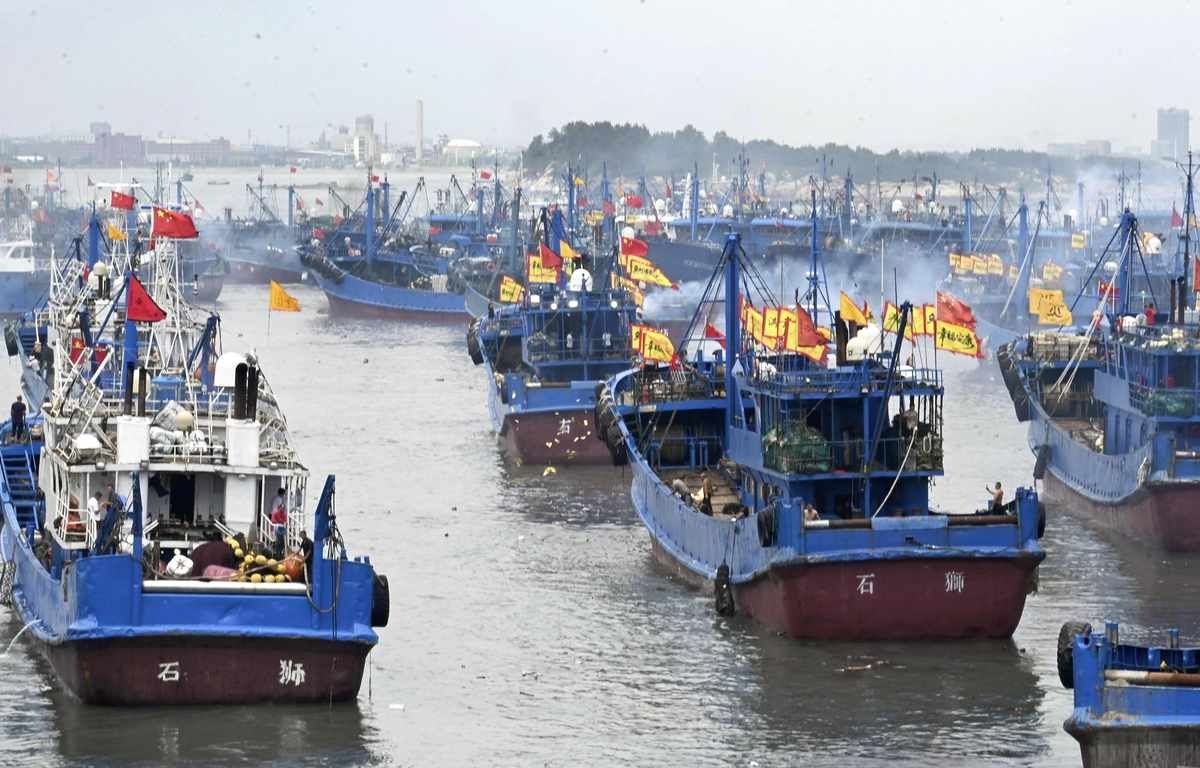
The resumption of fishing activities in contested waters of the East China Sea marks a potentially significant moment in deteriorating Sino-Japanese relations. With China's August 15 lifting of its annual fishing moratorium, hundreds of vessels departed Chinese ports on August 16, signalling the beginning of an intense fishing season that Japan will monitor with considerable apprehension. The situation carries historical weight, given that maritime disputes and fishing incidents have repeatedly inflamed tensions between the two nations and complicated regional stability across the broader Asia-Pacific.
On the morning of August 16 alone, approximately 654 fishing boats set out from the port city of Shishi in Fujian Province, many displaying Chinese national flags alongside the customary red and yellow banners symbolising hopes for safety and abundant catches. The ceremonial departure, complete with firecrackers fired from departing vessels, reflected the cultural significance of the fishing season reopening. However, this traditional maritime activity unfolds against a backdrop of geopolitical sensitivity, as these waters overlap with Japanese claims to the Senkaku Islands—an archipelago that remains one of Asia's most intractable territorial disputes.
Historical precedent demonstrates the volatility inherent in this situation. In August 2016, Chinese Coast Guard vessels and between 200 to 400 fishing boats concentrated around the Senkaku Islands in what appeared to be a coordinated operation, with incursions into Japanese territorial waters confirmed by Tokyo authorities. Japan lodged formal protests, characterising China's actions as unilateral escalation designed to heighten regional tensions. Analysts at the time linked the incident to China's defiant response following The Hague's Arbitral Tribunal ruling in July 2016, which rejected China's expansive sovereignty claims in the South China Sea. Tokyo had demanded Beijing accept the tribunal's verdict, and the subsequent maritime activity suggested a calculated assertion of Chinese interests in response to international legal pressure.
The regulatory framework governing fishing activities has historically served as a pressure valve for managing these tensions. In recent years, Chinese local government bodies have instructed fishermen to avoid operating in what authorities characterise as sensitive waters. This directive appears to reflect Beijing's awareness that maritime accidents or confrontations could spiral into broader diplomatic crises with Japan. The effectiveness of these informal constraints becomes evident in the statistical record: Japan's Coast Guard issued only four warnings to Chinese fishing vessels in the Senkaku territorial waters in 2025, a dramatic decline from 81 warnings in 2021. This reduction suggests that either Chinese compliance improved significantly or that vessels have altered their behaviour to avoid detection and interception.
Yet subtle shifts in official language signal potential changes in Beijing's operational calculus. On August 7, authorities in Quanzhou—the city administering Shishi—called for enhanced surveillance of sensitive waters, a statement that could be interpreted either as a commitment to restraint or as preparation for increased activity requiring closer management. More tellingly, the content of official notices to fishermen has shifted in revealing ways. Last year's circular explicitly warned against fishing in sensitive waters adjacent to South Korea, North Korea, and Japan. However, the notice issued on April 30 this year conspicuously omitted any reference to Japanese waters, restricting its prohibition to the interim measures area between China and South Korea. This semantic evolution, whether intentional or not, has prompted diplomatic observers to advocate for heightened vigilance.
The perspectives of individual fishermen provide crucial insight into the complex interplay between government directives, commercial incentives, and risk assessment. A fisherman in his fifties, speaking on condition of anonymity with journalists in Shishi, articulated the tension inherent in these restrictions. He acknowledged that the waters surrounding the Senkaku Islands constitute exceptionally productive fishing grounds, implicitly suggesting that economic incentives remain powerful. Simultaneously, he noted that while Chinese authorities conduct surveillance to prevent unauthorised fishing in sensitive areas, no explicit prohibition has been issued. This ambiguous situation creates a zone of plausible deniability: fishermen can justify operations in contested waters by pointing to the absence of formal bans, while authorities can maintain that they have not explicitly sanctioned such activities.
The broader context of Sino-Japanese relations cannot be divorced from this maritime dimension. Tensions between Tokyo and Beijing have intensified across multiple domains in recent years, encompassing economic competition, military modernisation, and competing visions for regional order. The East China Sea fishing dispute represents a tangible manifestation of these deeper strategic anxieties, particularly as China's growing naval capabilities and assertive maritime behaviour concern Japan and its allies. For Japanese policymakers, the reopening of the fishing season represents not merely an agricultural or commercial matter but rather a test of Beijing's willingness to exercise restraint and respect established international norms governing maritime conduct.
The implications extend beyond bilateral Japan-China dynamics to affect the broader Southeast Asian region and international stakeholders with interests in freedom of navigation and rules-based order in the Indo-Pacific. China's fishing ban system, ostensibly an environmental conservation measure, has repeatedly served as a mechanism for coordinating maritime activities with geopolitical objectives. The lifting of restrictions therefore carries symbolic weight as well as practical consequences. Other Southeast Asian nations, particularly those with maritime disputes involving China, watch the situation closely to discern whether Beijing intends to intensify assertiveness in contested areas or maintain existing patterns of activity.
The monitoring posture adopted by Japan reflects the fundamental asymmetry in maritime capability and strategic interest. Japan possesses advanced Coast Guard capabilities and sophisticated surveillance systems enabling detailed observation of vessel movements. However, managing hundreds of fishing boats operating in a vast maritime expanse presents considerable operational challenges. The distinction between legitimate fishing, inadvertent boundary violations, and deliberate incursions becomes legally and diplomatically fraught. Previous incidents have demonstrated how accidents or minor transgressions can rapidly escalate into significant diplomatic incidents if either side interprets them as provocative or indicative of broader strategic intent.
Looking forward, several potential scenarios merit attention. If Chinese fishing vessels demonstrate restraint and remain outside the Senkaku territorial waters despite economic incentives to venture into these productive grounds, it could signal Beijing's commitment to preventing escalation despite deteriorating overall relations. Conversely, a resumption of large-scale incursions into Japanese waters would indicate that strategic assertiveness has superseded concerns about diplomatic consequences. The actual conduct of Chinese fishermen and the responses of Chinese Coast Guard coordination will provide crucial indicators of Beijing's intentions regarding maritime disputes in the East China Sea.

