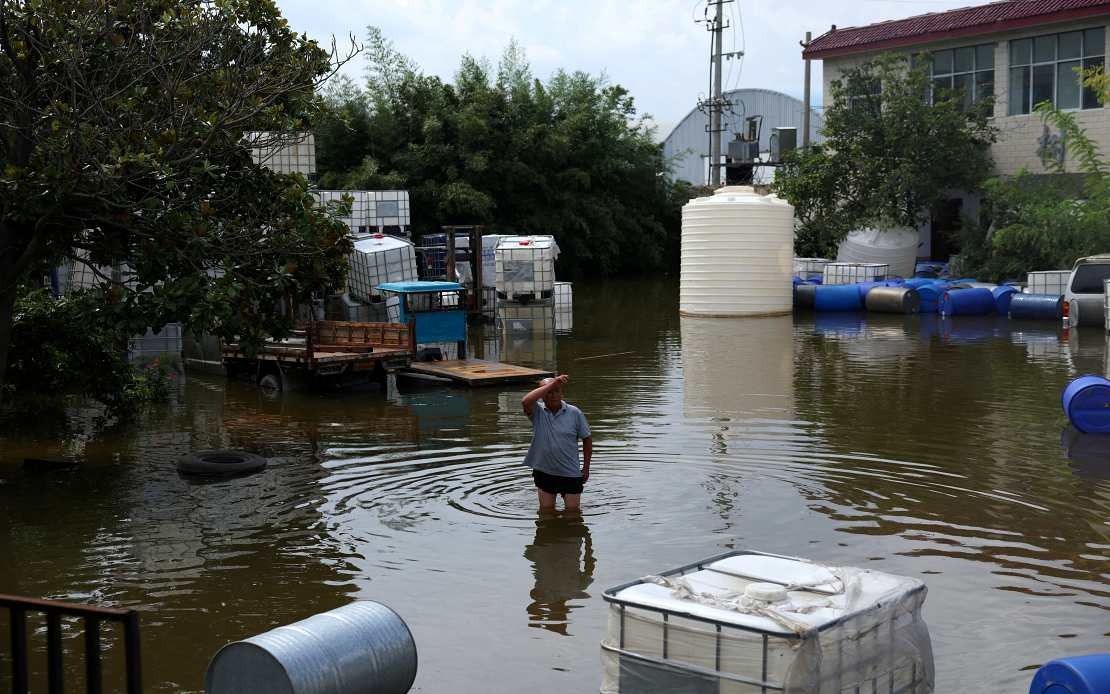
China's Ministry of Emergency Management has responded swiftly to a natural disaster unfolding in Zhoukou City, dispatching substantial rescue resources after a critical infrastructure failure Friday. The levee collapse occurred late Thursday evening following intense rainfall generated by the remnants of Typhoon Dolphin, the 13th named storm to impact the region this year. The breach allowed floodwaters to inundate communities across central Henan Province, prompting authorities to activate emergency protocols and coordinate a multi-agency response to protect citizens and restore essential services.
The immediate rescue deployment reflects Beijing's standardised approach to major disasters, with the Ministry of Emergency Management organising a specialised task force comprising 200 engineering rescue personnel drawn from China Anneng Group, a state-controlled enterprise with expertise in complex recovery operations. Accompanying the personnel is an impressive array of 110 sets of large-scale engineering equipment, essential machinery designed to stabilise damaged infrastructure, remove debris, and restore access routes through flooded zones. These specialist teams arrived in Zhoukou on Friday and immediately integrated with ongoing emergency operations, substantially augmenting the capacity of local authorities to manage the scale of devastation.
The National Commission for Disaster Prevention, Reduction and Relief formalised the emergency response by triggering a Level-IV national disaster relief protocol on Friday, elevating the Henan situation to official national significance. This designation facilitates rapid coordination between central government agencies and provincial administrations, ensuring resources flow efficiently to affected populations. Typhoon Dolphin's intensity and the resulting rainfall exceed typical seasonal patterns for the region, creating cascading challenges as saturated ground and overwhelmed waterways created multiple failure points in the aging infrastructure protecting populated areas.
Recognising the scale of humanitarian need, China's central government has allocated 30,000 items of disaster relief supplies specifically for deployment across Zhoukou, Xuchang, and neighbouring municipalities affected by the typhoon's destructive passage. These provisions include folding beds, summer quilts, and comprehensive family emergency kits—practical resources addressing the immediate shelter and comfort needs of displaced residents. The composition of relief packages reflects careful planning; summer quilts acknowledge the tropical climate even after flooding, whilst family emergency kits provide basic medical and sanitation items essential during post-disaster periods when public health risks escalate rapidly.
The logistics operation coordinating supply distribution involves three major state institutions functioning in parallel: the Commission's own administrative office, the Ministry of Emergency Management, and the National Food and Strategic Reserves Administration. This tripartite arrangement pools expertise across disaster response, emergency logistics, and national resource management, creating redundancy and specialisation that accelerates delivery to communities. The Friday dispatch of supplies demonstrates the pre-positioning and rapid-mobilisation systems Chinese authorities maintain for seasonal disaster scenarios, though the levee breach suggests these systems faced unexpected challenges from infrastructure vulnerabilities.
For Malaysia and Southeast Asian neighbours, the Zhoukou disaster illustrates vulnerabilities in aging water management infrastructure across the broader region. Many nations share similar challenges: dense settlement patterns downstream from dams and levees constructed decades ago, tropical weather systems generating extreme rainfall, and competing demands for water resources. The Chinese response—involving heavy equipment deployment, centralised supply chains, and coordinated inter-agency operations—represents a scalable model. However, regional economies with more limited state capacity may struggle replicating this response intensity, highlighting the importance of preventive infrastructure investment and international cooperation in transboundary river systems.
Typhoon Dolphin's trajectory across Henan underscores how tropical storm systems intensifying over warming oceans can reach inland provinces with destructive force. The remnants that triggered the levee breach travelled far from the coast, demonstrating that inland regions cannot assume immunity from maritime weather phenomena. Climate adaptation planning throughout East and Southeast Asia must account for these extended impact zones, particularly for critical infrastructure in river valleys and lowland agricultural zones that form the economic foundation of major cities.
The levee breach itself raises fundamental questions about infrastructure resilience standards. Chinese levees protecting urban centres like Zhoukou represent critical assets protecting millions of residents, yet this failure occurred despite supposedly modern engineering oversight. Whether the breach resulted from construction quality, inadequate maintenance, design specifications unsuited to contemporary climate intensity, or simply bad luck during a particularly severe rainfall event remains unclear from official announcements. Independent analysis of failure causes would provide valuable lessons for other jurisdictions managing similar assets under comparable climatic stress.
The mobilisation of rescue personnel and resources by the Ministry of Emergency Management, whilst impressive in scale, also illustrates how disaster response remains reactive rather than preventive. The 200 personnel and 110 equipment sets address consequences after infrastructure has already failed and communities have already suffered displacement and property loss. For Malaysian policymakers monitoring the response, the most pertinent lesson concerns the necessity of proactive infrastructure assessment and upgrade programmes. Reviewing dam and levee integrity before typhoon season, upgrading critical water management systems, and ensuring maintenance budgets receive adequate funding would prevent situations where rescue operations become necessary.
The Level-IV disaster response designation activates institutional mechanisms designed for managing large-scale emergencies, yet questions persist about whether these bureaucratic frameworks adequately address the immediate psychological and material trauma experienced by ordinary residents losing homes and livelihoods. The provision of relief supplies, whilst essential, cannot restore lost property or compensate for interrupted economic activity. Regional cooperation in disaster preparedness and infrastructure investment might reduce frequency and severity of such events, benefiting populations across China, Southeast Asia, and beyond.

