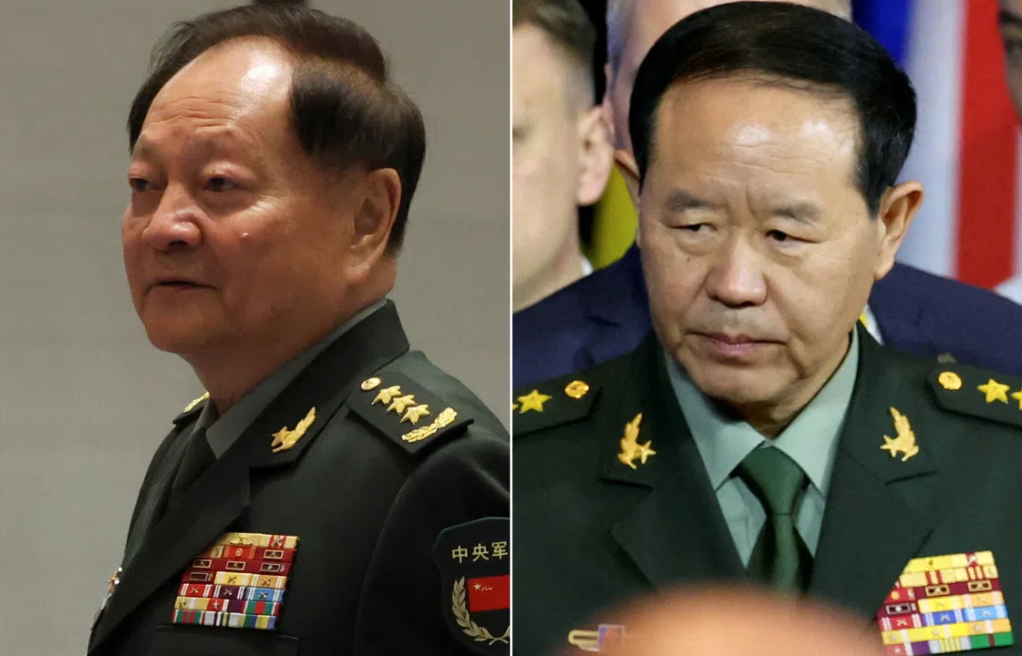
China has removed two high-ranking military commanders from the Central Military Commission, the country's supreme military authority, following investigations into alleged serious breaches of discipline and law. The removals, announced through state media Xinhua, represent a significant restructuring of Beijing's top defence apparatus and underscore President Xi Jinping's continuing campaign to consolidate control over the military establishment through aggressive anti-corruption measures.
The two officials stripped of their positions are Zhang Youxia, who held the position of vice-chairman of the Central Military Commission and ranked among China's most powerful defence officials, and Liu Zhenli, the chief of staff of the CMC's Joint Staff Department. Their departure leaves the commission with only two active members still serving alongside Xi himself, a dramatic reduction from the body's traditional seven-member structure. This depletion reflects the intensity of the disciplinary process sweeping through China's military hierarchy.
Zhang's removal carries particular weight within China's political system. As vice-chairman, he functioned as Xi's second-in-command on military matters and simultaneously held membership in the Politburo, China's most exclusive decision-making council comprising the country's top two dozen leaders. His dual positions underscored his importance in both defence policy and broader party governance. Liu's role, while more specialized, gave him direct authority over the Joint Staff Department's operations, placing him at the centre of military planning and coordination functions.
The purge reflects Xi's deliberate strategy, initiated in 2012, to use anti-corruption investigations as a mechanism for reshaping military institutions and removing potential rivals. The military has consistently been a primary focus of this broader campaign, reflecting historical patterns whereby Chinese leaders have sought to neutralize autonomous power bases within the armed forces. Over the preceding years, this initiative has resulted in the investigation, removal, and formal expulsion of numerous high-ranking officers and officials from senior positions.
Xi's explicit call last month for intensified anti-corruption efforts within military leadership circles signalled an acceleration of this process. Senior party leadership received direct instructions to deepen the fight against corruption, demonstrating that the campaign remains an active priority rather than a concluded initiative. This messaging to top commanders suggests that further disciplinary actions may follow as investigations continue.
The administrative structure of China's military creates a complex backdrop for these removals. The country maintains parallel Communist Party and state Central Military Commission organizations, though these function operationally as a unified institution. Friday's formal announcement concerned only their positions within the state CMC structure, as announced by the Standing Committee of the National People's Congress. Notably, Zhang and Liu have not yet been formally removed from the parallel Communist Party CMC, creating a technical distinction that may reflect evolving circumstances or signal that further actions could follow.
The parliament's updated list of deputies, released Friday alongside the CMC removals, confirmed the personnel changes by eliminating Zhang and Liu's names from official records. This parliamentary action served as formal legal documentation of their loss of formal positions, consistent with how China's state institutions process such changes. Additionally, ten other lawmakers lost their seats in this same revision, though they were not identified as military figures involved in corruption investigations.
The purge extended beyond Zhang and Liu to affect other senior defence and security figures. Lieutenant General Zhong Shaojun, who previously directed the CMC General Office, and General Ju Qiansheng, a former commander of the military's Strategic Support Force, also appeared among those losing their parliamentary positions. These removals indicate a coordinated campaign rather than isolated disciplinary cases. The inclusion of Gao Shiwen, former mayor of Nanchang in southern China and previously associated with China Aerospace Science and Technology Corporation, a major state-owned defence contractor, suggests that civilian officials with military-industrial connections have also fallen within the investigation's scope.
Separately, China's political advisory body stripped Zhao Zongqi, a former commander of the Western Theatre Command, of his membership this week. Zhao's removal carries particular symbolic weight given his command role during the 2020 China-India border clashes, one of the most serious military confrontations Beijing has experienced in recent decades. His loss of position may indicate that investigations into military performance during high-stakes regional conflicts have contributed to personnel changes within leadership ranks.
These developments hold significant implications for Southeast Asia and the broader Indo-Pacific region. Military leadership transitions in China directly affect defence policy formation, strategic decision-making, and the tenor of regional military interactions. The continuing centralization of military authority under Xi through these purges suggests an intensifying concentration of power and potentially greater direct presidential oversight of military operations and strategic initiatives. For neighbouring countries including Malaysia, understanding these internal Chinese dynamics proves essential for anticipating potential shifts in military posture or strategic priorities.
The frequency and scale of these removals also raise questions about institutional stability within China's defence establishment. Continuous high-level turnover can disrupt operational continuity, complicate command relationships, and potentially create uncertainty about authority structures. Yet from Xi's perspective, such disruption represents an acceptable cost for ensuring military loyalty and eliminating potential centres of independent power that might challenge central party authority.

