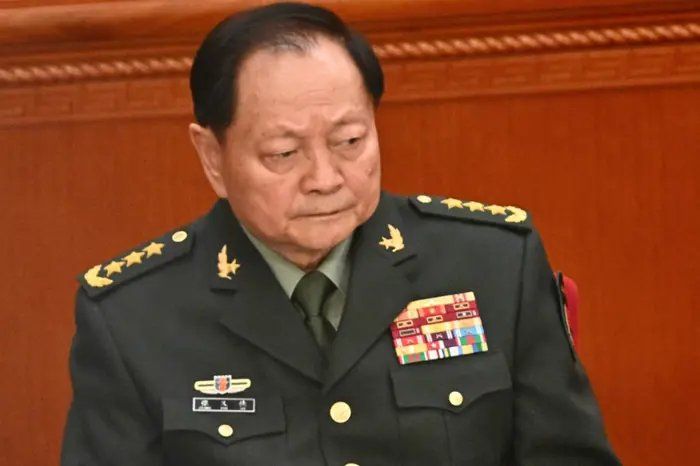
China's government has formally removed Zhang Youxia, a retired senior general, from his role as vice chairman of the Central Military Commission, the country's paramount military authority. The decision came through a formal announcement by parliament's standing committee on Friday, seven months after authorities disclosed that the decorated officer was the subject of an investigation into what state officials characterised as "serious violations of discipline and the law" — terminology that typically signals corruption allegations in the Chinese political system.
The removal represents a dramatic fall for Zhang, who until his dismissal held the distinction of being China's highest-ranking general. His position as the more senior of two vice chairmen on the CMC placed him at the apex of military hierarchy, reporting directly to President Xi Jinping and wielding considerable influence over China's defence strategy and military modernisation initiatives. The timing and scale of his ouster have prompted analysts to scrutinise the political implications within China's leadership structures, particularly given Zhang's perception as someone within Xi's inner circle and his long service record spanning several decades.
The investigation into Zhang was publicly announced in January alongside a parallel inquiry into Liu Zhenli, another prominent CMC member who served as chief of staff of the joint staff department overseeing combat planning and military operations. Both men's simultaneous investigation suggested the possibility of a coordinated crackdown targeting a faction or network within military circles. Liu's removal was formally confirmed alongside Zhang's on Friday, with state news agency Xinhua confirming that he too had been dismissed from his position, though his rank was subordinate to Zhang's.
The phrase used to describe their alleged misconduct — "serious violations of discipline and the law" — carries significant weight within China's political lexicon. This terminology has become the standard nomenclature employed when authorities move against high-level officials suspected of corruption, embezzlement, or bribery. The euphemistic language reflects Beijing's preference for indirect public communication about sensitive internal party matters, yet the severity of the accusation leaves no ambiguity about the gravity of the allegations. Given the scale of Zhang's position, the investigation would likely involve substantial financial or operational misconduct rather than minor infractions.
Zhang's downfall fits squarely into the broader anti-corruption campaign that has dominated Xi's tenure since assuming power in 2012. This sweeping initiative has ensnared hundreds of officials across civilian government, the military, and state enterprises, fundamentally reshaping China's political landscape and consolidating Xi's authority. The campaign has typically targeted both lower-level cadres and senior figures, creating an impression of comprehensive oversight, though critics argue it has also served as a mechanism for eliminating political rivals and consolidating factional control. The inclusion of a figure as senior as Zhang demonstrates that no rank provides immunity from investigation.
What has caught the attention of observers and analysts is the particular shock value of Zhang's removal given his apparent proximity to Xi and his considerable seniority. Unlike some previous anti-corruption targets who were already on the political periphery, Zhang occupied a central position within military governance and was widely understood to enjoy Xi's confidence. His investigation and subsequent removal therefore signal that Xi's consolidation of power remains active and that even trusted lieutenants within the military establishment remain subject to scrutiny and potential removal if they cross organisational or legal boundaries. This dynamic reinforces the highly personalised nature of power within China's system, where loyalty and Xi's confidence remain paramount.
The implications for Malaysia and the Southeast Asian region are worth considering. Changes within China's military hierarchy invariably influence Beijing's strategic calculations and defence policies affecting the region. The CMC vice chairman position carries responsibility for overseeing military modernisation, force projection capabilities, and strategic planning — all areas with direct relevance to regional stability. The specific removal of officers involved in combat planning oversight, as with Liu's position, suggests potential reassessment of military priorities or strategic direction. Regional nations monitoring China's military development and naval expansion in the South China Sea will be watching to understand whether this leadership transition presages any shifts in Beijing's regional approach.
The formal removal process itself demonstrates the procedural structure underpinning China's military governance, where ultimate authority rests with the Communist Party's civil leadership rather than with military bodies themselves. Though the CMC is nominally a state institution, decisions of this magnitude are effectively predetermined through party channels before any formal parliamentary announcement. The involvement of parliament's standing committee in the public announcement lends legitimacy and formal legal standing to the removal, though the real decision-making power lies elsewhere within the party apparatus.
As investigations into Zhang and Liu proceed further, more details may emerge regarding the specific nature of their alleged violations. Chinese state media will likely provide limited information, offering only carefully calibrated statements emphasising anti-corruption commitment without exposing internal divisions or damaging national security information. What remains clear is that Xi's influence over military personnel decisions remains absolute, and that the anti-corruption machinery continues functioning as a tool for managing elite behaviour and consolidating centralised authority within both civilian and military spheres of governance.

