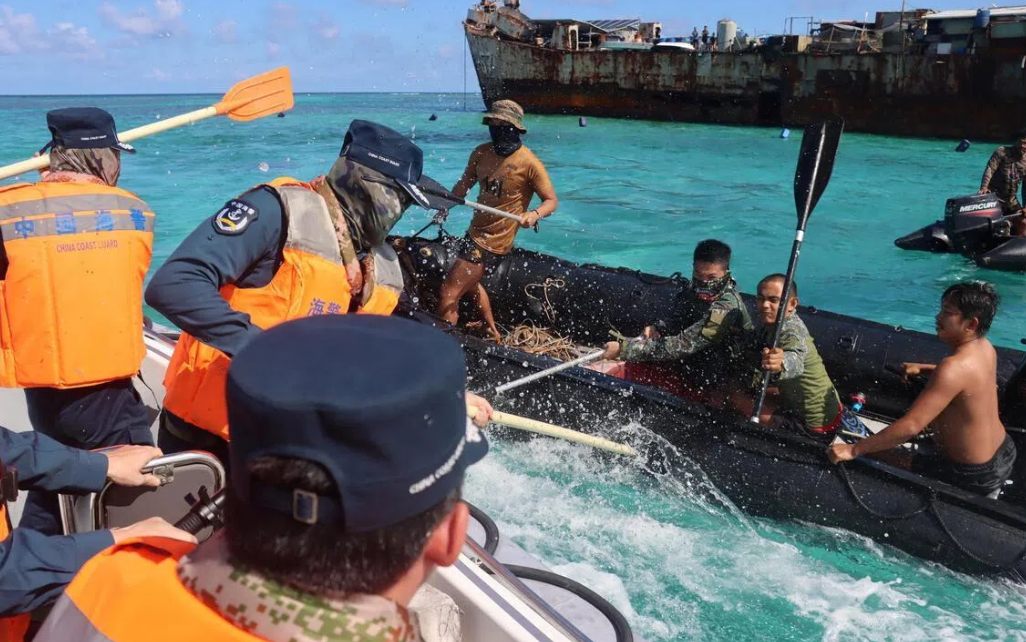
Beijing has formally summoned Manila's ambassador to register its protest against what Chinese officials characterised as provocative Philippine behaviour at Second Thomas Shoal, a contested feature in the South China Sea known locally as Ren'ai Reef. The summons on Tuesday occurred after Monday's incident involving the Chinese Coast Guard and a Filipino sailor aboard a grounded Philippine vessel that has functioned as a military garrison in the strategically vital waterway. The escalation underscores the persistent tensions defining maritime disputes across Southeast Asia and marks another flashpoint in the increasingly fraught relationship between two neighbouring claimants in a region crisscrossed by competing territorial ambitions.
The confrontation itself centred on allegations that Chinese Coast Guard personnel used batons to strike a Filipino crew member as Philippine forces sought to approach their long-established outpost. Manila's military made these claims public, prompting swift international responses that reflected the broader geopolitical anxieties surrounding Beijing's assertive posture in contested waters. China's foreign ministry rejected Philippine descriptions of events, asserting instead that Manila had initiated provocation and subsequently distorted the narrative to manufacture international outrage. This pattern of competing accounts and mutual blame has become routine in South China Sea incidents, complicating third-party efforts to establish objective facts and raising questions about the sustainability of current maritime protocols.
China maintains sweeping claims over nearly the entire South China Sea, a body of water through which trillions of dollars in annual trade flows and upon which hundreds of millions of people depend for food security and economic prosperity. Despite a 2016 international arbitration ruling that found these claims lack legal foundation under international law, Beijing has consistently maintained its position while progressively strengthening its military and administrative presence across the disputed expanse. The Philippines, Vietnam, Malaysia, Brunei, and Taiwan all maintain overlapping territorial claims that collide with China's maximalist position, creating a complex web of competing sovereignties where incidents such as Monday's confrontation become inevitable consequences of rival states attempting to maintain presence and assert rights in the same contested zones.
Second Thomas Shoal exemplifies the intractable nature of these disputes. The reef hosts a small Philippine military garrison aboard a deliberately grounded vessel, making it a symbolic flashpoint where Chinese and Philippine interests collide most acutely. Regular encounters between Philippine resupply missions and Chinese Coast Guard vessels have become routine occurrences, each carrying potential for escalation yet existing in a grey zone where neither side wishes full-scale confrontation. The Monday incident, involving alleged use of force against a Filipino sailor, crossed perceived thresholds and prompted international actors to signal concern about escalating methods employed by Beijing's maritime forces.
Australia's Foreign Minister Penny Wong characterised the clash as reflecting destabilising and dangerous Chinese conduct, joining the United States in expressing alarm about Beijing's apparent willingness to employ force in disputed waters. These statements represent coordinated messaging from democracies aligned against what they perceive as authoritarian overreach and destabilising regional behaviour. Wong's intervention carries particular significance for Southeast Asia, as Australia remains an influential Indo-Pacific power whose views shape regional perceptions of appropriate conduct and international norms. The Australian commentary signals that major powers are watching developments closely and prepared to comment publicly when they deem Chinese actions excessive.
US Secretary of State Marco Rubio arrived in Manila on Tuesday to participate in an Asean summit convening all eleven member states of the regional bloc. His timing demonstrated Washington's commitment to engaging Southeast Asian nations amid tensions involving one of their key members. Rubio's presence at the gathering, combined with his published commentary emphasising American commitment to freedom of navigation and regional security, sent unmistakable signals about Washington's determination to maintain influence across Southeast Asia despite China's growing economic and military capabilities. The message carried particular weight given that Asean has historically struggled to maintain consensus on South China Sea matters, with some members reluctant to confront Beijing directly.
Rubio indicated willingness to meet with Chinese Foreign Minister Wang Yi, who would also attend the Asean gathering, though no confirmed bilateral engagement had been publicly announced. The two officials had previously met during an Asean summit in Kuala Lumpur the previous year and again in Munich in February, establishing a pattern of engagement at major international forums. These meetings reflect the delicate balance both Washington and Beijing attempt to maintain—projecting strength and resolve to regional partners while preserving channels for dialogue and managing risks of unintended escalation. The possibility of further talks between American and Chinese diplomatic leadership suggests both capitals recognise the dangers inherent in allowing rhetorical intensity to translate into substantive military or economic confrontation.
Rubio's op-ed published in Philippine media outlets on Tuesday reaffirmed Washington's commitment to freedom of navigation and the American security umbrella protecting Southeast Asian interests. He articulated a vision wherein control of South China Sea waters by powers willing to weaponise trade relationships would pose existential threats to regional sovereignty, security, and economic futures. The language appeared clearly aimed at Beijing without naming it directly, framing the dispute in terms transcending bilateral Philippine-Chinese tensions and instead positioning it as a fundamental contest between competing visions of international order. This rhetorical framing attempts to mobilise Asean consensus around principles of rules-based conduct rather than accommodation of revisionist preferences.
The broader context illuminates why Monday's incident generated such immediate and emphatic international response. South China Sea tensions have progressively intensified as China modernises its maritime capabilities and expands infrastructure projects throughout contested territories. Simultaneously, the Philippines has grown more assertive in defending its claimed areas, emboldened by renewed American security commitments and regional solidarity. This combination of Chinese assertiveness and Philippine determination creates conditions where incidents become increasingly likely, yet where either side backing down would signal weakness to domestic audiences and regional competitors. The challenge confronting policymakers across Southeast Asia involves managing these escalating tensions without allowing individual incidents to trigger spirals of retaliation and counter-retaliation that could spiral beyond anyone's control.

