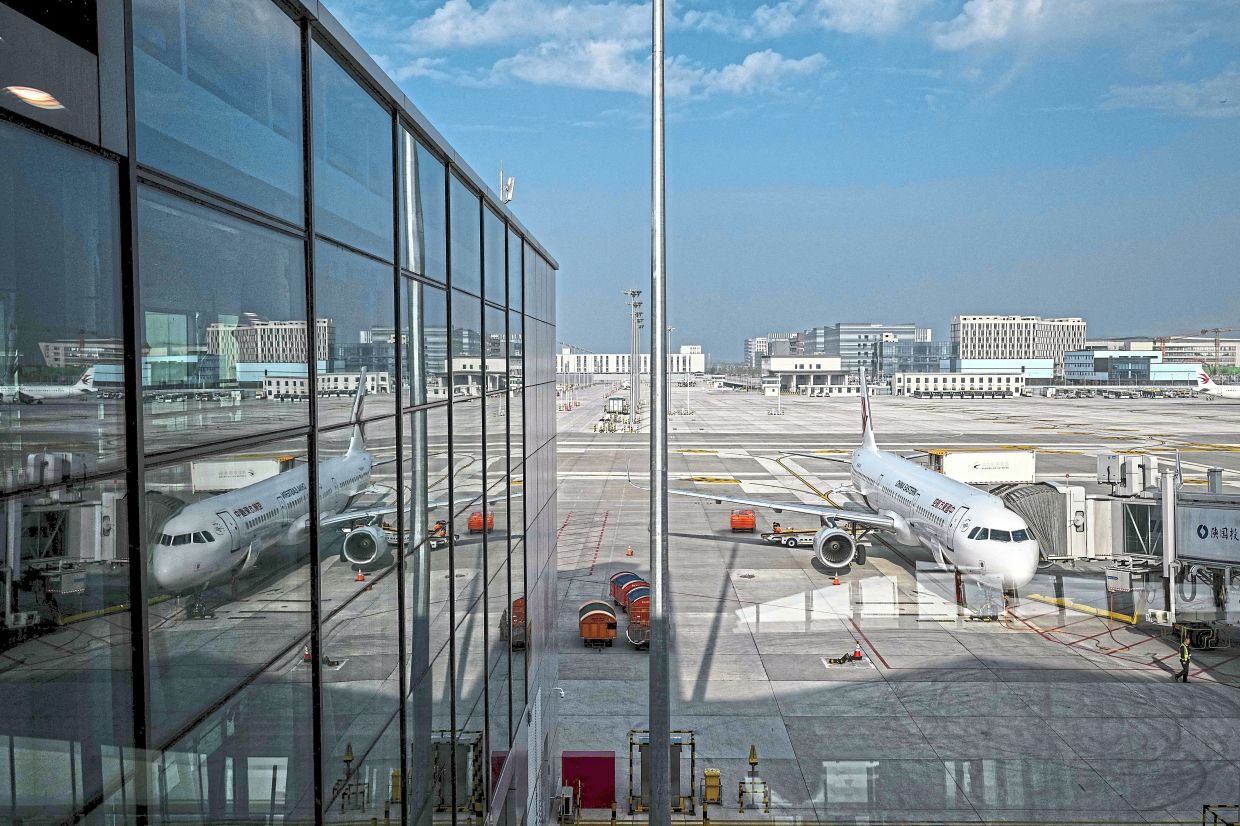
China's aviation sector is deepening its financial crisis, with the nation's three largest state-owned carriers reporting combined first-half losses of approximately 8.2 billion yuan ($1.22 billion). Air China, China Eastern Airlines, and China Southern Airlines have now endured seven consecutive years of losses, a troubling trajectory that underscores the structural fragility facing China's aviation industry even as the broader economy has recovered from pandemic disruptions. The losses, which triggered significant share price declines across mainland and Hong Kong exchanges on Monday, paint a stark picture of an industry struggling to adapt to persistently elevated operating costs and shifting travel patterns.
The magnitude of individual carrier losses reveals the uneven pressure points within the sector. Flag carrier Air China posted a net loss of 2.3 billion yuan, nearly doubling its prior-year deficit of 1.81 billion yuan. China Eastern sustained losses of 2.2 billion yuan against 1.43 billion yuan the previous year. Most severely affected was China Southern, which recorded a loss of 3.7 billion yuan compared with 1.53 billion yuan twelve months earlier. These deteriorating year-on-year comparisons become even more alarming when juxtaposed with the carriers' first-quarter performance, when combined profits reached 4.82 billion yuan buoyed by robust Lunar New Year travel demand. The dramatic swing from profit to substantial loss within a single year underscores how volatile and unsustainable the current operating environment has become.
Jet fuel costs represent the primary culprit behind the industry's distress. Across all three carriers, fuel expenses surged between 35 and 38 percent during the first half of the year, driven by geopolitical tensions in the Middle East and broader oil market volatility. What distinguishes Chinese carriers from their international competitors is their minimal hedging activity—unlike major Asian and European airlines that actively manage fuel price exposure through financial instruments, Chinese carriers remain acutely vulnerable to every fluctuation in crude oil markets. China Southern's interim filing starkly acknowledged that it currently has "no effective means available" to insulate itself from jet fuel price volatility, a remarkable admission of strategic unpreparedness. Even with recent declines from second-quarter peaks, fuel prices remain more than 50 percent elevated compared with pre-conflict levels, suggesting that cost relief remains distant.
Revenue generation itself has not faltered, which complicates the narrative around industry performance. Air China achieved revenue growth of 10.5 percent, China Eastern 11.1 percent, and China Southern 9.7 percent, all driven substantially by international route expansion. European services particularly benefited as international travelers redirected away from Middle Eastern aviation hubs destabilized by regional conflict. This revenue resilience, however, masks a troubling underlying dynamic: the carriers cannot leverage these additional revenues into profitability because cost growth is outpacing income growth. The inability to implement meaningful domestic fare increases without triggering demand destruction reflects broader economic softness in China's consumer travel sector. Competition from high-speed rail networks and domestic driving holidays has fundamentally altered the competitive landscape for domestic aviation, constraining pricing power precisely when carriers need it most.
The third quarter, traditionally the most profitable period for Chinese carriers, offers little prospect for recovery. An unusually severe typhoon season has disrupted domestic routes during peak summer travel months, creating operational chaos at precisely the wrong moment in the annual cycle. Meteorological records show 21 typhoons have formed across the northwestern Pacific Ocean and South China Sea year-to-date, exceeding the historical average by nine systems. This natural phenomenon arrives atop existing demand weakness, compounding the industry's challenges through the critical high-season period. Flight Master, a specialized aviation data firm, has projected that Chinese airlines will transport 142 million passengers across domestic and international routes in July and August, representing a 3.6 percent year-on-year contraction. This would mark the first passenger decline during the traditional peak season since 2022, when rolling lockdowns devastated travel demand during the height of China's zero-COVID policies.
Forecast projections from major financial institutions suggest the deterioration will continue accumulating. HSBC analysts anticipate that China's three largest carriers will collectively generate losses of approximately 16.8 billion yuan throughout 2026, a staggering reversal from market expectations of 1.3 billion yuan in combined profits. Stock markets have already begun pricing in this pessimistic outlook, with Shanghai-listed shares of all three carriers declining at least 36 percent since the start of 2026. Investor confidence has eroded further as none of the three carriers declared interim dividends, a typically standard practice that signals management confidence in near-term recovery prospects. For Malaysian and Southeast Asian investors with exposure to these carriers or their regional competitors, the warning signal is unmistakable: the structural headwinds facing major Chinese airlines extend well into 2026.
One potential bright spot emerges from the carriers' expanding deployment of domestic aircraft. China Eastern enlarged its fleet of COMAC C919 narrow-body jets to 17 aircraft following three deliveries during the first half, while both Air China and China Southern each operate 11 C919s after accepting two and three deliveries respectively. This expansion of indigenous aircraft represents a long-term strategic pivot toward reducing dependence on foreign suppliers and localizing supply chains. However, even this positive development carries concerning implications. China Eastern has downwardly revised its C919 delivery expectations by 13 aircraft between 2026 and 2028, suggesting either production delays at COMAC or a strategic decision to slow capital expenditure amid current financial distress. Air China maintained its previous delivery forecast while China Southern declined to disclose forward-looking projections, leaving significant uncertainty about how aggressively the carriers intend to expand their domestic fleet capacity.
The implications for the broader Southeast Asian aviation market deserve careful consideration. China's financial troubles may create competitive advantages for regional carriers that maintain stronger balance sheets and operational efficiency. However, reduced capacity and route pruning by Chinese carriers could also diminish competitive pressure on Southeast Asian airlines, potentially allowing them to implement fare increases without fear of aggressive price competition from major Chinese competitors attempting to generate cash flow. Additionally, as Chinese carriers potentially reduce international expansion plans, opportunities may emerge for carriers from Singapore, Thailand, Vietnam, and Malaysia to capture market share on cross-border routes that Chinese airlines are retreating from. The regional travel market dynamics are shifting in real-time as these structural adjustments unfold.
The persistence of losses across seven consecutive years indicates that the Chinese aviation sector faces not merely cyclical challenges but potentially structural transformation. The combination of volatile fuel costs, weak domestic pricing power, capacity constraints from weather disruptions, and ongoing geopolitical tensions creates a perfect storm unlikely to dissipate rapidly. For Malaysian stakeholders—whether investors, industry participants, or tourism-dependent businesses—the extended financial distress of China's largest carriers represents both a cautionary tale about the fragility of capital-intensive industries and a potential opportunity as regional competitors position themselves to capture redirected traffic and market share.

