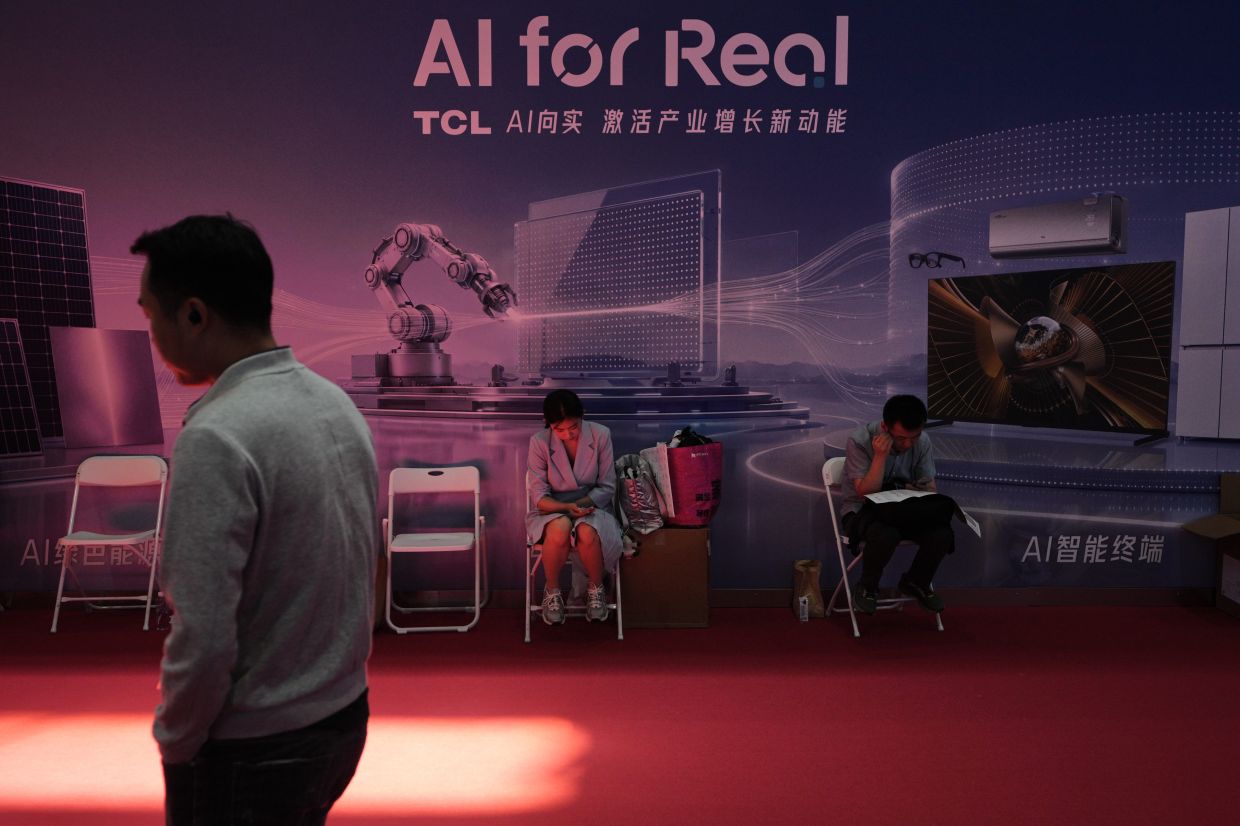
China's embrace of artificial intelligence is fundamentally altering its employment landscape in ways that leave many workers grappling with an uncertain future. As the government aggressively pushes AI integration across the economy, from manufacturing floors to creative industries, workers face mounting fears about job security and career viability. This technological shift comes at a precarious moment for the world's second-largest economy, which is already contending with sluggish consumer spending and demographic headwinds that could amplify the disruptive effects of automation.
The scale of AI adoption in China is strikingly rapid. Industrial enterprises using AI models and intelligent agents surged to 47.5 per cent last year from just 9.6 per cent in 2024, according to market intelligence firm IDC. This acceleration reflects deliberate government strategy, particularly through the "AI Plus" initiative and five-year plans extending to 2030, which aim to embed artificial intelligence throughout the Chinese economy. Unlike other nations where technology companies move at their own pace, Beijing is orchestrating a coordinated national push to gain technological dominance over the United States, effectively treating AI deployment as a strategic imperative rather than a market-driven process.
What distinguishes China's AI trajectory is the relative absence of public resistance. A Beijing-based analyst at research firm Plenum observed that anti-AI sentiment is considerably lower in China than elsewhere, with most citizens displaying positive, neutral, or passively interested attitudes. This docile acceptance masks deeper anxieties, however. Workers who fear replacement are paradoxically rushing to acquire AI skills and launch independent ventures powered by AI tools, seeking to stay ahead of displacement rather than resist it. This creates a race-to-the-bottom dynamic where individuals feel compelled to adopt technologies that may ultimately undermine their livelihoods.
The impact on specific professions illustrates the severity of this disruption. Mid-level programmers, once protected by their technical expertise, now find their core functions vulnerable to AI capabilities. A 40-year-old coder acknowledged that even imperfect AI can perform his work adequately from an employer's perspective, forcing him to abandon programming during a career break to experiment with alternative income streams through short-form video content. Translators in cities like Chengdu report that industry pay has collapsed by more than half as AI-powered translation tools proliferate, convincing universities that foreign language programs no longer merit investment. The decline in enrollment for these traditionally secure professions signals a fundamental reshaping of the job market.
The short drama and entertainment sector demonstrates how swiftly AI can obliterate entire categories of creative work. Chinese media reports show that live-action short and vertical video series designed for mobile platforms plummeted by approximately 75 per cent in the first quarter of this year compared to the same period last year. Generative AI now handles creation, production, and distribution functions that previously demanded teams of human writers, editors, and producers. A 32-year-old scriptwriter whose employer cut half its writing staff chose resignation over retention, now producing illustrated children's books independently. Yet he discovered that AI-generated scripts often feel mechanical and repetitive, revealing the technology's limitations even as it displaces human workers.
Robotics deployment is extending automation beyond knowledge work into physical domains previously considered immune to replacement. Humanoid robots now sort parcels in postal centres, direct traffic, and prepare food in commercial settings. Food delivery robots are proliferating across major Chinese cities, directly threatening the livelihoods of millions of workers in what has become a crucial informal employment sector. These visible manifestations of automation reinforce worker anxieties and demonstrate that displacement threatens not only skilled professions but also gig economy participants who lack safety nets or alternative career pathways.
The International Labour Organization has documented that women face disproportionate displacement risk from AI automation. Female workers concentrate in sectors particularly susceptible to automation, such as electronics assembly, while remaining underrepresented in science and technology fields where AI-related skills command premium wages. This gender dimension adds another layer of complexity to China's employment crisis, potentially widening wealth and opportunity gaps at a moment when social cohesion already faces pressure from economic anxiety.
The broader economic implications trouble serious analysts. China's GDP growth has already decelerated, and consumer spending has weakened partly because households fear job losses and are rationing discretionary purchases. This pessimism compounds damage from the prolonged housing market downturn, which has devastated household wealth—the traditional engine of consumption. Economists warn that AI-driven productivity gains will not necessarily translate into job creation; China's technology sector excels at innovation and output per worker but generates relatively few new positions. A Cornell University professor specialising in economics and trade policy cautioned that AI could severely disrupt employment while lifting productivity, potentially worsening China's existing jobless growth problem and destabilising social stability through mass underemployment.
Young people face particularly acute challenges. While the national urban unemployment rate hovers near five per cent, unemployment among citizens aged 16 to 24 excluding students reaches roughly 15 per cent—triple the national average. This youth employment crisis predates AI acceleration, but automation threatens to entrench and deepen generational scarring. Workers who enter the labour market during a period of technological disruption face reduced opportunity to accumulate skills, experience, and capital, potentially creating lasting damage to lifetime earnings and social mobility.
Demographic realities, however, introduce a countervailing dynamic. China's population of 1.4 billion is ageing and contracting rapidly. By 2050, the country is projected to have fewer than two working-age adults supporting each retiree, compared with more than 2.5 in the United States. Some economists argue that automation could partially offset this shrinking workforce rather than constituting a pure negative shock. A professor whose research spans technology and society suggested that from a long-term perspective, AI-driven productivity might prove essential for sustaining living standards and social provision as the demographic base erodes. This argument, however, offers cold comfort to workers facing displacement in the next decade.
The tension between short-term disruption and long-term necessity defines China's AI challenge. The government cannot reverse course on AI adoption without ceding technological advantage to the United States in a strategically critical domain. Yet accelerating automation without managing displacement risks triggering the social instability that President Xi Jinping and other leaders consider fundamentally destabilising. Workers are adapting individually by acquiring AI skills and launching independent ventures, but this entrepreneurial response masks rather than resolves underlying employment destruction. Unless policymakers develop robust social support mechanisms, retraining programmes, and employment generation strategies alongside their AI diffusion initiatives, China risks combining the worst outcomes: rapid technological displacement without the safety nets or job creation that characterise mature AI-adopting economies.

