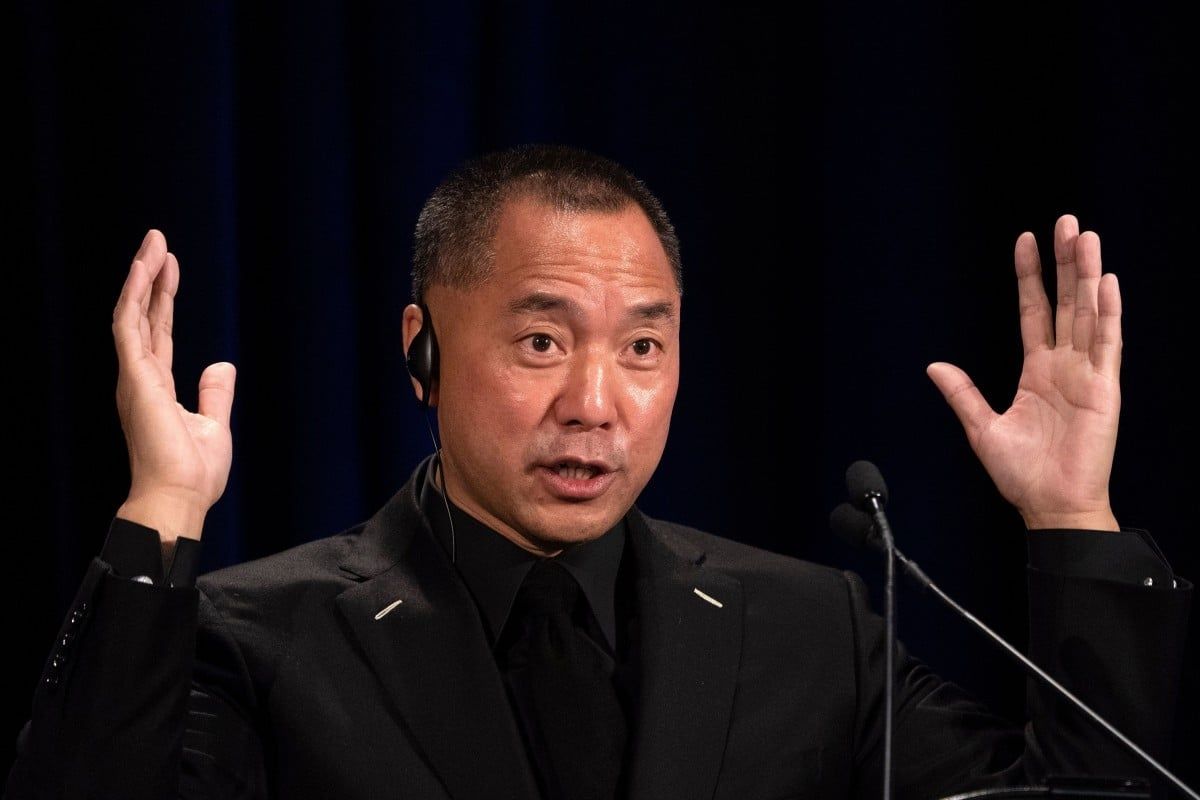
A self-exiled Chinese business magnate once numbered among his country's wealthiest individuals has been handed a 30-year prison sentence in Manhattan for orchestrating one of the most extensive financial frauds in recent US history. Guo Wengui, who abandoned China a decade ago to establish himself as a vocal critic of Beijing's Communist Party, faced sentencing Monday in a federal courtroom crowded with supporters, where federal Judge Analisa Torres described his scheme as a calculated betrayal of vulnerable investors seeking democratic change in China. The fraud, which prosecutors say extracted over USD 1 billion from hundreds of thousands of people worldwide, resulted in losses amounting to hundreds of millions of dollars and left more than 1,000 victims financially devastated.
During the sentencing hearing, Judge Torres detailed the emotional toll of Guo's crimes by reading excerpts from victim impact letters that documented ruined lives, destroyed savings, and fractured family relationships. The court heard testimony from Wei Chen, one of the defrauded investors, who described how Guo's scheme completely unraveled her life and that of her family members. Torres emphasised that Guo had "preyed on those seeking to bring Democracy to China," exploiting their ideological sympathies and financial trust to support an extravagant lifestyle characterised by luxury apartments, yachts, racing vehicles, and designer acquisitions. The judge noted particularly that Guo displayed no genuine remorse, instead insisting that his actions caused no harm, and had actively encouraged supporters to intimidate and harass those willing to testify against him.
The sentencing concluded a seven-week trial in which Guo faced twelve criminal charges and was convicted on nine counts. Federal prosecutors outlined how the defendant had systematically deceived thousands of investors through fraudulent schemes spanning from 2018 to 2023, establishing fake investment vehicles including his media company GTV Media Group Inc., the so-called Himalaya Farm Alliance, and the Himalaya Exchange. Each entity was presented as a legitimate opportunity for financial gain and ideological commitment, yet all funnelled investor capital directly into Guo's personal coffers. The court also ordered Guo to forfeit USD 889 million in restitution, a figure that prosecutors argue barely scratches the surface of the damage inflicted on victims who lost their life savings in hopes of supporting anti-Beijing activities.
Guo's rise in American circles before his arrest three years ago provided a cautionary tale about the intersection of wealth, political influence, and unchecked deception. The billionaire cultivated close relationships with conservative political operatives, most notably Steve Bannon, with whom he announced a joint 2020 initiative purporting to overthrow the Chinese government. His Manhattan penthouse overlooking Central Park and membership at President Donald Trump's Mar-a-Lago golf club in Florida symbolised his rapid integration into elite American political and social networks. This integration, however, masked the predatory financial schemes operating simultaneously beneath the surface, exploiting investors who were drawn to both Guo's anti-communist messaging and promises of financial returns.
Guo's defence strategy attempted to reframe his conviction within a broader geopolitical narrative, arguing that his prosecution represented an extension of Chinese Communist Party persecution rather than legitimate criminal accountability. His legal team contended that Guo had suffered physical torture while in China between 1993 and 2022, bearing scars and undergoing multiple reconstructive surgeries as evidence of his persecution. They characterised his flight to the United States—first to Hong Kong, then London, and finally New York in 2017—as escape from a regime that had accused him of rape, kidnapping, bribery, and other serious crimes. Defence arguments suggested that the extended prison sentence would validate Beijing's "grand, pervasive, and life threatening" campaign against him and serve to discourage other Chinese dissidents from seeking refuge in America. They pointed to comparables where defendants in similar financial fraud cases received substantially shorter sentences of two to four years, claiming the disparity reflected bias against Guo's political status.
Prosecutors, however, rejected such framing entirely, emphasising that Guo's criminal conduct bore no relationship to legitimate political opposition to Beijing. They highlighted instead the deliberate construction of his deception apparatus, whereby he cultivated an image of a persecuted dissident while simultaneously orchestrating an elaborate financial scam targeting ideologically sympathetic investors. The prosecution noted that Guo had exploited what they characterised as "lax U.S. asylum laws" to establish himself as a seemingly legitimate business figure and political voice, thereby enhancing his credibility with potential investors. Prosecutors documented his "astonishing" level of deception, the systematic nature of the fraud spanning multiple years and entities, and the emotional and psychological devastation experienced by victims who had trusted him with their savings.
The implications of Guo's conviction extend beyond individual criminal accountability to broader questions about the vulnerability of diaspora communities and ideologically-motivated investors to exploitation. His particular targeting of individuals seeking democratic change in China revealed how perpetrators can weaponise political sympathies and national identity sentiments to override normal investment scepticism. The case underscores the necessity for greater regulatory scrutiny of entities promoted to diaspora communities and highlights how genuine political opposition can be distorted and exploited by individuals motivated primarily by personal enrichment. For Malaysian readers, the case offers relevant lessons about evaluating investment opportunities promoted through political or community networks, particularly when such investments promise both financial returns and ideological alignment.
China's response to the sentencing further illustrated the geopolitical dimensions of Guo's case. The Chinese Ministry of Foreign Affairs announced that they had taken note of the verdict and reiterated that Guo remains wanted by Beijing authorities, maintaining an Interpol "Red Notice" designation that requests law enforcement worldwide to arrest him pending extradition proceedings. This positioning allows China to claim vindication of its accusations while simultaneously complicating any narrative that Guo's imprisonment represents political persecution. The combination of legitimate criminal conviction in the United States and China's longstanding allegations against him creates a complex scenario where legitimate justice processes intersect with geopolitical rivalry, making the distinction between pure criminality and political motivation difficult for outside observers to parse.
Guo's courtroom demeanour during sentencing—protesting claims of malingering while displaying visible illness, briefly defending his motivations by referring to opposition to the Communist Party, and remaining surrounded by supporters who applauded as he departed—suggested an individual still unwilling to acknowledge the fundamental nature of his crimes. His insistence that he came to America specifically "to destroy the CCP" represented a final attempt to obscure the criminal scheme beneath a veneer of political commitment. This refusal to accept responsibility, which Judge Torres specifically noted in her sentencing remarks, may have influenced the decision to impose the maximum requested sentence rather than accepting defence pleas for leniency based on geopolitical persecution arguments.

