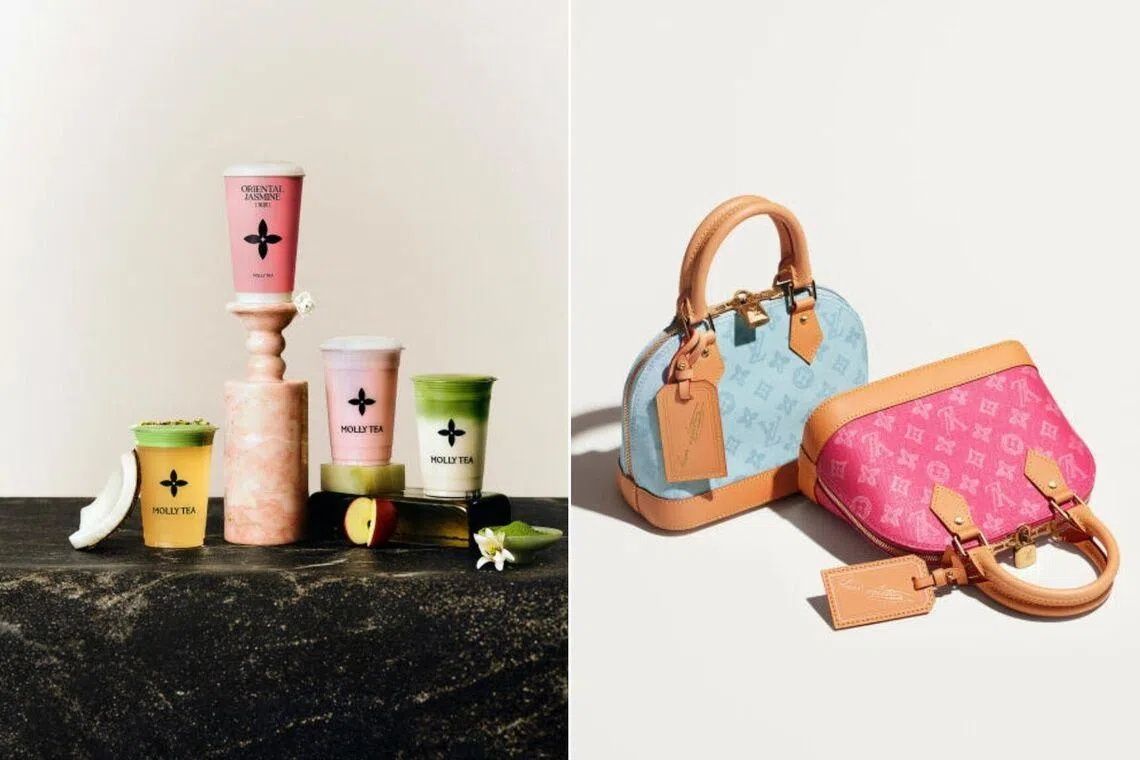
A Chinese court has ordered Molly Tea, a Shenzhen-based milk tea chain, to pay 10.3 million yuan (approximately US$1.5 million) to Louis Vuitton after finding the company infringed upon the French luxury brand's registered four-petal flower graphic trademarks. The Suzhou Intermediate People's Court in Jiangsu province issued the ruling on June 29 after determining that Molly Tea and one of its franchise stores in Wuzhong district had unlawfully used designs substantially similar to seven of Louis Vuitton's iconic monogram motifs. Beyond financial compensation, the court mandated that the tea company issue a public apology and cease using the disputed emblem, measures that underscore the seriousness with which Chinese intellectual property courts now treat trademark violations even when they cross product categories.
The dispute centred on the visual similarities between Molly Tea's brand emblem—a four-petal floral design—and the unmistakable iconography that Louis Vuitton has spent over a century cultivating and protecting globally. When the French luxury conglomerate initiated legal proceedings in May 2025, it leveraged established trademark law principles that extend brand protection beyond the specific categories in which a mark is registered, particularly when dealing with highly distinctive and widely recognised brands. The timing of the lawsuit and the swift court resolution reflect growing vigilance among international luxury brands operating in Greater China regarding counterfeit or confusingly similar designs, an issue that has long vexed companies seeking to maintain brand integrity across sprawling Chinese markets.
Molly Tea's trademark application history reveals an aggressive strategy beginning in March 2024, when the company and its affiliated entities filed multiple applications with the China National Intellectual Property Administration featuring various floral designs. These applications predominantly covered restaurant and accommodation services, advertising, and convenience food categories—segments that directly overlap with or complement the beverage business. However, the intellectual property office rejected most applications featuring the floral motifs, granting registration only to the trademark containing the Chinese characters spelling "Molly Tea." This pattern of rejections before the court case suggests that administrative examiners had already flagged potential conflicts with pre-existing protected marks, a warning signal that the company either overlooked or deliberately disregarded.
The ruling has triggered extensive public discourse across Chinese social media platforms, tapping into broader conversations about intellectual property enforcement, cultural appropriation, and fair competition in China's booming beverage market. A hashtag tracking the dispute accumulated over 360 million views, while related discussions garnered an additional 18.7 million reads, demonstrating the visceral interest ordinary Chinese consumers and observers hold regarding such cases. The volume of engagement reflects not merely curiosity about the financial penalties but genuine disagreement within society about how courts should balance trademark protection against the use of traditional cultural symbols that exist within the public domain.
Public opinion has fractured along several fault lines. Some observers contend that Molly Tea's four-petal design closely approximates Louis Vuitton's signature pattern to the point of deliberate imitation, particularly given that the company likely recognised the visual appeal and brand cachet such similarity would convey to consumers. Conversely, others argue that the designs contain sufficiently distinct visual characteristics and that the two enterprises occupy entirely different market positions—one serving luxury clientele globally and the other catering to domestic and regional mid-market consumers seeking trendy beverages. A third camp has questioned the originality of Louis Vuitton's four-petal motif itself, asserting that floral patterns permeate traditional Chinese artistic traditions and should not be subject to exclusive commercial ownership by foreign enterprises.
Kang Lixia, a trademark specialist at Beijing Standzer IP Firm, provided critical insight into the legal mechanisms underpinning the court's decision. She explained that under China's "first to file" principle, the applicant who registers a trademark earliest acquires exclusive rights, and subsequent applications for identical or confusingly similar marks are rejected. Critically, she noted that Louis Vuitton's status as an earlier-registered and extraordinarily well-known international brand qualifies for cross-class protection, meaning its rights extend beyond the luxury goods category into unrelated product classes. This legal doctrine significantly disadvantages later applicants seeking to utilise similar designs, even in entirely different commercial contexts, creating what some perceive as an asymmetrical playing field favouring established multinational corporations.
Yet Kang emphasised an important principle that complicates the cultural argument: traditional floral patterns and motifs derived from Chinese heritage constitute part of the public cultural domain and remain available for use by anyone in their original forms. The challenge for companies arises when applying or modifying such patterns in commercially distinctive ways that resemble already-protected trademarks. The intersection of these two realities—public access to traditional elements versus registered trademark protection for specific commercial applications—defines much of the contemporary tension surrounding intellectual property cases in China.
Liu Bin, an intellectual property attorney from Beijing Zhongwen Law Firm, advocated for a more nuanced understanding of the dispute, emphasising that figurative trademark protection does not require perfect identity between a challenged design and the registered mark. Rather, Chinese law considers whether consumers would likely experience confusion when encountering the disputed sign, a subjective standard that courts must evaluate contextually. He underscored that considerable public uncertainty persists regarding how traditional Chinese cultural patterns should be protected and deployed fairly in commerce, acknowledging the legitimate concern that no single entity should monopolise elements originating from centuries of shared cultural heritage.
However, Liu drew a crucial distinction that reconciles cultural preservation with commercial trademark law. He argued that while traditional elements should remain open for continued cultural transmission and artistic development, companies cannot deploy these elements in branded commercial contexts that create market confusion or essentially replicate earlier registered marks. The protection afforded by intellectual property law attaches not to the traditional elements themselves but to the accumulated brand recognition and market identity that companies develop through commercial use, promotion, and consumer association. Under this framework, Molly Tea would theoretically have considerable freedom to incorporate floral motifs in artistic or cultural expressions, yet its use of such patterns as primary brand identification in a competitive beverage market—where consumer perception and brand loyalty drive purchasing decisions—attracts genuine trademark liability.
Molly Tea has confirmed its intention to appeal the ruling to a higher court, setting the stage for additional litigation that may clarify the boundaries between legitimate use of traditional cultural symbols and actionable trademark infringement. The outcome of an appeal would largely depend on whether the company can marshal sufficient evidence demonstrating that its design constitutes an original and distinctive creation meriting protection independent of Louis Vuitton's earlier mark. The case assumes particular significance for Southeast Asian companies and entrepreneurs, many of whom incorporate cultural motifs in branding strategies and face similar pressures from international trademark holders.
For Malaysian and broader Southeast Asian business communities, this case underscores several practical lessons regarding intellectual property strategy in increasingly globalised markets. Companies seeking to register trademarks featuring traditional cultural designs should conduct thorough searches of existing registered marks across relevant product classes and jurisdictions, recognising that courts increasingly apply expansive interpretations of trademark protection for well-known brands. Additionally, the decision reflects China's evolution toward more stringent intellectual property enforcement, a trend that directly affects any company with commercial interests in Greater China or that sells products across Southeast Asian markets where Chinese consumers represent important customer segments. As regional companies expand and build international brands, understanding how courts balance cultural heritage against commercial trademark rights will prove increasingly essential to avoid costly legal disputes and market disruptions.

