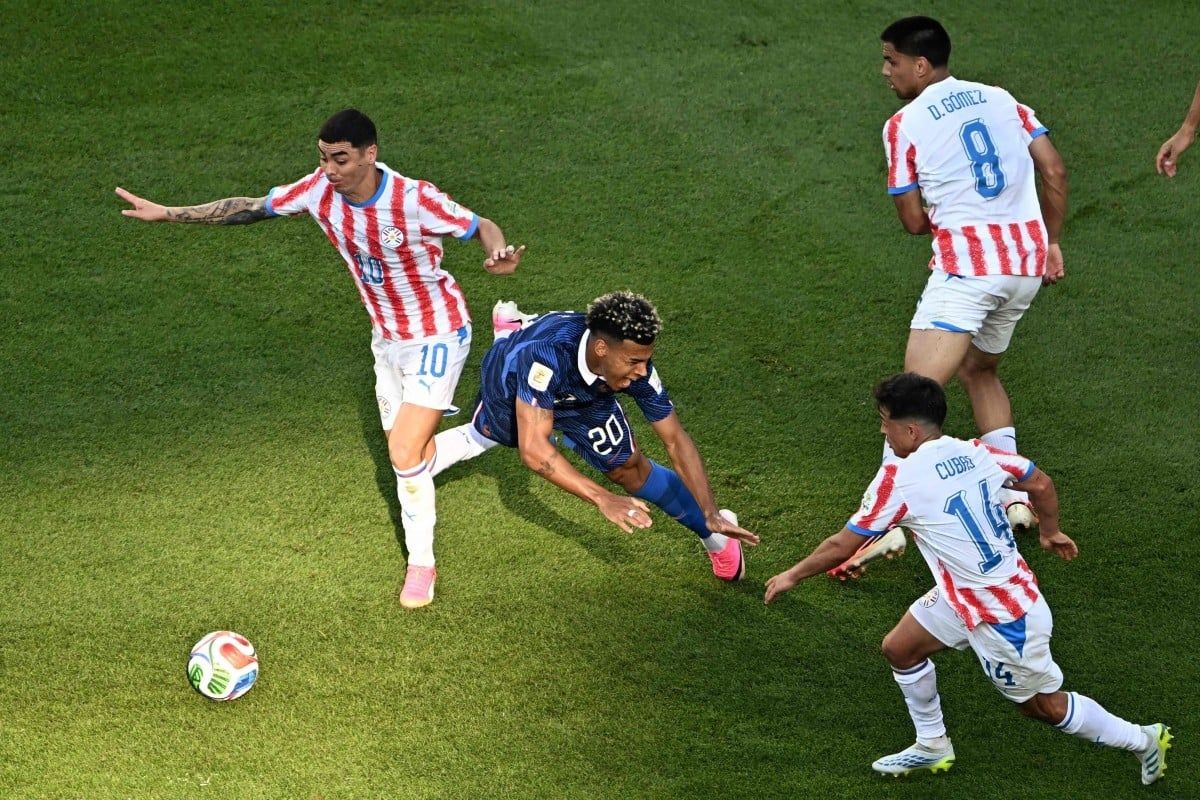
Paraguay's bruising World Cup encounter with France in Philadelphia last Saturday has ignited passionate debate among Chinese football enthusiasts, who found themselves questioning both the South American side's approach to the game and the officiating standards on display. The round-of-16 clash, which France won through a Kylian Mbappe penalty twenty minutes from the final whistle, became memorable not for football artistry but for the physical intensity and lack of disciplinary action that characterised the contest.
The bulk of Chinese fan commentary centred on the officiating performance of Uzbekistan referee Ilgiz Tantashev, whose decision-making stood in sharp contrast to the disciplinary reputation of Chinese referee Ma Ning. In a match filled with niggling fouls and rough challenges, Tantashev distributed only four yellow cards—three of which went to France—a restraint that struck many observers as inadequate given the match's volatile nature. The disparity drew particular attention because Ma Ning has earned the nickname "card master" among Chinese supporters for his readiness to brandish cards in response to misconduct, creating a pointed contrast that resonated through social media discussions.
One commenter succinctly captured the prevailing sentiment by suggesting that had Ma Ning been in charge, Paraguay would have been reduced to eleven men—or fewer. Another quipped directly at Mbappe, suggesting the French star should now appreciate the standards Ma Ning brings to refereeing. The broader consensus among Chinese fans was that Tantashev's performance fell well short of FIFA World Cup standards, with numerous posts rating his display as substandard and questioning his competence.
Beyond concerns about card distribution, some Chinese observers questioned Tantashev's impartiality, suggesting his lenience appeared calculated rather than merely inconsistent. References circulated to Paraguay's surprising quarter-final elimination of Germany in the previous round, prompting speculation about whether the referee had been deliberately undermining France's chances. One particularly pointed comment suggested Tantashev appeared to be "wearing a Paraguay jersey," implying allegiance rather than neutrality. These conspiracy-flavoured interpretations, while speculative, reflected genuine frustration with what Chinese fans perceived as a match officiated below the standards expected at football's premier tournament.
Paraguay's approach itself drew considerable criticism from Chinese commentators, many of whom viewed the South American side's physicality as antithetical to the sport. Rather than constructing meaningful attacking play, Paraguay appeared primarily focused on physical intimidation of their French counterparts, particularly targeting Mbappe with aggressive marking and challenges. The pattern of play—defensive, combative, and devoid of creative intention—prompted debate about whether such tactical approaches represent legitimate football strategy or constitute a distortion of the game itself.
Mbappe's response to Paraguay's physical attention demonstrated both composure and tactical awareness. The French forward acknowledged beforehand that his team understood the character of the contest they faced, indicating that France had anticipated and prepared for an aggressive French engagement. His comments revealed a mature understanding that World Cup football often requires teams to adapt their style to circumstances, explaining that his team was equally prepared to abandon aesthetic football in favour of pragmatic, physical approaches when necessary. Mbappe explicitly stated France would "get their hands dirty" if required, signalling neither victims nor complainers but rather a team equipped to compete within whatever parameters opponents imposed.
France's coaching staff corroborated accounts of Paraguay's aggressive approach, with manager Didier Deschamps confirming that unsporting conduct extended beyond the field itself. Deschamps revealed that Paraguay's bench engaged in insulting exchanges with the French coaching staff, behaviour he characterised as unbecoming of professional football at the highest level. This sideline dimension added another layer to Chinese fan criticism, suggesting that Paraguay's approach represented not isolated incidents but rather a comprehensive philosophy encompassing on-field aggression and off-field disrespect.
An incident following the final whistle encapsulated the broader frustration. Paraguay goalkeeper Orlando Gill, apparently aggrieved that Mbappe had not acknowledged him, threw a ball at the French forward's back—behaviour that drew particular scorn from Chinese social media users. Gill subsequently blamed the heat of competition, an explanation that failed to resonate with observers who saw it as evidence of poor sportsmanship and loss of composure. Chinese commentators interpreted the incident as Paraguay losing not merely the match but also the moral high ground, describing the conduct as childish and lacking the professionalism expected of World Cup participants.
The broader discourse among Chinese fans reflected deeper questions about football philosophy and refereeing standards at international level. The contrast with Ma Ning's approach suggested that different refereeing styles produce vastly different outcomes, raising questions about consistency and fairness in tournament administration. If Ma Ning would have issued significantly more cards in identical circumstances, observers reasoned, then the absence of cards under Tantashev represented either inadequate officiating or systematic bias—neither of which reflects well on tournament integrity.
For Malaysian and Southeast Asian readers, this incident carries relevance beyond mere football commentary. It illustrates how international sporting events become forums for discussion about fairness, standards, and the administration of global competitions. The Chinese fan perspective—emphasising disciplinary consistency and professional conduct—represents values that resonate across the region. Furthermore, the episode underscores how referee selection and training directly influence match outcomes and tournament narratives, matters of concern to any nation with aspirations for participation at football's highest levels.
The contrasts drawn between Tantashev's lenient approach and Ma Ning's strictness also highlight the subjective dimensions of sports officiating, even at professional levels. While neither approach is inherently wrong, consistency within tournaments matters significantly for competitive fairness. France's ability to navigate Paraguay's aggression and prevail despite what many viewed as inadequate protection from officials suggests that elite teams possess resilience to overcome such obstacles—but it does not excuse the standards failure itself.
Ultimately, Chinese football fans used the Paraguay-France encounter as a lens through which to examine larger questions about World Cup standards, referee professionalism, and sportsmanship. Their engagement, while occasionally speculative and coloured by preference for stricter discipline, reflected genuine investment in seeing international football conducted to the highest standards of both technical quality and professional conduct.

