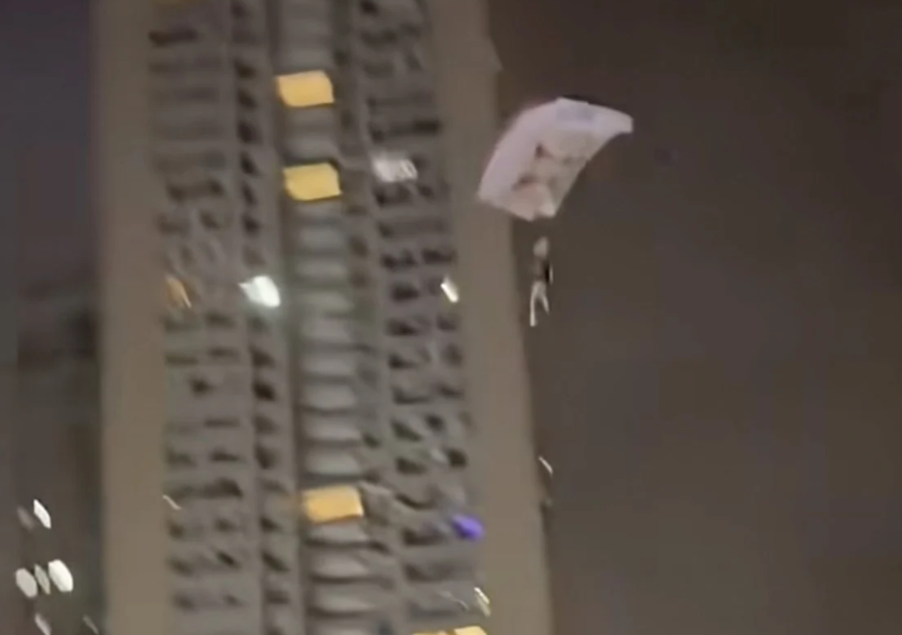
A 23-year-old man identified as Ren has been detained by police in Chenghua district, Sichuan province, for executing an unauthorized parachute jump from a residential tower on the evening of June 30. The stunt, performed at 11pm without official clearance, was deliberately orchestrated to increase traffic to his social media accounts and boost his online visibility among his 60,000 followers on a leading platform.
Ren, who operates under the social media persona "Parachute Coach Kakaxi," documented the jump and uploaded footage the following day, which quickly circulated across mainland Chinese social networks. The video footage revealed the alarming proximity of his descent to nearby residential structures and trees, demonstrating the inherent danger posed not only to himself but to residents and pedestrians below. This reckless positioning raised immediate concerns among authorities about the genuine safety risks created by such unauthorized aerial activity in densely populated urban areas.
The Chenghua district police authority moved swiftly to investigate and subsequently charged Ren under public order disturbance provisions. His conduct was deemed to have seriously compromised public order while simultaneously endangering the safety of civilians in the vicinity. Following standard procedures for administrative violations in China, Ren was placed under administrative detention for the maximum permissible period of 15 days. Beyond the detention order, authorities implemented a comprehensive ban prohibiting him from further use of social media platforms, effectively silencing his ability to broadcast additional content.
During their investigation, police verified Ren's credentials and discovered a significant discrepancy in his claimed qualifications. Although Ren presented himself publicly as a professional parachute coach, authorities confirmed he had not yet obtained the requisite coaching license required by Chinese regulations. This finding undermined his authority to conduct or advocate for any skydiving activities, let alone perform unauthorized jumps in residential zones. Investigators also uncovered evidence suggesting this was not an isolated incident—records indicated Ren had previously executed a similar parachute jump from a residential building in May 2024, indicating a pattern of dangerous behavior pursued for online engagement.
The police authority subsequently issued formal guidance reminding the public of strict regulations governing skydiving activities across the country. According to these directives, legitimate skydiving can only be conducted with explicit government permission and must occur exclusively within designated and approved facilities or zones. The regulations explicitly prohibit parachute jumping from public venues including downtown office buildings, residential towers, and bridges. Authorities emphasized that violations involving high-density population areas would face severe penalties, signaling their commitment to preventing similar incidents.
Public reaction across mainland social media platforms reflected widespread disapproval of Ren's actions, with commentators articulating genuine safety concerns. One user expressed alarm at the inherent danger, noting that Ren's reckless behavior placed both his own life and the lives of innocent people below at grave risk, warranting serious legal consequences. Another respondent critiqued the motivation behind the stunt, expressing incomprehension that someone would pursue such dangerous actions solely for the sake of online traffic and engagement metrics. A third commenter called for extended detention periods, arguing that without substantial consequences, other influencers might attempt copycat stunts.
This incident exemplifies a broader troubling pattern in China where online influencers pursue increasingly extreme activities to capture audience attention, even when such actions present life-threatening risks. The problem has become sufficiently prevalent that it attracts regular law enforcement attention. Earlier in June, authorities in eastern Zhejiang province apprehended a driver who uploaded video content showing him operating a vehicle at 152 kilometers per hour on an expressway—significantly exceeding the legal speed limit—while simultaneously filming with a mobile telephone. The resulting penalties included nine deduction points from the driver's annual 12-point allowance and a monetary fine of 250 yuan, demonstrating authorities' willingness to pursue legal action against traffic safety violations.
The dangers inherent in pursuing online celebrity status through extreme stunts carry sobering historical weight in China. In 2017, renowned parkour blogger Wu Yongning died from physical exhaustion while scaling a 260-meter-high building in Hunan province during a live-streaming broadcast. Wu had previously gained substantial attention for his trademark style of ascending skyscrapers without safety equipment or harnesses. He had publicly justified his dangerous pursuits as necessary labor to generate income for treating his mother's medical condition, adding tragic personal dimensions to his fatal accident.
The Ren case carries significant implications for how Asian countries approach digital regulation and public safety. Malaysia and other Southeast Asian nations increasingly grapple with similar challenges as social media platforms enable rapid dissemination of user-generated content, sometimes promoting dangerous behavior among youth audiences seeking viral recognition. The episode demonstrates that technological advancement and social media connectivity have created novel public safety challenges that traditional regulatory frameworks sometimes struggle to address adequately. China's response—combining swift police action, administrative detention, social media bans, and public safety education—offers one model that authorities across the region may observe as they develop their own strategies for managing online influence and protecting public safety.

