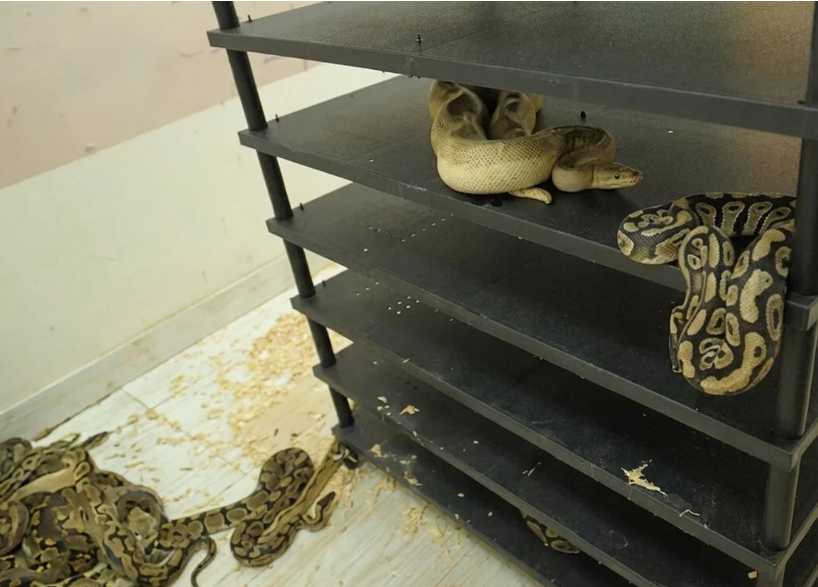
A residential flat in Taizhou, Zhejiang province became the unexpected home to one of China's largest illegal python breeding operations when authorities arrested a man surnamed Guo and sentenced him to prison for harbouring over 300 of the protected reptiles. The case, reported by state media CCTV in late June, highlights how modern law enforcement increasingly relies on unusual consumption patterns and digital footprints to uncover wildlife crimes that might otherwise escape notice.
The operation unravelled after an elderly resident discovered a large python at the base of a local mountain in March 2024. The discovery proved pivotal: pythons are not native to Zhejiang and would not naturally be active outdoors during the cold months, prompting investigators to suspect the snake had escaped from a breeding facility. This seemingly isolated incident triggered a more sophisticated investigation that would ultimately expose a trafficking network spanning multiple provinces and involving hundreds of animals valued at over 30 million yuan (US$4.4 million).
Police expertise proved essential to cracking the case. A professional snake handler consulted by officers explained that pythons require carefully controlled environments maintained between 20 and 30 degrees Celsius with specific humidity levels. This environmental necessity created an investigative advantage: only a breeder would consume enough electricity to sustain such conditions year-round in a residential setting. Authorities began systematically reviewing power consumption data from households near the discovery site, using utility records as a novel investigative tool to identify suspicious patterns.
This data-driven approach led them to Guo, a single unemployed man whose electricity consumption was abnormally high. Once identified as a person of interest, a more comprehensive investigation revealed that Guo maintained regular contact with an associate named Di, who frequently collected courier packages from delivery stations. These packages contained large quantities of white mice purchased online, which reptile keepers typically use as feed. Online sellers confirmed they had supplied these rodents specifically for reptile feeding purposes, establishing a clear chain of evidence linking the flat to active animal husbandry.
Further investigation of Guo's digital footprint proved damning. He had shared photographs of snakes on social media and made indirect references to selling pythons, leaving a quasi-public record of his activities. Transaction records showed that Di had sold at least two pythons to another buyer for 1,000 yuan, providing evidence of commercial operation rather than private hobby keeping. These digital traces transformed an environmental detection into a prosecutable case with documented sales activity.
When police executed a search warrant at Guo's flat, they encountered a scene that shocked even experienced officers. The entire residential space had been repurposed as a breeding facility. Guo had consolidated all personal furniture into a single bedroom, converting the other two bedrooms and living room into stacking areas for plastic containers, each holding a python. The officers discovered 309 pythons at Guo's residence, which were subsequently transferred to a local zoo for care and rehabilitation.
Interrogation revealed that Guo's interest in snakes dated back a decade. He had purchased four pythons in 2014 and had spent years developing expertise in breeding snakes of different colour variations. Guo expressed satisfaction with his work, describing himself as feeling like "a creature creator" with capability to cultivate pythons displaying diverse colours. His transition from hobbyist to commercial breeder appears gradual, driven by accumulating knowledge and the financial incentive that Di's sales network provided.
The investigation expanded beyond Guo to capture the broader trafficking network. Di faced charges for his role in distributing the snakes. A pet shop owner named Deng, who had sold the original four pythons to Guo in 2014, was also arrested. Police uncovered 47 additional pythons at Deng's residence, revealing that multiple nodes of the operation existed simultaneously. The comprehensive enforcement action ultimately recovered 436 pythons across all three locations, indicating this was not an isolated case but rather a coordinated breeding and distribution enterprise.
The legal framework under which these individuals were prosecuted reflects China's approach to wildlife protection. Pythons are classified as Grade Two protected animals under Chinese law, a designation that prohibits buying, selling, breeding, and transporting the species without explicit government authorisation. China's Criminal Law permits sentences of up to five years imprisonment for Grade Two protected animal violations, though the specific sentences handed down to Guo, Di, and Deng were not disclosed in the official report.
For Southeast Asian readers, this case carries particular significance given the region's role in wildlife trafficking networks. Many snakes bred or traded in China ultimately originate from or transit through Southeast Asian countries, where weak enforcement and porous borders create smuggling opportunities. The Chinese authorities' success in dismantling this operation demonstrates increasing sophistication in wildlife crime investigation, combining traditional detective work with data analysis and digital evidence. The cooperation between police and wildlife experts shows how interagency coordination strengthens enforcement capabilities against illegal breeding operations.
The case also underscores how species protection extends beyond preventing wild poaching and encompasses controlling captive breeding. By restricting breeding licenses and prosecuting unauthorized breeders, governments aim to prevent market saturation that incentivizes wild collection. Guo's operation, had it continued unchecked, could have released more snakes into local ecosystems or generated commercial demand that eventually encourages wild capture. The electricity audit that triggered the investigation represents an innovative enforcement mechanism that other countries might consider adopting as wildlife trafficking becomes increasingly sophisticated.
Malaysia and other Southeast Asian nations face similar challenges with illegal reptile breeding and trafficking. The Guo case demonstrates that authorities can leverage utility data, social media monitoring, courier records, and expert consultation to identify and shut down these operations. As regional wildlife enforcement agencies develop their investigative capabilities, learning from cases like this—where multiple evidence streams converged to expose a hidden criminal enterprise—becomes increasingly important in protecting species and degrading the supply chains that sustain the illegal wildlife trade.