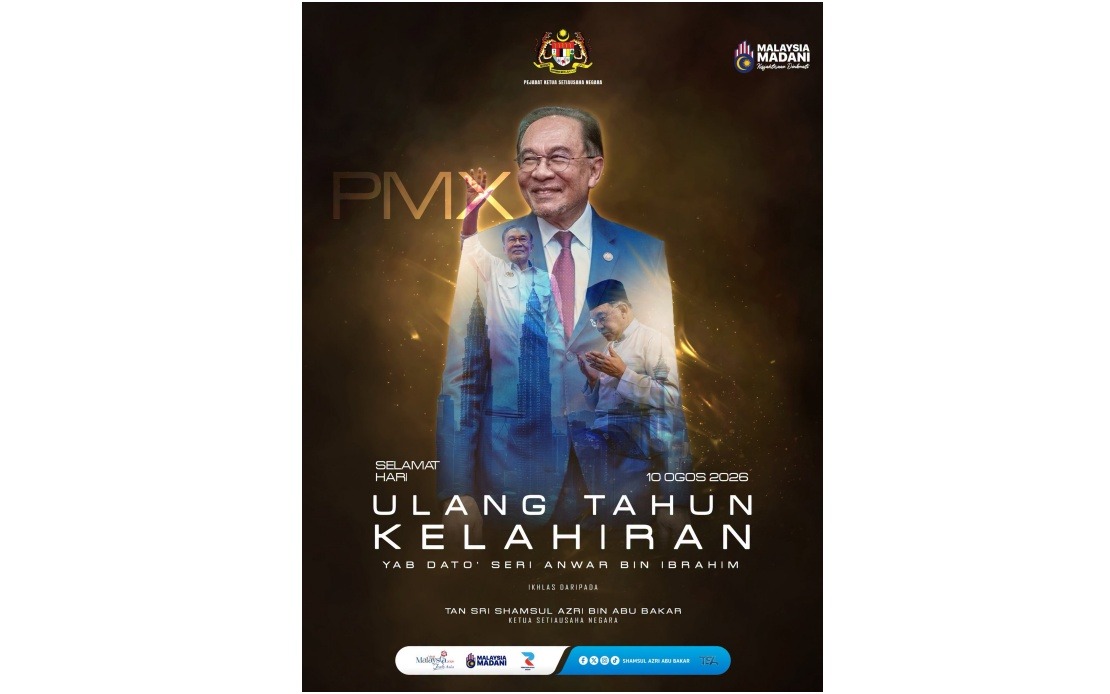
The Chief Secretary to the Government, Tan Sri Shamsul Azri Abu Bakar, extended birthday greetings to Prime Minister Datuk Seri Anwar Ibrahim on August 10 as the nation's leader turned 79. The gesture, shared through official channels, reflected the deep institutional relationships between the country's top administrative leadership and its chief executive, underscoring the collaborative spirit expected to define the government's functioning during a critical period of national development.
In his birthday message, Shamsul Azri articulated a vision of continued partnership between the civil service apparatus and the Prime Minister's office. Beyond the customary well-wishes for personal health and longevity, he invoked divine blessings of strength and wisdom—qualities he deemed essential for the demanding role of steering a nation through complex governance challenges. This framing positioned the birthday acknowledgment not merely as ceremonial protocol but as a statement of institutional continuity and purpose.
The Chief Secretary's remarks carried particular significance given his pivotal role in coordinating government operations across Malaysia's sprawling federal bureaucracy. His affirmation that the civil service would "steadfastly support the aspirations and reform agenda of the public service for the people and the country" represented more than personal sentiment. It constituted a public reaffirmation of the administrative machinery's commitment to the Prime Minister's policy directions, signalling to both internal government structures and the broader public that bureaucratic alignment remains intact despite the political complexities that have characterised recent Malaysian governance.
The Prime Minister's Office simultaneously released a video message delivering birthday wishes, employing language rich with symbolic meaning. The phrase "Efforts continue, the trust is fulfilled, and to Allah SWT we place our trust" encapsulated the administration's self-perception as a project in progress—one grounded in persistent endeavour, fulfillment of public confidence, and reliance upon divine guidance. This messaging strategy reflected how Malaysian political and administrative institutions often interweave secular governance frameworks with explicitly religious references, acknowledging the centrality of Islam in national identity and public discourse.
The Malaysia MADANI initiative, the government's flagship transformation programme, also joined in the birthday acknowledgments through official social media channels. The message extended prayers for the Prime Minister's continued wellbeing and his capacity to sustain the demanding workload inherent in national leadership. By channelling the birthday wishes through the MADANI platform specifically, the administration linked personal recognition of the Prime Minister with his signature governance agenda, reinforcing the connection between his leadership and the broader national transformation initiative that has defined his tenure since his return to office.
These coordinated expressions of support from multiple government entities—the Chief Secretary's office, the Prime Minister's office proper, and the MADANI initiative—demonstrated the careful orchestration characteristic of Malaysian state communications. Rather than scattered individual acknowledgments, the system produced a harmonised ensemble of institutional voices, each contributing distinct but complementary perspectives on the Prime Minister's role and the government's trajectory.
For Malaysian observers, these birthday tributes offered subtle insights into administrative confidence and continuity. The absence of discord in the messaging, the emphasis on reform agendas, and the repeated invocation of perseverance suggested institutional stability at the apex of government—a critical factor in a nation where leadership transitions and bureaucratic realignments have occasionally created uncertainty. The reaffirmation of civil service commitment holds particular relevance given ongoing debates about government efficiency, corruption prevention, and the effectiveness of public sector reform programmes.
At 79 years old, Prime Minister Anwar Ibrahim remains engaged in intensive governance responsibilities at an age when many leaders have transitioned into retirement or advisory roles. The birthday messages implicitly acknowledged this reality, with repeated references to strength, endurance, and divine sustenance—a gentle recognition that the position demands considerable physical and mental resilience. For a Prime Minister navigating complex regional relationships, managing domestic economic challenges, and overseeing institutional reforms, the expressions of support carried practical significance beyond ceremonial value.
The timing of these birthday greetings also occurred within a broader context of Malaysian political consolidation. Having navigated the complex coalition arrangements that characterised his administration's early months, the Prime Minister appeared to have established firmer institutional footing by this point. The unified birthday messages from key government figures suggested that whatever tensions or disagreements might exist within the ruling coalition remained subordinated to public expressions of unified purpose and institutional loyalty.
These birthday acknowledgments reflect deeper patterns in Malaysian governance culture, where personal respect for leaders and institutional hierarchies remain pronounced. The civil service's public endorsement of the Prime Minister's leadership agenda, articulated through birthday wishes, reinforces the administrative state's traditional alignment with elected executives. In contemporary Malaysia, where civil service independence and government impartiality face recurring scrutiny, such demonstrations of supportive institutional positioning merit careful observation as indicators of administrative relationships and power dynamics.
The episode illustrates how modern Malaysian governance employs multiple communication channels—from formal statements to social media messaging—to project coherence and unity at the highest levels. Whether through the Chief Secretary's Facebook post, the Prime Minister's office video, or the MADANI initiative's social media engagement, the government orchestrated a multi-platform celebration that simultaneously honoured the individual leader and reaffirmed institutional commitment to national development objectives.

