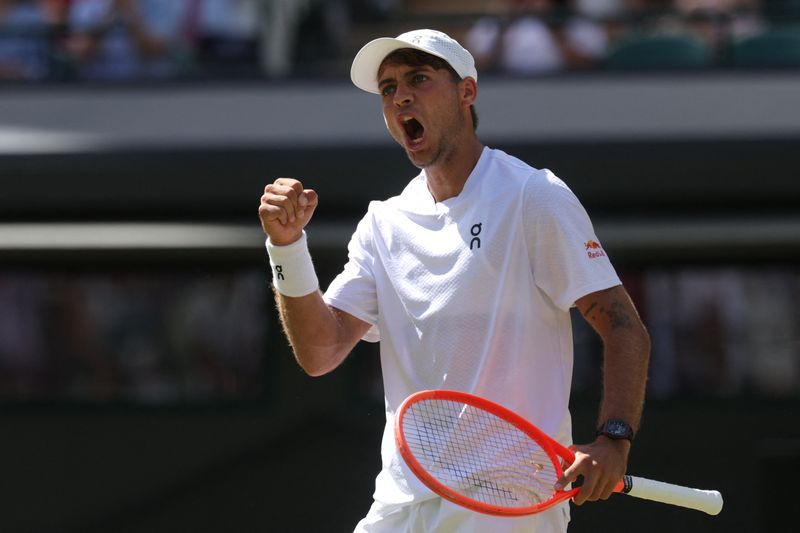
Flavio Cobolli's impressive Grand Slam trajectory continued on Monday when the Italian ninth seed dispatched Australian fifth seed Alex de Minaur 7-5 7-6(4) 6-3 on Court One, securing his place in the Wimbledon quarter-finals for a second consecutive year. The victory marked another milestone in what has become an exceptional few weeks for the 24-year-old, who finished as runner-up at Roland Garros just weeks earlier and is rapidly establishing himself among tennis's rising talents.
Cobolli's path to the quarter-finals this year appears considerably more forgiving than many of his peers, with a potential wildcard opponent awaiting in the next round. His fourth-round adversary will emerge from the clash between British hopeful Arthur Fery and Bulgarian veteran Grigor Dimitrov, both of whom have demonstrated considerable comfort on the grass courts of the All England Club during the preceding week. This favourable draw positioning offers Cobolli a genuine opportunity to extend his run even further and potentially challenge for a maiden Grand Slam title.
The Italian's domination of De Minaur—a significant scalp given the Australian's ranking and consistency—showcased his maturity and tactical acumen under pressure. Cobolli seized the opening set by forcing a backhand error to break serve in the eleventh game, claiming it in 50 minutes through aggressive and controlled play. The performance demonstrated why he has captured the attention of the global tennis establishment and accumulated ranking points that now place him among the tour's most dangerous competitors.
Extreme heat forced two stoppages during the match, reflecting broader concerns about player welfare and spectator safety at the tournament. During one interruption, a spectator fell ill as temperatures soared, prompting Cobolli to engage in lengthy courtside conversations with both supporters and his opponent. The Italian's sportsmanship during these intervals—acknowledging the difficultly of playing in such conditions and expressing gratitude to fans for enduring the heat—revealed a player comfortable with the theatrical and human dimensions of professional tennis beyond mere scorelines.
Cobolli's composure through the second set proved particularly impressive. After trailing 2-5, he rattled off three consecutive games to level the contest before navigating a tiebreak at 6-6 to take the set and establish commanding momentum. This resilience, combined with the powerful hitting that characterised his play at crucial junctures, underscored why he has already surpassed career expectations this season. De Minaur, despite his ranking and experience, could not withstand the variety and aggression Cobolli brought to key moments.
The third set became almost academic, with Cobolli recovering from trailing 0-2 and overcoming another break in the sixth game to dispatch his opponent decisively. His ability to maintain concentration through multiple service breaks—a weakness that has historically undermined less mature players—suggested genuine growth in his tactical and mental development. The commanding final set demonstrated a player who has clearly learned from his experiences at Roland Garros and carries that knowledge confidently into subsequent tournaments.
In his post-match commentary, Cobolli demonstrated refreshing candour about the physical and emotional toll of elite tennis. He acknowledged feeling fatigued from the tour's relentless demands and expressed satisfaction at defeating De Minaur in straight sets, allowing him to conserve energy for forthcoming challenges. This pragmatic approach to tournament management—prioritising freshness and preparation over spectacle—suggests coaching maturity and a player thinking beyond individual matches toward broader seasonal objectives.
Cobolli's respect for De Minaur was evident in his remarks, noting the Australian's tennis and wishing him well for the match ahead. Yet the Italian candidly admitted he had no intention of watching the Dimitrov-Fery encounter, preferring instead to recover through simpler pleasures: ice cream to combat the oppressive heat and homemade pasta prepared by his father. This glimpse into his preparation methods—combining strategic rest with nutritional support and family connection—offered insight into the holistic approach modern elite athletes employ beyond court performance.
The Italian's casual reference to planning to watch Spain versus Portugal in international football suggested balanced perspective about competitive sport's place within broader entertainment and personal interest. Rather than obsessing over upcoming opponents, Cobolli maintains intellectual and emotional equilibrium through diversified engagement. Such psychological equilibrium often distinguishes sustainable Grand Slam contenders from those who burn out after promising early seasons.
Cobolli's trajectory at Wimbledon this year mirrors his broader emergence as a genuine force in men's tennis. His French Open runner-up finish demonstrated capacity to sustain excellence across a fortnight, while his Wimbledon performance, coupled with strategic rest and recovery, suggests he approaches different surfaces with appropriate tactical flexibility. For Southeast Asian tennis enthusiasts tracking rising European talent, Cobolli's combination of youthful exuberance and developing maturity warrants sustained attention as subsequent Grand Slams unfold.

