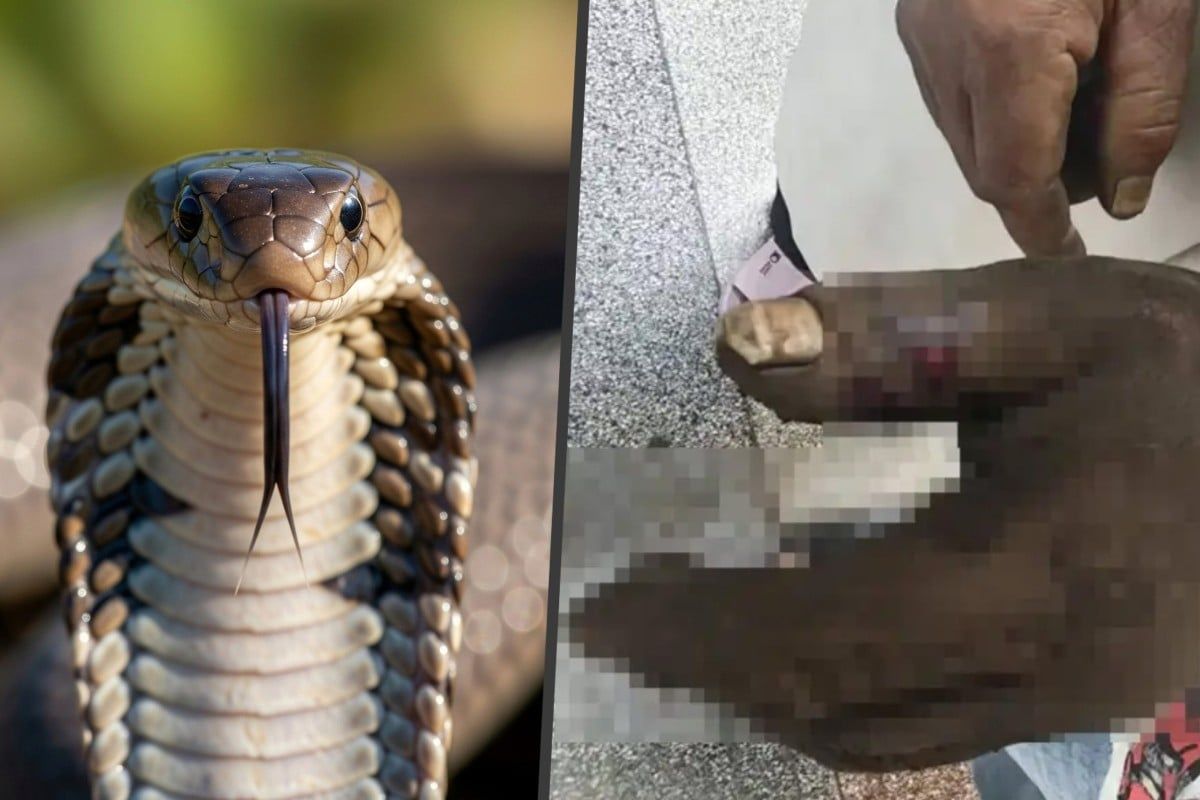
A farmer's life took an unexpected turn when a cobra bite triggered a chain of events that would harm not only him but also his devoted wife. The incident unfolded in Yuanyang county, Yunnan province in southwestern China, where the man was bitten on his finger while working his fields. What followed was a classic case of good intentions gone awry—his panicked wife, drawing on rescue techniques she had witnessed in television dramas, made a split-second decision that would land both of them in hospital beds.
The initial symptoms seemed manageable at first. The man's finger swelled considerably and he began experiencing dizziness and weakness, prompting his wife to act. Without hesitation or protective measures, she placed his wounded hand to her mouth and began sucking the venom directly from the puncture. This instinctive response, so frequently depicted in action films and television programmes, seemed like the logical course of action in a medical emergency. Her husband was rushed to Honghe Prefecture No 3 People's Hospital, where medical staff began treating his snakebite with appropriate antivenom serum.
Hours passed before the gravity of her decision became apparent. The wife began experiencing numbness in her mouth, tongue, face and limbs—telltale signs of neurotoxic poisoning. By the next day, she had developed severe fatigue that alarmed her family enough to bring her to the same hospital where her husband was being treated. Tests confirmed what hospital staff suspected: she had absorbed enough cobra venom through the delicate tissues in her mouth to cause systemic poisoning. Both patients received antivenom injections and supportive medical care, and after several days, their conditions stabilised enough for discharge.
The incident has provided an unexpected teaching moment for medical professionals across China, who have seized the opportunity to publicly debunk a dangerous misconception. Doctors at the Yunnan hospital explained that the oral mucosa—the soft tissue lining the mouth—contains an exceptionally rich network of capillaries, minute blood vessels that lie extraordinarily close to the surface. When venom comes into direct contact with these tissues, it enters the bloodstream almost instantaneously, allowing toxins to circulate throughout the body within minutes. What appears to be a rescue mechanism is actually a direct conduit for poison into the rescuer's own circulatory system.
The anatomy of snakebites further complicates this flawed rescue approach. Cobra fangs create tiny puncture wounds that resembles little more than small pinholes to the naked eye. Contrary to popular belief, venom does not remain in these shallow wounds waiting to be extracted. Instead, it rapidly disperses into subcutaneous tissues beneath the skin and enters the bloodstream through tissue fluid absorption. By the time a rescuer attempts to suck out venom, the toxins have already begun their journey through the victim's body, making the sucking action both futile and dangerous to the would-be helper.
Medical professionals have also warned against several other popular but harmful interventions that circulate in folk remedies and entertainment media. Cutting open the wound to encourage bleeding is particularly perilous, as it can cause excessive blood loss in an already-compromised victim and dramatically increase the risk of infection. The damaged tissue becomes vulnerable to bacteria, potentially leading to secondary complications more serious than the initial snakebite. Similarly, applying fire to burn away venom or ice to freeze it—techniques occasionally featured in films—should be avoided entirely. These approaches cause additional tissue damage and serve no therapeutic purpose.
Instead, medical authorities across China have launched public education campaigns outlining the correct protocol for snakebite incidents. The fundamental rule is immediate immobility; a snakebite victim should move as little as possible, as physical activity accelerates the circulation of venom throughout the body. Emergency services must be contacted without delay by calling the medical emergency hotline. Equally important is gathering information about the offending snake. Victims and bystanders should note the reptile's colour, pattern markings, and head shape—details that enable doctors to identify the species and select the appropriate antivenom serum.
China has experienced several high-profile snakebite cases in recent years, many of which have circulated widely on social media platforms. A particularly alarming incident occurred in Guangdong province in May when a 14-year-old middle school student was bitten by an unidentified reptile on his school campus. The teenager initially dismissed the incident, feeling no pain and unable to identify what had attacked him. Only hours later, when numbness spread through his limbs and his vision became blurred, did he report the incident to school staff. Hospital doctors treating him with antivenom serum provided a sobering assessment: had medical treatment been delayed by merely one to two additional hours, the boy would have experienced complete respiratory paralysis, a life-threatening condition.
The Yunnan farmer and his wife's ordeal has resonated across Chinese social media, where observers have reflected on the incident's broader implications. One online commentator noted that the case serves as a reminder that television dramas frequently prioritise dramatic impact over medical accuracy, and that viewers must approach such depictions with appropriate scepticism. Another response focused on the relationship between the couple, highlighting the wife's instinctive willingness to risk her own safety to help her spouse. Such incidents, while individually tragic, contribute to growing public awareness about snakebite first aid and the dangers of relying on entertainment media for health emergencies.
For residents of Southeast Asia, where venomous snakes remain common in agricultural and rural areas, the Yunnan incident carries particular relevance. Many countries in the region share similar ecosystems and snake species with southwestern China, meaning snakebites remain a genuine occupational hazard for farmers and outdoor workers. Public health authorities would be wise to disseminate similar educational messaging emphasising proper first aid protocols, as misguided rescue attempts could prove equally disastrous across the region. The couple's experience, despite its painful outcome, offers a valuable reminder that medical emergencies require clear thinking guided by evidence-based practices rather than entertainment-inspired instincts.

