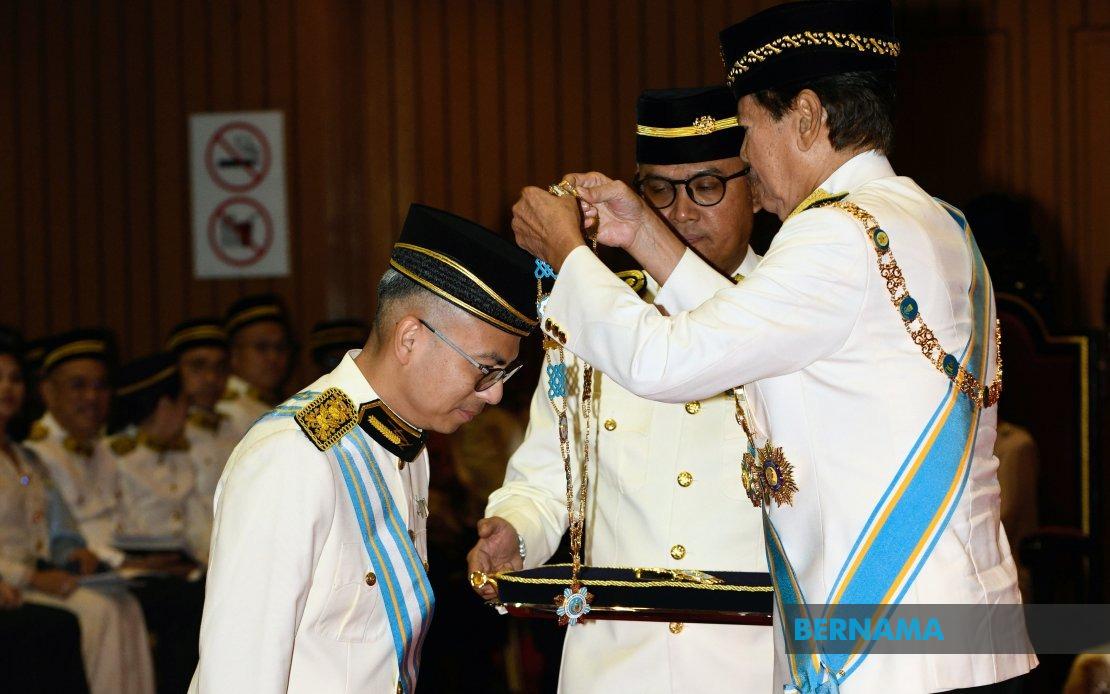
Datuk Fahmi Fadzil, the Communications Minister and government spokesperson, has been elevated to Datuk Seri status following his conferment with the Darjah Panglima Pangkuan Negeri (DPPN) award at Penang's investiture ceremony held in George Town. The honour was presented as part of the annual celebration marking the 85th birthday milestone of Penang Governor Tun Ramli Ngah Talib, underscoring the state's tradition of recognising distinguished public figures and notable citizens during ceremonial occasions.
Fahmi's recognition represents a significant acknowledgment of his tenure in a key ministerial portfolio overseeing Malaysia's communications sector, a domain increasingly critical to the nation's digital transformation and institutional effectiveness. As the sole recipient of the DPPN award in this round of honours, his selection reflects the prestige associated with this particular award class, which represents one of the highest tiers in Penang's honours hierarchy.
The broader investiture ceremony, formally titled the 2026 Investiture Ceremony for Penang State Orders, Decorations and Medals, demonstrates the comprehensive scope of Penang's annual recognition programme. A total of 230 individuals received acknowledgment across various honour categories during this edition, with the four-day event commencing on July 11 and continuing through July 15. This scale of recognition illustrates how Malaysian states utilise formal honours systems to acknowledge contributions across government, business, civil society, and cultural sectors.
Beyond Fahmi's elevation, the ceremony conferred the DGPN award—which likewise carries the Datuk Seri designation—upon 19 recipients, expanding the cohort of newly minted Datuk Seri holders across different professional domains. This group included Datuk Abdul Halim Mohammad, chairman of MARA Incorporated Sdn Bhd, a crucial institution supporting Bumiputera business development, and Datuk Loo Lee Lian, chief executive officer of Invest Penang, the state's investment promotion agency. These appointments reflect recognition of stewardship in organisations positioned at the intersection of economic development and state advancement.
Additional honour categories distributed during the ceremony encompassed the DMPN award granted to nine individuals and the DSPN award conferred upon 72 recipients, the latter category bestowing the title Datuk upon its recipients. The DSPN cohort notably included the late Nordin Ahmad, a respected filmmaker and scriptwriter from Cathay-Keris Film Productions, whose posthumous recognition underscores the state's acknowledgment of cultural contributions that extend beyond his lifetime. Other DSPN honourees encompassed Meor Ismail Meor Akim, director-general of the National Disaster Management Agency, and Datuk Mohd Irwan Mohd Mubarak, chairman of Bank Rakyat, each representing critical sectors including disaster resilience infrastructure and financial inclusion for lower-income populations.
The ceremonial proceedings were formally inaugurated by Tun Ramli Ngah Talib and his wife, Toh Puan Raja Noora Ashikin Raja Abdullah, who arrived at the Dewan Sri Pinang venue at 8:45 am to officially commence the investiture proceedings. The attendance and participation of the state governor underscore the constitutional and administrative significance attributed to these honour ceremonies within Malaysia's federal system, where state governors retain considerable custodianship over honours protocols and their distribution.
Among those receiving the DMPN classification was Datuk Azizee Ismail, former chief of the Penang police contingent, recognising his tenure leading the state's law enforcement apparatus during a period of evolving security challenges and community policing initiatives. His honour reflects how state recognition systems incorporate acknowledgment of senior civil service figures whose tenure shaped institutional development and public safety frameworks across their respective jurisdictions.
The comprehensive scale of this investiture programme extends significantly beyond the 101 individuals receiving formal state honours across the four designated award categories. An additional 1,120 recipients were scheduled to receive medals and honorary decorations over the same ceremony period, illustrating the tiered approach through which Malaysian states distribute recognition. This stratification allows for broader public acknowledgment across diverse constituencies while maintaining distinctive prestige associated with higher honour classifications, creating a system that balances inclusivity with hierarchical distinction.
For Malaysian political observers, Fahmi's elevation to Datuk Seri status carries implications beyond ceremonial significance. His prominence within the current administration—managing portfolio responsibilities across communications infrastructure and serving as the government's primary spokesperson—positions him as a central figure in shaping public communication strategies during a government renewal phase. The timing and nature of his honours recognition potentially signal sustained confidence from state-level institutions in federal ministerial capability, even as Malaysia's political landscape experiences periodic recalibrations at both national and state administration levels.
The Penang honours system, administered through the state's constitutional framework and governor's prerogatives, represents one of Malaysia's more active honour-conferring bodies. The state's consistent application of annual investiture ceremonies, combined with substantial numbers of recipients across multiple categories, reflects either robust institutional participation or heightened emphasis on public recognition within Penang's governance philosophy compared to certain other Malaysian states. These programmes serve broader functions in maintaining institutional morale, recognising unheralded contributions, and providing tangible acknowledgment of professional achievement across sectors that may receive limited public visibility.
Looking toward broader implications, honours systems like Penang's investiture ceremony serve as important instruments for state-federal relations and institutional cohesion. When senior federal figures receive recognition from state honours bodies, such moments reinforce inter-governmental cooperation frameworks and signal mutual respect across administrative hierarchies. For Malaysian readers monitoring government effectiveness and institutional relationships, such ceremonial events often contain subtle signalling regarding political relationships and administrative priorities that extend beyond their formal, celebratory dimensions.

