The 2026 National Day and Malaysia Day (HKHM) celebrations will be marked by an expanded programme featuring 16 specially designed activities aimed at deepening Malaysians' connection to their nation and reinforcing the bonds of unity across diverse communities. According to Harun Ali, the secretary of the Communications Ministry's Management Services Division, this comprehensive slate of initiatives represents a deliberate governmental strategy to ensure that the festivities extend beyond ceremonial observance and become genuinely participatory events that resonate with citizens from all walks of life.
Among the centrepiece programmes is Kembara Merdeka Jalur Gemilang (KMJG), complemented by a National Month Decoration Competition and activities branded as Ekspresi Merdeka and Kita MADANI Carnival. Each component has been carefully conceived to offer distinct entry points for public engagement, whether through competitive participation, community gatherings, or cultural expressions. The diversity of these offerings acknowledges that patriotism manifests differently across age groups, educational backgrounds, and cultural communities, and that a one-size-fits-all approach to national celebrations risks alienating segments of the population.
A particularly significant shift in the 2026 format involves relocating the Merdeka Eve Celebration highlight from its traditional venue to Stadium Merdeka, a venue laden with historical symbolism as the birthplace of Malaysian independence. This choice carries considerable weight, as Stadium Merdeka represents not merely a physical location but a symbolic anchor point connecting contemporary citizens to the founding moment of their nation. The decision to stage the principal evening ceremony there invites Malaysians to engage with their history tangibly, creating an emotional and experiential dimension to the national narrative that transcends abstract patriotic sentiment.
The centrepiece of the relocated Merdeka Eve Celebration will feature a special address by Prime Minister Datuk Seri Anwar Ibrahim timed to inspire national consciousness as midnight approaches. The strategic timing of this address—positioned at the threshold between one day and the next—carries psychological significance, framing the moment as a threshold between reflection on past struggles and commitment to future endeavours. Through this carefully orchestrated moment, the government seeks to crystallize disparate individual attachments to the nation into a collective moment of rededication and resolve.
Innovation in the 2026 programme includes "Melukis Senja," an aerial display component featuring Aero 3 aerobatic performances that produce dramatic smoke trails and synchronized fireworks illuminating Putrajaya's skyline. This visual spectacle serves multiple functions: it captures public attention through sheer aesthetic impact, generates social media content that extends reach beyond those physically present, and creates memorable imagery that becomes associated with the national celebration itself. The investment in such productions reflects an understanding that modern national celebrations must compete for attention in an increasingly fragmented media landscape.
Harun Ali's emphasis during his Bernama Radio appearance that these programmes target "all segments of society" underscores a recognition that national unity cannot be assumed but must be actively cultivated through deliberate outreach and inclusive programming. This approach acknowledges demographic and socioeconomic diversity as fundamental features of contemporary Malaysia requiring strategic accommodation rather than oversight. The breadth of proposed activities—spanning competitive, recreational, cultural, and ceremonial dimensions—creates multiple pathways through which different demographic groups can find meaningful participation opportunities.
The Communications Ministry's framing of these celebrations as an opportunity to emphasize the "price" of independence carries particular resonance in a Malaysian context where younger generations increasingly have no direct memory of pre-independence or early post-independence experiences. By explicitly connecting contemporary celebration to historical struggle and sacrifice, the government attempts to transmit an understanding of national achievement as earned rather than inherited, potentially motivating contemporary citizens to view their own civic responsibilities with equivalent seriousness.
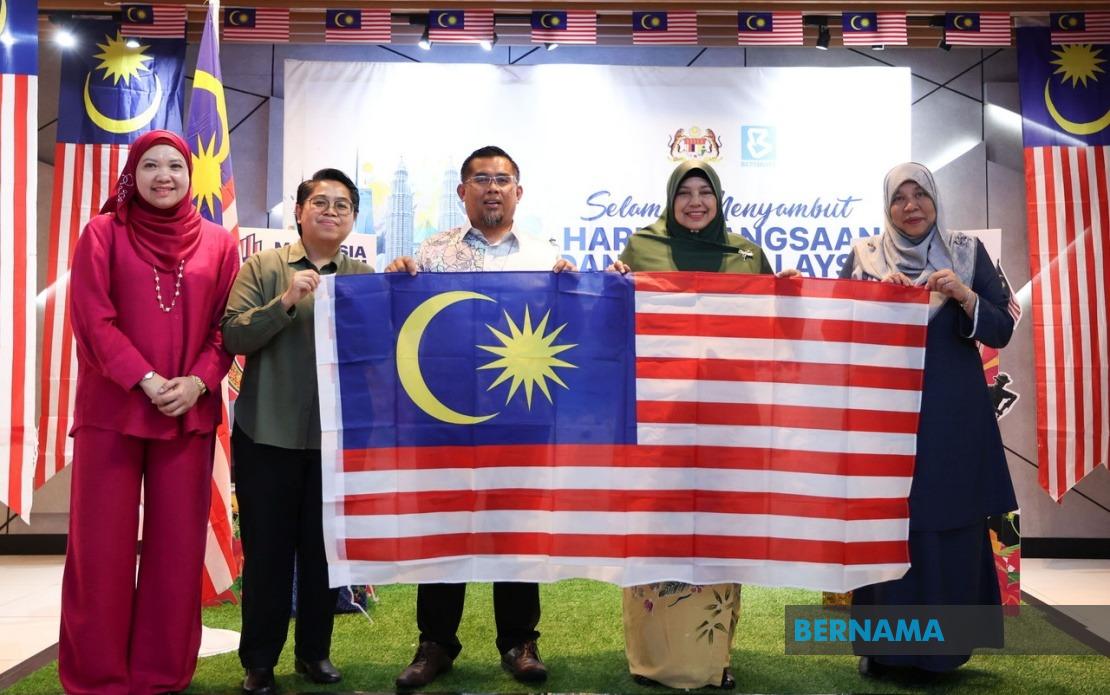
The symbolic gesture of presenting Jalur Gemilang flags to Bernama staff representatives a conscious effort to enlist media institutions in the patriotic enterprise. Since media organizations serve as crucial conduits through which national narratives reach the broader public, securing their active participation in flag-flying and celebration creates institutional commitment to amplifying the government's patriotic messaging. This approach reflects sophisticated understanding that state-sponsored nationalism requires coordination across multiple institutional sectors to achieve cultural penetration.
Harun Ali's specific call for Malaysians to demonstrate their "love for the country by flying the Jalur Gemilang" translates abstract patriotic sentiment into concrete behavioral expectations. The flag becomes a communicative medium through which private attachment is made publicly visible, transforming individual conviction into collective display. In the Malaysian context, where ethnic and religious diversity has historically required careful negotiation of shared national symbols, the Jalur Gemilang functions as a particularly laden symbol capable of conveying multiple meanings simultaneously—pride in national achievement, commitment to constitutional order, and acknowledgment of shared citizenship across difference.
The breadth of the proposed 2026 programming suggests recognition that sustained national unity requires ongoing cultivation and that commemoration ceremonies, if left to routine and habit, risk becoming hollow ritual divorced from genuine civic engagement. By introducing novel elements such as the Aero 3 aerial displays and expanding the geographic distribution of activities beyond Putrajaya's typical concentration, the government signals its intention to refresh approaches to national celebration while maintaining connection to established traditions. This balance between innovation and continuity carries particular importance in Malaysia's political economy, where generational change and urbanization pressures continuously reshape patterns of civic participation.
For Malaysian readers and observers across Southeast Asia, the 2026 HKHM programming reflects broader regional trends wherein governments increasingly employ experiential and immersive celebration strategies to strengthen national consciousness amid competing claims on citizen attention and loyalty. The Malaysian model, with its explicit inclusion of diverse community types and cultural expression modalities, offers a particular approach to managing multicultural national identity construction through celebration infrastructure. The ultimate success of these programmes will depend substantially on execution quality and genuine responsiveness to community participation preferences rather than top-down imposition of celebration formats.

