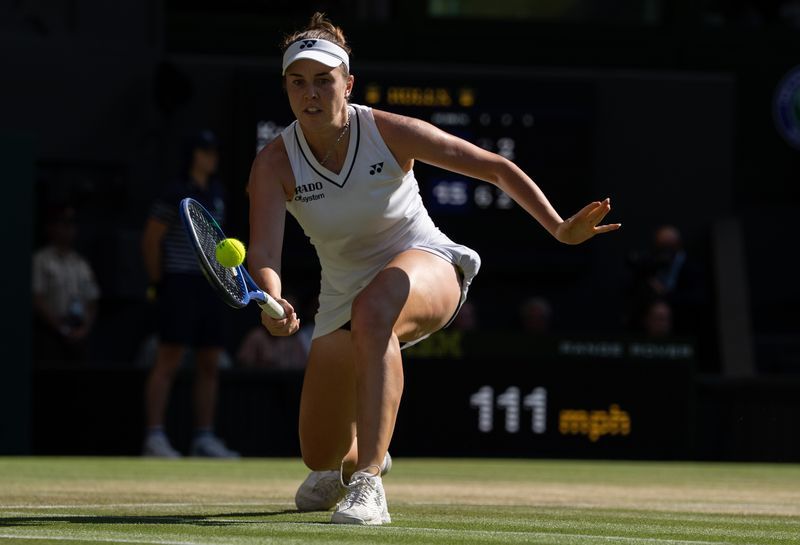
Linda Noskova's journey to the Wimbledon title reads like a study in mental fortitude and the psychology of competitive sport. The 21-year-old Czech player's triumph on Saturday came not from smooth dominance but from the kind of adversity that typically breaks young champions. Facing fellow Czech and friend Karolina Muchova in the final, Noskova found herself in an unimaginable position: commanding the match with five match points within her grasp, only to watch them slip away one by one, sending her spiralling toward what seemed like inevitable defeat.
The collapse itself was brutal in its drama. Leading 5-2 in the second set, Noskova appeared destined to raise the Venus Rosewater Dish on Centre Court. The victory seemed a formality, the path to hoisting the trophy a foregone conclusion. Yet Muchova's defiance began when serving at 2-5, refusing to surrender. The pressure of standing on the brink of the ultimate prize visibly seized Noskova's nerve. A double-fault conceded another match point at 5-3. Another critical opportunity dissolved in the ninth game. Before comprehension could fully register what was happening, Muchova had reeled off five consecutive games, forcing a decider that minutes earlier had seemed mathematically impossible. Noskova walked toward her chair in visible shock, covering her ears to muffle the crowd noise—a gesture that captured the psychological weight of nearly winning and nearly losing simultaneously.
What happened during that brief bathroom break would prove transformative. Noskova splashed cold water on her face, a physical reset that matched her mental recalibration. But the true turning point came not from tactics or technique—it came from perspective. Walking back toward the court, she glimpsed the trophies displayed nearby. In that moment, her thinking crystallised with remarkable clarity. "I was like, I'm not going to take the small one, I'm taking the big one," she explained afterward, describing how that visual reminder of what remained at stake shifted something fundamental in her consciousness. The trophies became a metaphorical anchor, pulling her back from the precipice of defeat and toward absolute commitment.
That psychological shift proved decisive. Returning for the third set, Noskova held serve in the opening game—a moment she would later identify as crucial to everything that followed. Holding that first game represented not merely a successful service hold, but a narrative reversal, a statement that the match was indeed starting anew. As she secured that hold, tangible changes became visible. Her timing on groundstrokes sharpened. Her footwork regained its rhythm. The player who had looked shell-shocked moments earlier now moved with renewed purpose across Centre Court. When match points came again at 5-3, nearly an hour after her first opportunity, Noskova would not be denied again. This time, she converted, claiming the title through sheer force of will.
Noskova's victory carries particular significance within Central European tennis. She becomes the third Czech woman to claim the Wimbledon title within four years, extending a remarkable run of success by Czech players on grass. At just 21 years old, she is the youngest women's champion since her compatriot Petra Kvitova captured the first of her two titles in 2011. The achievement places her in rarefied company and suggests the emergence of yet another formidable talent from a nation that has produced multiple Grand Slam champions in recent decades.
What distinguishes Noskova beyond her tennis abilities is a philosophical maturity that seems incongruous with her age. The ninth seed, identifiable by the nose ring she wears, carries perspectives formed by genuine personal adversity. Two years prior to her Wimbledon triumph, her mother Ivana died from cancer—an experience that has clearly shaped her approach to competition and life. Rather than allowing grief to diminish her ambitions, Noskova has channelled that loss into a broader worldview that extends well beyond tennis courts. During her off-season the previous year, she had travelled to Zanzibar, dedicating time to volunteer work at a school through a charitable organisation. That experience reinforced her appreciation for what she possesses, grounding her competitive drive within a larger framework of gratitude and social awareness.
Her environmental consciousness and plans for volunteering around nature conservation issues reveal a player with genuine depth of character. Speaking after defeating Marta Kostyuk in the semi-finals, Noskova articulated her vision for combining competitive tennis with meaningful volunteer work focused on environmental protection. Having grown up in a village within a Czech forest, her connection to nature appears foundational to her identity. She has articulated plans for her post-tennis career with the kind of deliberate intentionality that suggests someone thinking beyond trophy accumulation.
For Malaysian and Southeast Asian tennis enthusiasts, Noskova's narrative holds particular resonance. The region has produced its own rising tennis stars, yet the psychological frameworks that separate champions from near-champions often remain invisible. Noskova's recovery from near-certain defeat demonstrates that Grand Slam success at the highest level demands not merely technical excellence but psychological resilience, the capacity to reframe failure within minutes, and the mental discipline to prevent one setback from contaminating an entire match. Her relative youth amplifies the significance of these qualities—she has managed to develop championship mentality before many of her peers have even consolidated their basic professional credentials.
The match itself, despite its dramatic conclusion, showcased the depth of Czech tennis in the women's game. That two Czech players occupied the final speaks to systematic excellence in their tennis development. Yet beyond the Czech context, Noskova's victory demonstrates how younger players increasingly possess the psychological resources to navigate the intense pressure of Grand Slam competition. She faced a moment of genuine crisis—not merely a lost set but a complete mental collapse after squandering multiple championship-deciding opportunities—and found a way to reset and recommit with sufficient clarity to win the most demanding match in tennis.
As she processes her achievement, Noskova has expressed the weight of the moment. She recognised that this week will remain permanently etched in her memory, that the combination of near-heartbreak and ultimate triumph creates the kind of narrative that defines a career. The mental demons she confronted—the voice suggesting that five match points lost constitutes failure, that redemption would be impossible, that younger players cannot navigate such adversity—proved ultimately conquerable. She looked at those trophies, made a conscious choice about which one she would claim, and then executed that choice with the maturity of a champion far exceeding her chronological years.

