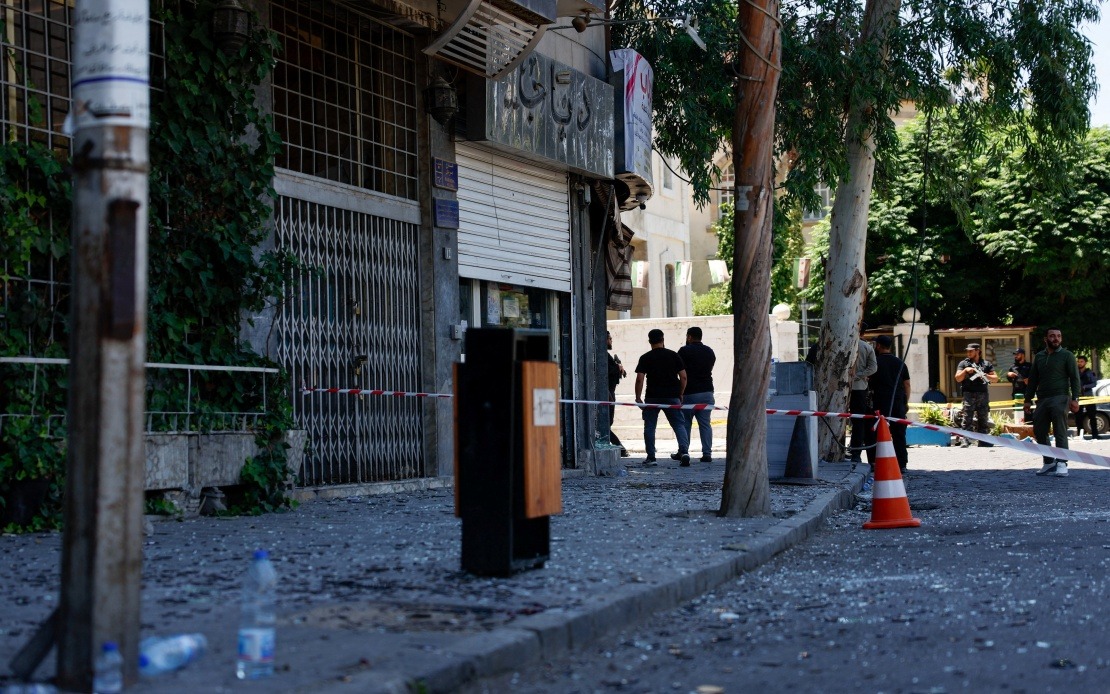
Two improvised explosive devices detonated in Damascus on Tuesday, leaving at least 18 people wounded including four police officers, according to Syria's Interior Ministry. The twin blasts struck the Syrian capital during a visit by French President Emmanuel Macron, whose official security team confirmed he remained unharmed in the incident. The explosions triggered significant concern among Damascus residents and prompted an immediate security response across the affected district.
Accounts from the Syrian Observatory for Human Rights, a London-based monitoring organisation, suggest the blasts occurred in close succession near the hotel where Macron was understood to be lodged during his stay. The initial explosion was followed seconds later by a more powerful detonation, according to the monitoring group's assessment. The proximity of the attacks to the French leader's location underscored security vulnerabilities in the Syrian capital despite the sensitive nature of his presence.
Macron's visit represents a watershed moment in European-Syrian relations, making him the first head of state from the European Union to enter Syria since 2010. His arrival on Monday evening signalled a potential shift in diplomatic engagement with the Damascus government following years of international isolation over the Syrian civil war. The timing of the bombings complicates what was intended as a carefully choreographed diplomatic mission aimed at reestablishing bilateral channels.
The Élysée Palace in Paris moved swiftly to reassure international observers about the French president's safety, confirming through official channels that Macron had not been harmed in the attacks. At the time of the blasts, he was engaged in substantive bilateral discussions with Syrian officials at the presidential palace, away from the central location where the explosions occurred. This separation from the blast site, while fortunate, nonetheless raised questions about security protocols during such high-profile visits to volatile environments.
Emergency response teams mobilised rapidly following the detonations, with ambulances and medical personnel converging on the scene to provide assistance to the wounded. The swift deployment of first responders helped limit potential casualties, though the full extent of injuries was still being assessed. Security forces established cordons around the affected area to preserve the scene and prevent further incidents while investigators began preliminary examinations.
The incident underscores the complex security environment facing Damascus, where sporadic violence persists despite the formal conclusion of the country's major conflict. Improvised explosive devices remain a recurring threat in Syrian cities, deployed by various non-state actors and reflecting the fragile security situation. For Malaysian observers and regional analysts, the bombing illustrates the precarious conditions that international delegations encounter when engaging with Middle Eastern governments emerging from prolonged civil conflict.
Macron's mission carries significant strategic implications for France's broader Middle East policy and Europe's approach to Syria's rehabilitation within the international system. The French leader's decision to visit personally, rather than sending lower-level representatives, demonstrates commitment to direct engagement with Bashar al-Assad's government. However, the bombing raises difficult questions about whether such diplomatic overtures can proceed safely amid ongoing instability.
The incident also reflects broader regional dynamics relevant to Southeast Asian policymakers. Syria's gradual return to Arab League membership and normalisation with regional actors has created diplomatic space for international engagement. France's initiative represents European interest in managing Syria's future trajectory through dialogue rather than isolation, a calculation that may influence how other nations approach their own diplomatic positioning in the region.
The timing of the attacks—occurring during talks between delegations—suggests potential coordination or advance intelligence by groups opposed to such engagement. Various factions within Syria's fractious political landscape have incentives to disrupt normalisation efforts, whether Islamist organisations, Kurdish groups, or other non-state actors. Understanding the source of Tuesday's blasts will be crucial for assessing whether this represents an isolated incident or signals broader opposition to Macron's diplomatic initiative.
Security challenges notwithstanding, Macron's itinerary proceeded as planned, with the French president remaining at the presidential palace for continued discussions. This determination to maintain the scheduled engagement despite the bombing sends a signal about commitment to diplomatic process, though it also exposes the inherent risks accompanying high-level visits to countries with active security threats. For regional observers, including those in Malaysia and ASEAN, the incident serves as a reminder that conflict termination does not automatically resolve underlying tensions or eliminate actors willing to deploy violence against international actors.
The broader implications of the bombing extend beyond immediate security concerns. It raises questions about whether Damascus can provide adequate protection for international dignitaries, potentially affecting the pace and nature of Syria's international rehabilitation. Nations considering their own diplomatic engagement with Syria will factor Tuesday's security incident into calculations about risk tolerance and the conditions under which such visits can be undertaken safely. The incident thus becomes part of the continuing assessment of whether Syria's stabilisation trajectory is proceeding sufficiently to warrant increased international involvement.

