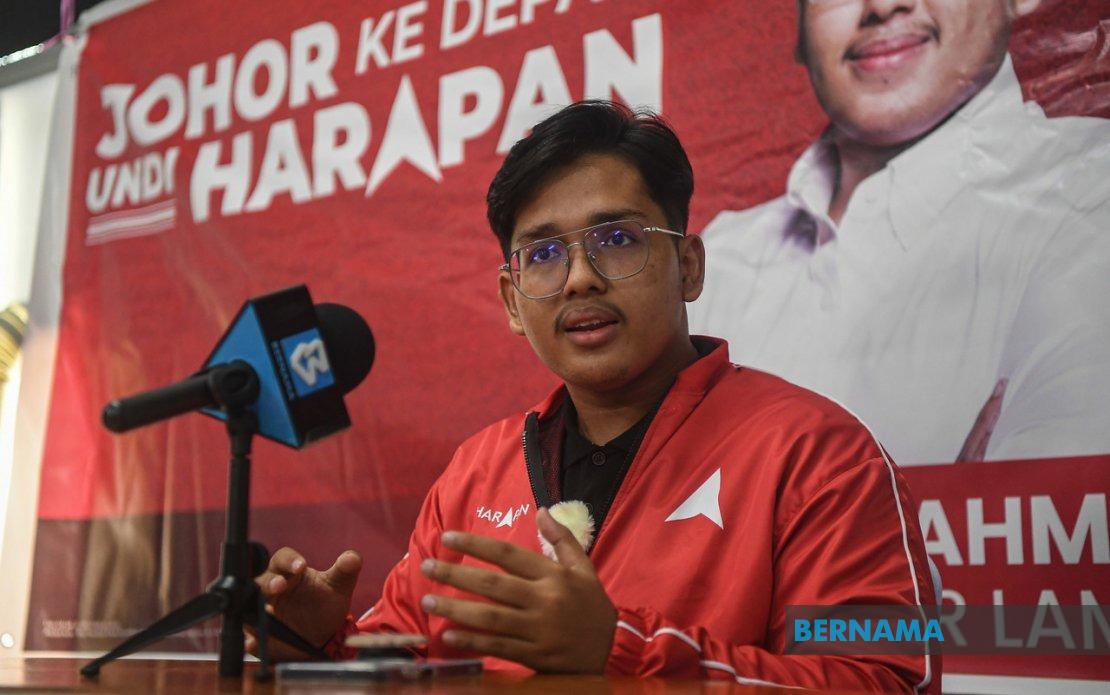
At 23 years old, Danish Hossman Abd Rahman stands as the youngest contender in Johor's state election, bringing a youthful perspective to the competition for the Johor Lama constituency. Running under Pakatan Harapan's banner with the campaign slogan "Wajah Baharu, Johor Lama" (A New Face, Johor Lama), the candidate has identified economic disparity and rural job creation as his central campaign themes ahead of the July 11 polling date.
The core of Danish's political platform centres on reversing the demographic drain afflicting rural Johor. He recognises that young people from Felda settlements and surrounding areas regularly migrate to Johor Bahru, Kuala Lumpur, or Singapore in search of employment, leaving their home communities depleted of working-age residents. Rather than accepting this as inevitable, Danish proposes that targeted investment in Johor Lama could fundamentally alter these migration patterns by creating viable economic opportunities within the constituency itself.
Crucially, Danish emphasises that this development strategy requires seamless coordination between state and federal governments. His argument suggests that fragmented governance—where state and federal agencies work in silos—has historically hindered policy implementation and infrastructure projects in peripheral constituencies. By advocating for stronger institutional alignment, he is positioning himself as a bridge-builder who understands that rural economic development cannot succeed through state-level initiatives alone.
The candidate specifically critiques what he characterises as a development imbalance within Johor itself. While major urban centres like Johor Bahru, Tebrau, and Kulai continue to attract substantial investment and government attention, constituencies like Johor Lama remain relatively neglected in terms of industrial development and economic diversification. This uneven distribution of resources has perpetuated the cycle where ambitious young people see no future in their own constituencies and therefore depart for greener pastures.
Beyond macroeconomic issues, Danish has identified a practical administrative grievance affecting Johor Lama residents: the absence of an Immigration Department branch office in Kota Tinggi. Currently, constituents requiring passport applications, visa processing, or other immigration services must travel to Johor Bahru, Kulai, or Mersing—journeys that consume time and resources. He proposes establishing an immigration centre locally, a modest but tangible commitment that addresses genuine constituent inconvenience.
His campaign methodology reflects an understanding of contemporary electoral dynamics in Malaysia. Danish combines traditional ground-level engagement—meeting constituents face-to-face and listening to their concerns—with active social media deployment to reach the constituency's 32,000-plus eligible voters. This hybrid approach acknowledges that different voter demographics respond to different communication channels, and that digital-native younger voters require online engagement whilst older residents value direct interaction.
The Johor Lama contest itself has become genuinely competitive. Danish faces a three-way battle against incumbent Norlizah Noh representing Barisan Nasional and Aisah Esa fielded by Perikatan Nasional. The presence of two established political forces means Danish must differentiate himself through distinctive policy offerings and grassroots energy rather than relying on organisational machinery or incumbency advantages. His youth, paradoxically, becomes both liability and asset—presenting him as an outsider unburdened by past political entanglements, but also requiring him to demonstrate sufficient gravitas and policy depth.
The timing of this election reflects broader political recalibration within Johor. The state has become a crucial battleground where PH seeks to rebuild presence after previous electoral setbacks, Barisan Nasional attempts to consolidate traditional strongholds, and Perikatan Nasional competes to expand footprint beyond its initial power bases. Danish's campaign in Johor Lama, therefore, carries implications extending well beyond the constituency itself, potentially influencing broader state-level political trajectories.
For rural constituencies across Malaysia and Southeast Asia, the issues Danish raises—economic marginalisation of non-urban areas, youth migration, inadequate service provision—resonate widely. His campaign represents an implicit critique of development models that concentrate investment in metropolitan regions whilst peripheral areas stagnate. Should voters respond positively to his message, it could signal Malaysian electorate appetite for politicians who explicitly address rural-urban inequalities rather than assuming them inevitable.
The early voting scheduled for July 7 and main polling on July 11 will determine whether Danish's message of bringing investment and opportunity to neglected rural areas succeeds in mobilising sufficient support. Regardless of electoral outcome, his candidacy reflects evolving demands from Malaysian voters, particularly in rural constituencies, for tangible plans addressing economic inclusion and service accessibility rather than abstract political slogans.
Danish's focus on the Felda community is particularly significant given these settlements' historical importance to Malaysian governance and their contemporary economic challenges. Many Felda residents—descendants of the land schemes' original settlers—face accumulated disadvantages including aging agricultural economies, limited non-farm employment, and generational outmigration. A political narrative centring their specific needs potentially opens space for broader conversation about how Malaysian development can become more geographically inclusive.
The constituency contest ultimately tests whether young, articulate candidates offering localised development solutions can compete against established political machines and incumbency. If Danish's approach gains traction, it may inspire similar campaigns elsewhere, potentially reshaping how Malaysian politicians address rural development challenges.

