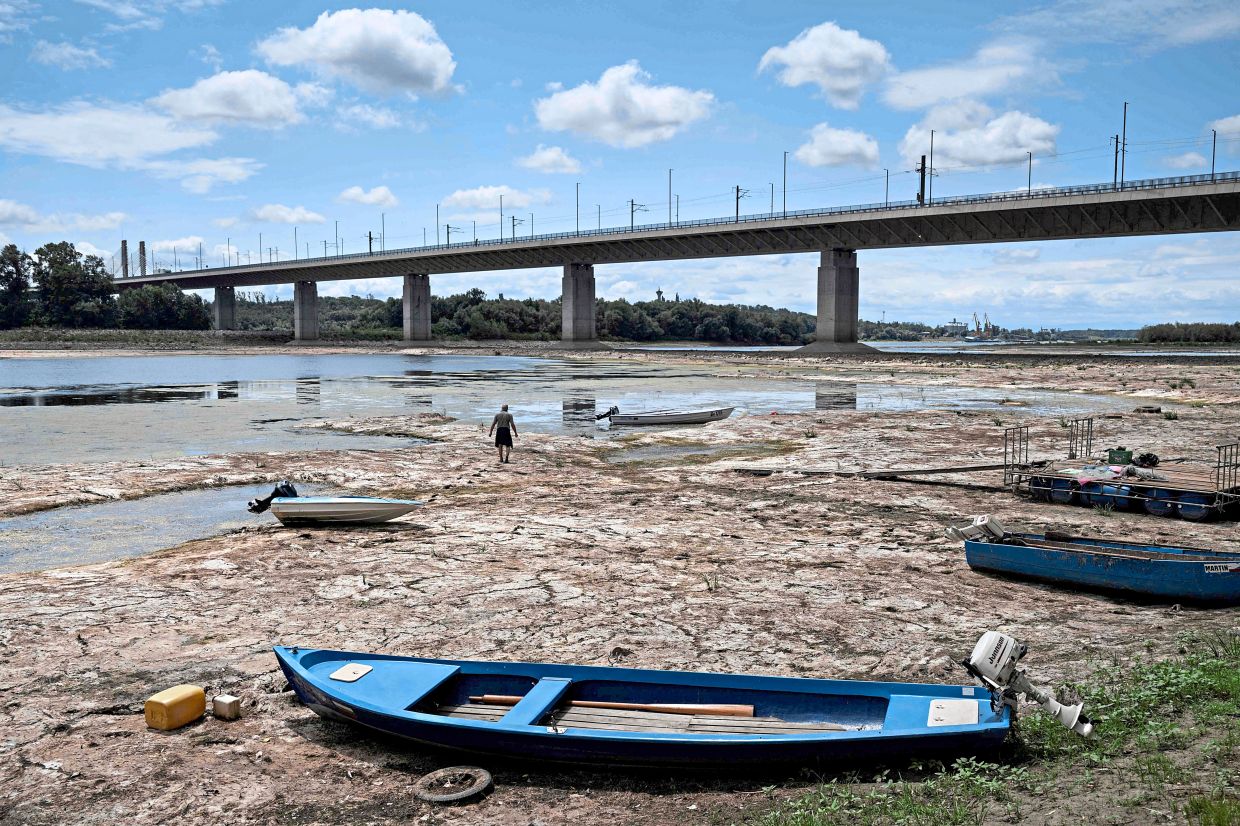
The Danube River, one of Europe's most strategically important waterways, has plunged to historically unprecedented levels as a sprawling drought grips Central Europe, creating cascading disruptions across the continent's energy, transport, and tourism sectors. The waterway, which traverses ten countries from southwestern Germany to the Black Sea, has retreated so dramatically along much of its course that submerged obstacles invisible for decades—corroded shipwrecks, buried debris, and ordnance from world wars—now protrude from exposed sandbars and rocky outcrops. This environmental crisis offers a stark illustration of how climate change manifests through interconnected systems, with consequences that ripple across industries, national borders, and energy supplies across Southeast Europe and beyond.
Measurements recorded in Budapest during late July revealed water levels at merely 23 centimetres, obliterating the previous record low of 33 centimetres established in 2018. Hungary's national water authority documented this alarming decline even as meteorologists forecast continued heat, with temperatures expected to exceed 38 degrees Celsius across the region and virtually no meaningful precipitation anticipated. The Hungarian Meteorological Service has calculated that 90-day rainfall accumulations across nearly the entire country have fallen 80 to 130 millimetres below long-term statistical averages, indicating a systematic failure of normal precipitation patterns rather than a temporary anomaly. This extended drought, compounded by consecutive heat waves that accelerated evaporation rates, has transformed what should be one of Europe's most reliably navigable waterways into an increasingly marginal transportation corridor.
The immediate impact on passenger and cargo operations has been severe. Tourism operators have been forced to relocate embarkation points for cruise ships far upstream from Budapest, disrupting the carefully choreographed logistics that support Central Europe's river-tourism industry. Cargo vessels, which form the backbone of regional freight movement, have essentially ceased operations entirely according to Hungary's Ministry of Transport and Investment. The broader economic consequence extends beyond shipowners: riverside communities that depend on transshipment hubs, stevedores whose livelihoods centre on cargo handling, and hospitality businesses reliant on cruise passenger spending now confront weeks of lost revenue with no certainty about recovery timelines.
The human dimension of this crisis became starkly visible in late July when Bulgarian authorities evacuated 186 tourists from the cruise ship Viking Ullur, which had run aground on a shallow bar near Vidin, a port city on the Danube-Romania border. The vessel had become stranded while attempting to reach Vidin to replenish food and water supplies, leaving passengers in a precarious situation. The ship's 52 crew members faced an indefinite stay aboard pending navigation conditions and technical refloating assessments, transforming what had been advertised as a leisurely holiday into an involuntary maritime detention. In Serbia's northern region near Novi Sad, the situation deteriorated further, with hundreds of recreational vessels and dozens of commercial cargo ships marooned along the exposed riverbank, their owners watching helplessly as the waterline retreated 15 to 20 metres from its normal position.
One river-excursion operator, Radovan Segrt, crystallised the seasonal catastrophe facing thousands of small businesses: the entire summer tourism season has effectively concluded, stranding workers without income and leaving planned revenues unrealised. Photographer Gabor Kertesz documented the jarring transformation at Budapest's Margaret Bridge, capturing images of previously submerged terrain now accessible to foot traffic. His observations reflected a broader psychological shift among Central Europeans confronting visible evidence of climatic transformation: the sight of bare rock and desiccated sandbars where water had always flowed provoked reflections on causation and consequences that climate statistics alone rarely achieve.
Perhaps most consequential is the threat to nuclear energy infrastructure upon which multiple countries depend for baseload electricity generation. Romania's water flow measurements along the Danube had declined to 1,630 cubic metres per second—approximately one-third of typical July averages—forcing authorities to initiate a controlled shutdown of a reactor unit at the Cernavoda nuclear power plant for safety reasons, with plans to deactivate an additional unit shortly thereafter. Hungary's Paks nuclear facility, which supplies nearly half of the nation's total electricity output, began emergency power reductions on July 29 due to insufficient cooling water availability. This facility had already implemented two successive power reductions across separate reactor units during the preceding two days, indicating an escalating constraint on available cooling capacity. The cascading shutdowns raise critical questions about grid stability and energy security across Central Europe during peak summer demand periods when air-conditioning loads are at maximum.
The vulnerability of nuclear plants to hydrological constraints represents a dimension of climate adaptation that policymakers across the region had inadequately addressed. Unlike coal or gas facilities that require absolute water volumes, nuclear reactors depend on continuous temperature-differential cooling; when ambient water temperatures rise and available volumes contract simultaneously, safety margins compress dramatically. Romania and Hungary now confront scenarios where environmental conditions force energy deficits precisely when demand peaks, potentially necessitating emergency power imports at premium costs or rolling load-shedding that disrupts industrial and residential consumers.
Beyond the immediate economic disruptions, the receding Danube has exposed dangerous historical artifacts that demand urgent remediation. Budapest authorities closed the Margaret Bridge after a World War II-era bomb surfaced at the bridge's foundation, exposed by the vanished water column. Treasure hunters with magnetic retrieval equipment have begun systematically extracting submerged metal objects from the riverbed—corroded radio amplifiers, ammunition casings from successive world wars—items that had remained safely entombed beneath decades of river silt. This archaeological exposure, while occasionally yielding to romantic interpretations about history emerging from the depths, simultaneously underscores the potential for uncovering dangerous unexploded ordnance that threatens public safety across multiple countries.
The Danube's crisis encapsulates how climate change operates not as a distant abstraction but as a tangible reordering of physical systems upon which contemporary societies depend. For Malaysia and Southeast Asia, which monitor European developments closely while managing their own water-security challenges during increasingly erratic monsoon patterns, the Danube situation offers instructive lessons about infrastructure vulnerability. When precipitation patterns become unreliable and extreme temperatures accelerate evaporation, water-dependent systems—whether nuclear cooling, hydroelectric generation, irrigation, or navigation—simultaneously experience constraint, potentially triggering cascading failures across multiple sectors. Central Europe's current crisis serves as advance warning about the integrated nature of climate impacts and the inadequacy of sectoral adaptation strategies that fail to anticipate simultaneous stresses on interconnected systems.

