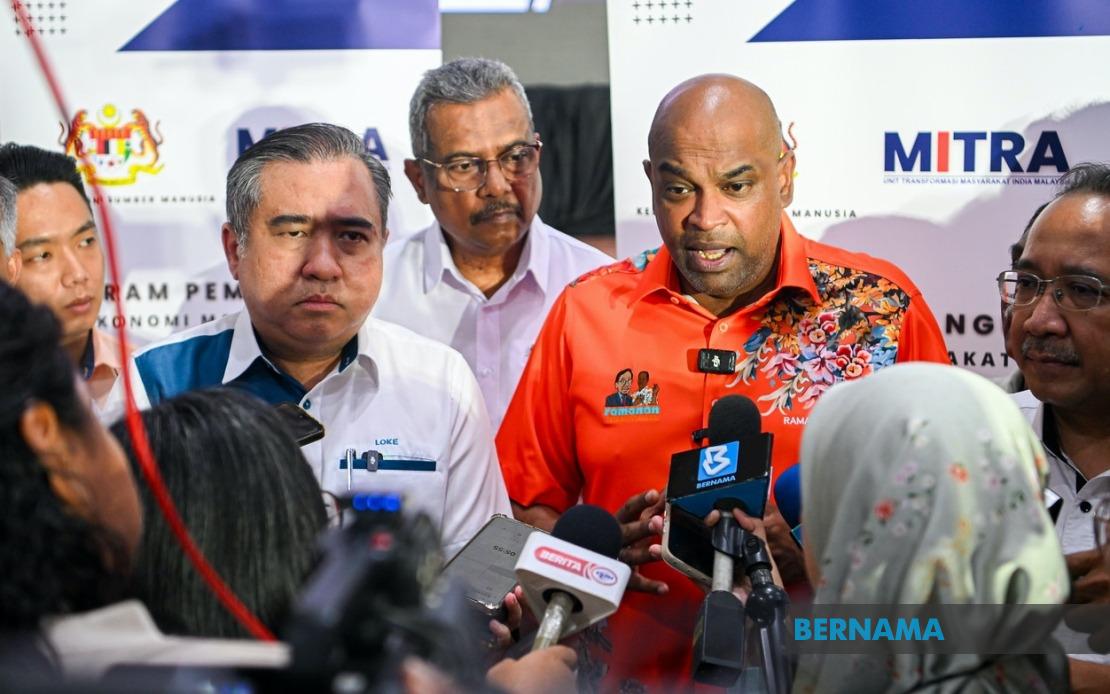
Transport Minister Anthony Loke moved to quash what he characterised as a repetitive political attack on Pakatan Harapan, flatly rejecting suggestions that the Democratic Action Party exercises unilateral control over the coalition government. Speaking in Seremban on July 7, the DAP secretary-general explained that the machinery of decision-making operates fundamentally on collaborative principles, with multiple parties contributing to the formulation of both federal and state-level policies.
Loke's remarks came as a direct response to persistent claims in political circles that the federal administration takes its direction from DAP rather than functioning as a genuine partnership among its constituent members. He characterised these allegations as a worn-out rhetorical device, one that opposition figures and critics repeatedly deploy to undermine public confidence in the Pakatan Harapan administration. The framing of such accusations as a "tired narrative" suggests frustration within the coalition at having to repeatedly defend the legitimacy of its governance model against what it views as predictable partisan attacks.
Elaborating on the decision-making process, Loke outlined how Prime Minister Datuk Seri Anwar Ibrahim presides over a consultative framework that genuinely incorporates input from DAP, UMNO, and PKR before finalising any major governmental direction. This structure reflects the fundamental challenge facing any multiparty coalition: balancing the need for decisive leadership with the competing interests and policy preferences of diverse partner organisations. Loke's description emphasises that while each component party actively voices its position during internal deliberations, final authority rests with the Prime Minister, a distinction that appears designed to address concerns about DAP capturing the administration.
The minister's comments reveal an important tension within Malaysian coalition governance. DAP, as the most ideologically cohesive and organisationally disciplined component of Pakatan Harapan, naturally wields considerable influence in policy discussions. However, framing this influence as domination becomes problematic in a system predicated on shared responsibility. By insisting that all parties contribute their perspectives and that the Prime Minister retains ultimate decision-making authority, Loke attempts to position DAP as one voice among several rather than as the hidden puppet master that opposition narratives suggest.
In Negeri Sembilan specifically, Loke pointed to the governance model adopted under Menteri Besar Datuk Seri Aminuddin Harun as evidence that collaborative decision-making extends beyond federal level. The state administration similarly consults with all coalition component parties before implementing policy, according to Loke, demonstrating consistency in how Pakatan Harapan translates its partnership principles into actual governance practice. This multi-level perspective matters because it allows Loke to argue that the coalition's approach reflects genuine structural commitment rather than tactical accommodation.
Another line of attack that Loke addressed concerns demographic and communal interests in Negeri Sembilan. Opposition voices had suggested that Malay communities faced marginalisation under Pakatan Harapan stewardship, a sensitive claim in a state where Malay-Muslim demographics predominate. Loke's response deployed a straightforward factual counterargument: the Menteri Besar remains Malay, continuity matters, and government programmes ostensibly continue safeguarding community interests across all ethnic groups. The rhetorical move here attempts to delegitimise what Loke characterises as recycled fearmongering by pointing to observable evidence that fundamental structures and protections remain intact.
The broader context for Loke's statements involves the fragility inherent in Malaysia's multiparty coalition system. Pakatan Harapan comprises parties with fundamentally different ideological orientations and social bases. DAP draws predominantly Chinese urban support with secular-progressive leanings, while UMNO represents traditional Malay-Muslim conservatism, and PKR occupies a centrist space. That such a coalition functions at all is remarkable; that it occasionally fractures under pressure is entirely predictable. Accusations that one party dominates naturally resonate because coalition governance genuinely does involve jockeying for influence and policy concessions.
Loke's insistence on collective decision-making reflects how coalition partners must publicly present their relationship to maintain both internal cohesion and external legitimacy. Acknowledging that DAP exercises disproportionate influence would validate opposition narratives about one-party domination and potentially alienate UMNO or PKR members concerned about their standing within the government. Conversely, pretending that party affiliations and philosophical differences simply dissolve in collegial consensus strains credibility. The Transport Minister navigates this tension by acknowledging robust internal debate while emphasising that hierarchy and final authority rest with the Prime Minister.
For Malaysian voters, particularly in states like Negeri Sembilan where Pakatan Harapan holds power, these arguments about internal governance structure carry practical implications. If DAP indeed captures policy direction, the implications for Malay-Muslim interests, Islamic affairs, and traditional institutions might differ significantly from a genuinely balanced coalition approach. Conversely, if decision-making truly emerges from negotiated compromise among parties with competing constituencies, voters should expect policies reflecting that bargaining dynamic. Loke's intervention essentially asks the public to trust that institutional safeguards exist and function as designed.
The controversy also highlights how Malaysian political discourse remains vulnerable to identity-based narratives despite Malaysia's democratic evolution. Suggestions that one ethnic or religious group dominates government naturally provoke anxiety, particularly among communities accustomed to thinking of themselves as majority populations. DAP's prominence in Pakatan Harapan, combined with its historical association with non-Malay interests, creates a natural target for such claims regardless of actual policy outcomes. Loke's rebuttal attempts to reframe the discussion around institutional structures and substantive governance rather than demographic identity, though such reframing challenges deeply embedded political reflexes.
Moving forward, the credibility of Loke's position depends substantially on observable policy outcomes and perceived fairness in how coalition disputes are resolved. If Negeri Sembilan and federal governments continue demonstrating that Malay-Muslim community concerns receive genuine consideration and that policy reflects negotiated compromise rather than DAP preferences, the "DAP dictates" narrative may gradually lose traction. Conversely, if policies appear consistently to privilege urban secular constituencies at the expense of traditional interests, such accusations will likely intensify regardless of Loke's institutional explanations.

