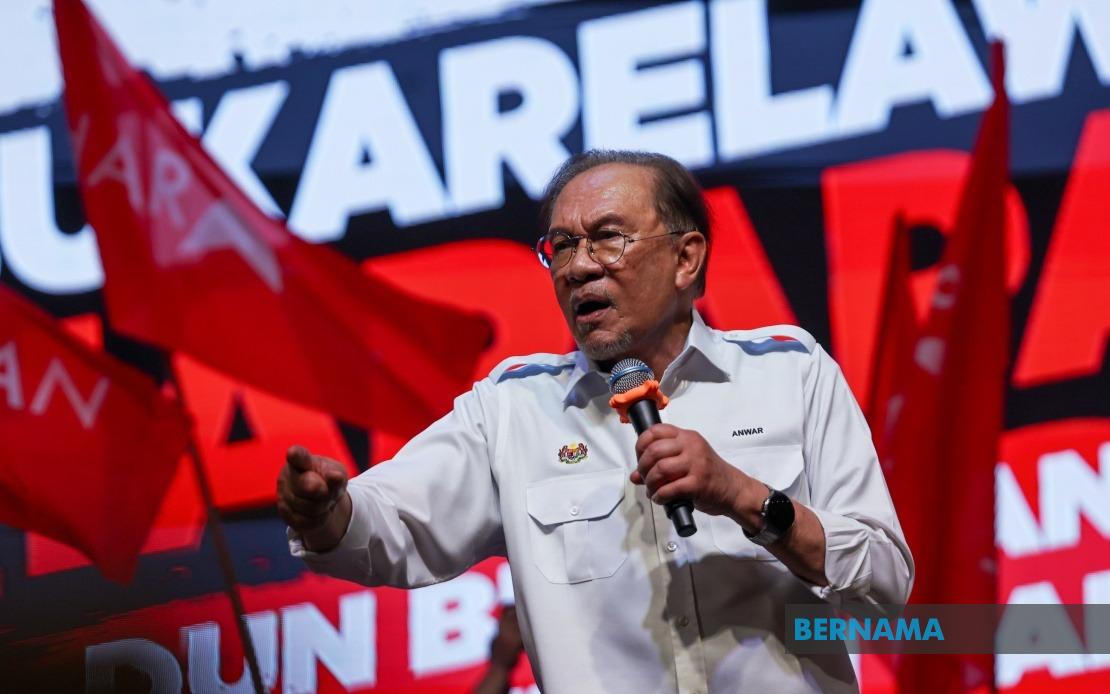
Prime Minister Datuk Seri Anwar Ibrahim moved to counter perceptions that the Democratic Action Party harbours anti-Malay sentiment, asserting instead that the Chinese-majority coalition partner has consistently upheld constitutional protections for the Malay community. Speaking during a grassroots engagement in Muar on July 5, Anwar positioned himself as a bridge-builder between competing narratives about race and governance, arguing that defending minority interests need not come at the expense of recognising Malay and Bumiputera privileges enshrined in the Federal Constitution.
As chairman of the Pakatan Harapan coalition that anchors the Unity Government, Anwar cited concrete examples to buttress his defence of DAP. He highlighted the party's acceptance of gazetting 20.23 hectares in Bandar Malaysia as Malay Reserve Land, a decision that could have faced legal or procedural objections had DAP genuinely opposed Malay rights. This example underscores a broader political reality: the coalition government, despite its multiethnic composition, has functioned without dismantling existing Bumiputera privileges or constitutional protections that form the bedrock of Malaysia's social contract.
The Prime Minister's comments arrive at a sensitive moment for the Unity Government. Since its formation in 2022, DAP's participation alongside United Malays National Organisation has generated periodic accusations from opposition quarters that the coalition represents a threat to Malay-Muslim dominance. These narratives, though often politically motivated, have proven resilient in certain constituencies, particularly among Malay voters concerned about demographic change and cultural erosion. Anwar's intervention seeks to neutralise such messaging ahead of the Johor state election scheduled for July 11, where 172 candidates compete for 56 assembly seats.
Anwar articulated a vision of inclusive governance that does not require abandoning targeted support for any community. He stressed that expanding assistance to Bumiputeras through agencies such as Perbadanan Usahawan Nasional Berhad, a state enterprise promoting Malay and indigenous entrepreneurship, proceeds without obstruction from coalition partners. Simultaneously, he rejected what he characterised as zero-sum thinking about development: programmes serving Chinese communities or impoverished Indians should not be portrayed as threats to Malay advancement. This framing implicitly critiques opposition parties that capitalise on racial anxieties by suggesting that any concession to minority populations inherently diminishes majority group welfare.
Beyond the immediate politics of ethnic relations, Anwar invoked a broader philosophy of developmental fairness. He contended that Malaysia's economic growth, visible in recent macroeconomic indicators, loses legitimacy if confined to enriching political elites or business cronies rather than trickling down to ordinary households. The distinction Anwar drew—between growth and genuine prosperity—reflects frustration among many Malaysians that headline GDP figures obscure persistent inequality, stagnant wages, and declining purchasing power for middle and lower-income families.
The Prime Minister enumerated concrete manifestations of shared prosperity: affordable housing, accessible basic services, and quality education for all children regardless of background. These touchstones resonate particularly in Johor, where rapid urbanisation has strained infrastructure while rural voters feel increasingly marginalised from development corridors. By anchoring his argument to material improvements rather than abstract principles of equality, Anwar attempts to reframe the unity agenda as pragmatically beneficial rather than ideologically threatening to Malay voters.
Anwar's remarks also contained a subtle moral critique of political leadership. He cautioned younger Malaysians that political power represents a public trust rather than a vehicle for personal enrichment, an implicit rebuke to perceptions of corruption and self-dealing that have dogged Malaysian politics across party lines. This ethical dimension distinguishes his appeal from purely transactional campaign messaging and signals that the Unity Government, despite its internal contradictions, aspires to transcend the patronage networks that have historically fragmented Malaysian politics along ethnic lines.
The timing of these comments in Muar, a Johor constituency with significant urban and rural populations, underscores their strategic importance. Johor represents crucial electoral terrain: the state has historically favoured UMNO, yet its diverse economy and growing migrant populations make it permeable to multiethnic messaging. The opposition Perikatan Nasional coalition, which controls several Johor constituencies, has cultivated Malay anxieties to mobilise support. Anwar's intervention seeks to inoculate voters against such appeals by demonstrating that the Unity Government can simultaneously respect constitutional Malay privileges while expanding opportunity for all communities.
Critically, Anwar did not argue that Malay or Bumiputera rights should be diluted. Rather, he contended that expanding the economic pie and improving governance benefits Malays alongside other communities more than zero-sum competition. This distinction proves crucial for legitimising the coalitional arrangement within Johor's Malay-majority voter base, many of whom supported UMNO for decades partly because the party positioned itself as the guardian of Malay interests. Anwar implicitly suggests that the Unity Government can fulfil that custodial role whilst offering more competent administration and broader prosperity than alternative arrangements.
The electoral context surrounding these remarks cannot be divorced from their substance. With early voting scheduled for July 7 and polling on July 11, the Johor state election will test whether the multiethnic coalition retains sufficient support to govern effectively. A strong showing in Johor would validate Anwar's vision of inclusive governance and provide momentum for the Unity Government as it approaches the critical federal election cycle. Conversely, a Perikatan surge would embolden opposition narratives about ethnic threat and coalition instability, potentially unravelling the delicate balance Anwar has carefully constructed.
For Malaysian and regional observers, Anwar's intervention illustrates the continuing centrality of race in Southeast Asian politics. Despite decades of modernisation, multiethnic democracies in the region remain vulnerable to narratives positioning ethnic groups as competitors for fixed resources. Anwar's attempt to decouple economic advancement from ethnic zero-sum logic represents a genuine, if precarious, departure from that template. Whether such messaging proves durable—particularly when economic growth slows and distributional conflicts sharpen—remains an open question that will shape Malaysia's political trajectory for years ahead.

