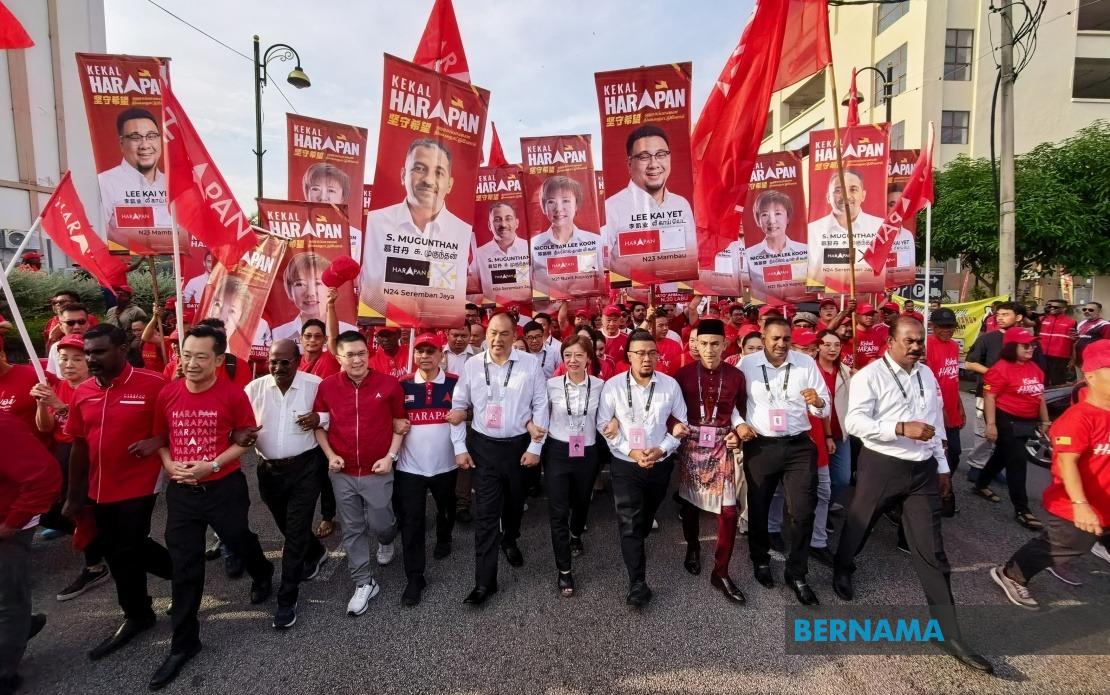
Negeri Sembilan DAP treasurer Siaw Meow Keong will contest a fiercely competitive four-cornered battle to retain the Rahang seat in the 16th Negeri Sembilan state election, having secured the constituency just over a year ago in 2023. The announcement came following the formal nomination process in Seremban on July 18, when the returning officer Mohamad Najib Mustafa released the full slate of eligible candidates at the Seremban City Council Hall.
Siaw's nomination for the Rahang seat represents Pakatan Harapan's endorsement of his tenure since 2018, signalling party confidence in his representation of the largely Chinese-majority constituency. However, the diverse challengers he faces reflect the fragmented opposition landscape that has characterised recent Malaysian electoral contests. His principal rival will be Yap Siok Moy, the Rasah MCA Wanita chief representing Barisan Nasional, alongside S. Thinagaran of Parti Sosialis Malaysia and Tang Jay San fielded by Bersatu. The filing sequence witnessed Thinagaran submitting papers first at 9.06 am, followed by Tang at 9.10 am, Siaw at 9.12 am, and Yap completing the quartet at 9.13 am, indicating intense coordination among campaign teams.
The Rahang constituency contest exemplifies the broader political dynamics reshaping Negeri Sembilan, where established coalitions now face sustained pressure from multiple fronts. DAP's stronghold in this predominantly urban, Chinese-populated area has historically been relatively secure, yet the emergence of credible challengers from both traditional opposition forces and newer entrants demonstrates the volatility of contemporary Malaysian politics. The PSM candidate's presence particularly signals that left-wing alternatives are attempting to gain traction in state-level contests, while Bersatu's participation underscores the party's ongoing efforts to establish itself as a meaningful electoral force beyond its Peninsular strongholds.
Across the state, other constituencies reveal similarly competitive dynamics. In Bukit Kepayang, incumbent Nicole Tan Lee Koon of DAP Wanita faces a direct contest against Lee Boon Shian representing Perikatan Nasional, suggesting that this seat has become a key battleground between the ruling coalition and the PN-led opposition bloc. This binary contest reflects the polarisation occurring in certain constituencies where one opposition alliance has effectively consolidated its challenge to Pakatan Harapan's hold on power.
The election commission has structured the campaign timeline carefully, with early voting scheduled for July 28 and election day set for August 1, providing candidates with approximately two weeks for intensive campaigning. This compressed timeframe means resources and ground organisation will prove particularly decisive in swaying voters in marginal contests. For constituencies like Rahang with four competing candidates, vote fragmentation could prove critical, potentially allowing a plurality victor to emerge even without majority support.
Three-cornered contests further fragment the electoral landscape across multiple seats. In Labu, Datuk Ahmad Faez Abdul Razak of Pakatan Harapan will encounter Mohamad Hanifah Abu Baker from Bersatu and Siti Nur Umaira Hasim representing Barisan Nasional, creating a genuinely open contest where previous voting patterns may not reliably predict outcomes. Similarly, Mambau's three-way clash between PH's Lee Kai Yet, Bersatu's N. Sarawanan, and PN candidate Eric Michael suggests that neither traditional coalition can guarantee securing constituencies that might previously have appeared safe.
Seremban Jaya constitutes another three-cornered battleground, pitting PH candidate S. Mugunthan against Datuk T. R. Thinalan of Barisan Nasional and R. Mahendran from Bersatu. These multipolar contests introduce considerable uncertainty into electoral predictions, as the interplay between candidate quality, ground presence, and voter sentiment becomes exponentially more complex when voters must choose among three or four viable options rather than a binary choice.
The broader implications for Negeri Sembilan's political future remain significant. A state assembly with 36 seats represents a crucial strategic position within the Malaysian federation, and control of the state government carries considerable implications for federal coalition dynamics and resource allocation. Pakatan Harapan's performance in this election will serve as an important barometer of the coalition's popularity beyond its urban strongholds and among diverse ethnic constituencies. Similarly, the showing by Bersatu and other opposition elements will indicate whether genuine multipolarity is emerging in Malaysian electoral politics or whether binary Pakatan-Barisan competition remains the dominant framework.
For Malaysian readers following the state election, the Rahang contest particularly merits attention as a microcosm of contemporary political competition. The constituency's relatively high proportion of Chinese voters, combined with its competitive three-cornered and four-cornered contests, reflects the challenge facing all major political forces in maintaining voter loyalty amid proliferating alternatives. The role of smaller parties like PSM and Bersatu in fragmenting votes previously concentrated within two or three major contestants represents a potentially consequential shift in electoral behaviour. As Negeri Sembilan heads toward its August 1 election, the fate of seats like Rahang will substantially influence not only state governance but also the broader trajectory of coalition politics across Malaysia.

