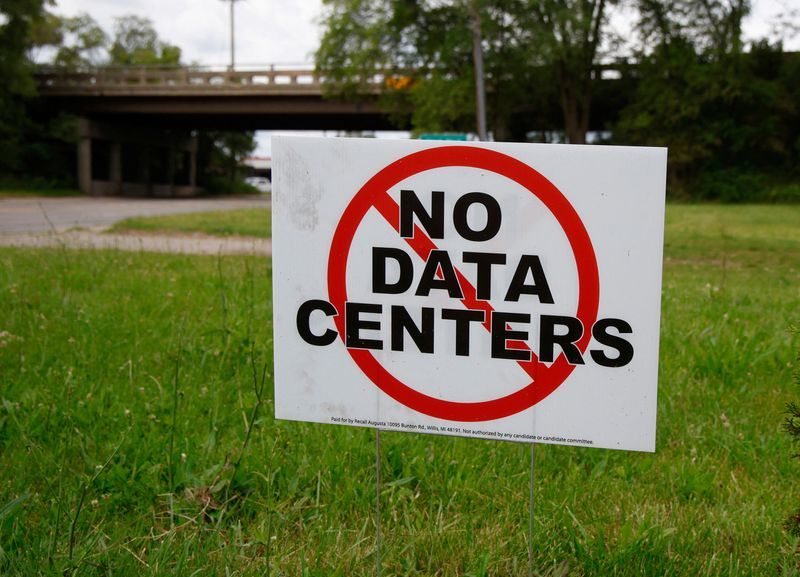
A nationwide surge in community resistance to artificial intelligence infrastructure is reaching a critical juncture, with opponents organizing simultaneous demonstrations across at least 125 locations throughout the United States on Saturday. This marks the first large-scale coordinated campaign to channel widespread frustration over the accelerated deployment of data centers—the vast computing facilities that power AI applications—into organized political action. The movement reflects months of mounting tension between tech companies seeking rapid expansion and communities grappling with unforeseen consequences of this industrial buildout.
The protests are being orchestrated by HumansFirst, a grassroots coalition founded by Amy Kremer, a prominent figure from the Tea Party movement of the late 2000s. Kremer has explicitly drawn parallels between today's data center resistance and the 2009 conservative uprising, suggesting that the intensity and breadth of public anger mirrors that earlier populist moment. What distinguishes the current movement, however, is its deliberate effort to transcend traditional left-right political divisions, uniting citizens from diverse ideological backgrounds under a shared concern about technological overreach and community autonomy.
The geographic distribution of planned protests reveals telling patterns about where data center development has proven most contentious. Texas, traditionally viewed as a business-friendly state, is leading with 16 scheduled demonstrations, underscoring how even regions traditionally supportive of industrial investment are experiencing serious reservations about data center proliferation. Georgia, a crucial swing state in American politics, is hosting 11 protests, while California, Florida, and Pennsylvania each have seven scheduled events. This dispersion across red, blue, and purple states provides compelling evidence that data center opposition has become genuinely nonpartisan.
The fundamental grievances driving protest activity centre on three interconnected concerns: the secrecy surrounding development approvals, the environmental footprint of these facilities, and the absence of meaningful community input. In numerous instances, local officials have negotiated with developers under confidentiality agreements that effectively prevent residents from understanding proposed projects until announcements are made. This lack of transparency has become a rallying point for organizers who argue that communities deserve to participate in decisions that directly affect their futures. The circumvention of traditional democratic processes, regardless of political ideology, strikes many Americans as fundamentally illegitimate.
Public opinion data underscores the depth of skepticism about data center expansion. A June Reuters/Ipsos survey found that merely one-third of Americans approve of the current pace of data center construction, a remarkably low figure for infrastructure broadly portrayed as essential to economic competitiveness. Even more striking, only 14 per cent of survey respondents would welcome a data center in their own community, even if explicitly intended to support artificial intelligence initiatives for major technology companies including Meta, Alphabet, Amazon, Microsoft, and Elon Musk's xAI. This yawning gap between abstract acceptance and concrete opposition demonstrates that Americans distinguish between supporting technological advancement in principle and accepting its concentrated impacts locally.
Water consumption has emerged as perhaps the most visceral concern, particularly in water-stressed regions. A proposed data center project in Imperial County, California—already facing severe water scarcity challenges—would require 260 million gallons annually from the Colorado River, a shared resource already stretched across seven states and Mexico. For environmental advocates like Ivan DelSol, a 54-year-old activist helping coordinate California desert protests, deploying such quantities of freshwater for artificial intelligence computing represents a dystopian misallocation of finite resources. The irony of consuming water supplies that sustain agricultural communities and residential populations to power algorithms has crystallised public opposition in the Southwest and other arid regions.
Power consumption presents a parallel concern that extends beyond water-stressed areas to affect electricity grids nationwide. Communities worry that massive data center demands will drive up utility bills for residential and small business consumers, effectively subsidising tech company infrastructure through elevated electricity costs for ordinary citizens. This concern resonates across income levels and political persuasions, binding together blue-collar workers, retirees, and small business owners in common cause. The fear that individual Americans will bear financial costs for development decisions they neither approved nor benefit from tangibly fuels the nonpartisan character of opposition.
Organisers have deliberately avoided endorsing blanket moratoriums on data center development, distinguishing their movement from Democratic-led efforts like those in New York State. Instead, activist coalitions emphasise procedural and substantive reforms: transparent development processes, robust environmental protections, community benefit agreements guaranteeing well-paid union employment, and enforceable developer accountability mechanisms. This pragmatic framing suggests protestors are not fundamentally opposed to data center expansion itself but rather to its current trajectory of opaque approvals, inadequate environmental safeguards, and concentrated benefits flowing exclusively to technology companies.
The organisers' diverse political backgrounds illuminate how technological disruption is reshaping political coalitions. Eva Cardona, a 31-year-old first-time activist from Texas who describes herself as a "political nomad," joined the movement after recognising that unregulated artificial intelligence expansion posed threats that transcended traditional partisan concerns. Her motivation—progressing beyond social media activism to hands-on organising—typifies a broader shift among younger Americans who regard technological policy as insufficiently addressed by established political structures. This generation appears increasingly willing to build cross-partisan coalitions around specific grievances rather than adhering to rigid ideological frameworks.
The tech industry's response has been notably muted. The Data Center Coalition, the sector's primary lobbying organisation, declined immediate comment on Saturday's protests, though it previously asserted that data centers demonstrate commitment to being responsible community neighbours. This defensive posture suggests industry recognition that public opinion represents a genuine threat to future expansion plans. Without demonstrable improvements in transparency, environmental stewardship, and community engagement, data center development faces potential political headwinds that could constrain projects and impose regulatory costs.
For Southeast Asian policymakers and communities, the American data center backlash carries immediate relevance. As major technology companies expand regional infrastructure investments—particularly across Southeast Asian countries with favourable regulatory environments and lower operational costs—similar tensions between development aspirations and environmental protection are likely to emerge. Communities in Malaysia, Singapore, Thailand, and Vietnam should study the American experience, recognising that data center expansion, while economically attractive, requires proactive regulatory frameworks, environmental impact assessments, and genuine community consultation to maintain public legitimacy. The success or failure of American efforts to balance technological advancement with community protection will establish precedents influencing regional policy development.
As data center opposition crystallises into a defining political issue spanning multiple election cycles, American political parties face pressure to articulate coherent positions on technological infrastructure policy. Both Democrats and Republicans risk losing credibility with constituents if perceived as either blocking progress or enabling unconstrained corporate expansion. The emergence of data center politics as a serious electoral concern suggests that the next presidential cycle and beyond will require politicians to demonstrate genuine commitment to reconciling technological advancement with environmental sustainability and community autonomy—concerns that transcend traditional partisan divides and reflect evolving American priorities regarding progress and governance.

