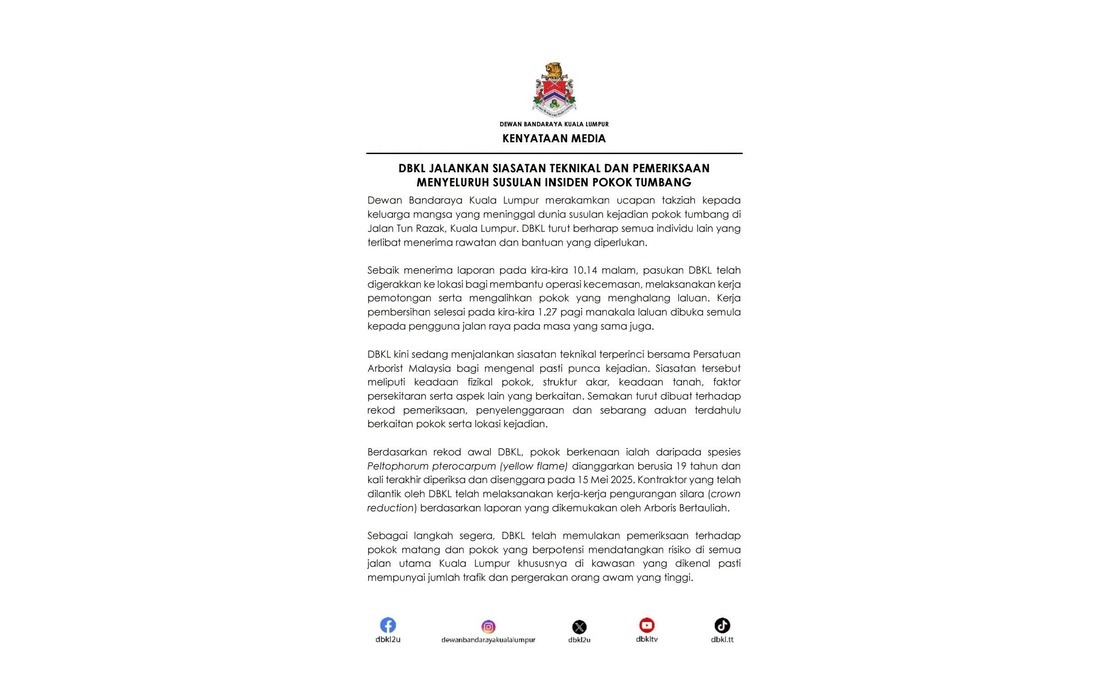
A 19-year-old Yellow Flame tree collapsed on Jalan Tun Razak on the evening of July 19, resulting in the death of a man in what has prompted Kuala Lumpur City Hall (DBKL) to launch an exhaustive examination into the circumstances surrounding the incident. The investigation, conducted jointly with the Malaysian Society of Arborist, represents part of a broader safety initiative across the capital's road network following the tragedy. DBKL has pledged full cooperation with police and other relevant agencies as they work to establish precisely what structural or environmental factors led to the tree's failure.
The technical probe encompasses a multifaceted assessment of the fallen specimen, extending well beyond simple visual inspection. Investigators are systematically examining the physical condition of the tree itself, its root structure and subterranean development, the composition and stability of the surrounding soil, and the broader environmental context of the location. Additionally, the inquiry will scrutinise all available documentation pertaining to the tree, including previous inspection records, maintenance schedules, and any complaints or safety concerns that had been lodged regarding the tree or its vicinity. This comprehensive approach reflects recognition that tree failures typically result from a combination of factors rather than a single isolated cause.
Records indicate that the Peltophorum pterocarpum specimen had been standing for approximately 19 years, placing it squarely in the mature category of urban vegetation. The tree had most recently undergone professional inspection and maintenance work on May 15, just two months prior to its collapse. A certified arborist had previously recommended crown reduction works, which the appointed contractor had duly executed. Despite these interventions and monitoring protocols, the tree ultimately failed catastrophically, raising questions about whether existing inspection and maintenance protocols are sufficiently robust or frequent to identify incipient structural problems before they become life-threatening.
Emergency response protocols functioned efficiently in the immediate aftermath of the incident. Upon receiving notification at 10.14 pm, DBKL deployed an emergency response team to the site, where they undertook urgent tree-cutting operations and removal of debris obstructing the roadway. These clearing operations proceeded methodically, with Jalan Tun Razak reopened to traffic by 1.27 am—a relatively swift restoration of a major arterial route in the capital. Nevertheless, the incident has exposed the potential vulnerability of Kuala Lumpur's mature tree stock and prompted authorities to reconsider preventive strategies.
In response to the fatal incident, DBKL has immediately commenced a comprehensive inspection programme targeting mature trees and specimens exhibiting elevated risk profiles throughout Kuala Lumpur's major road network. The initial phase of these inspections focuses on corridors known for dense vehicular and pedestrian traffic, including Jalan Ampang, Jalan Sultan Ismail, Jalan Raja Laut, Jalan Datuk Keramat, and sections of Jalan Tun Razak itself. Eight inspection teams, comprising five qualified arborists and supporting personnel, have been mobilised to conduct these assessments. The authority has allocated approximately ten weeks to complete this preliminary sweep, a timeline that reflects both the urgency of the safety imperative and the logistical complexity of systematically evaluating hundreds of trees across multiple major thoroughfares.
Looking toward longer-term systemic improvements, DBKL is pursuing a medium-term preventive strategy centred on technological monitoring of high-risk specimens. The city authority is presently seeking approval from SIRIM—the Standards and Industrial Research Institute of Malaysia—to deploy approximately 400 advanced tree sensors across the city in a phased installation programme. These sensors represent a significant departure from conventional inspection methodologies, as they would provide continuous real-time monitoring of tree health indicators rather than relying solely on periodic manual assessments. The devices would track soil conditions, moisture content within the soil and tree, structural movements in branches and trunk, and the impact of adverse meteorological events including heavy precipitation and flooding conditions.
The technological enhancement addresses a fundamental limitation of existing practice: manual inspections, however thorough and frequent, can only capture a snapshot of conditions at the moment of assessment. A tree can appear structurally sound during an inspection yet develop critical weaknesses—perhaps due to progressive root rot, hidden internal decay, or sudden soil destabilisation—within the intervals between scheduled assessments. Continuous sensor monitoring would theoretically provide early warning indicators of such deterioration, potentially allowing intervention before catastrophic failure occurs. This approach has gained increasing prominence in arboriculture sectors worldwide, particularly in densely populated urban environments where tree failures carry elevated consequences for public safety.
The initial deployment phase of this sensor programme will concentrate on four strategically significant locations: Jalan Bangsar, Dataran Merdeka, Jalan Ampang, and Jalan Raja Chulan. Selection of these sites likely reflects a combination of factors including high foot traffic volumes, presence of mature tree specimens, proximity to key commercial or civic infrastructure, and assessment of soil conditions and environmental stressors. By piloting the system in these carefully selected locations, DBKL can gather data on sensor performance, accuracy of early warning systems, and operational protocols before broader citywide deployment.
The incident and subsequent response reflect growing international concerns regarding urban tree management in tropical and subtropical megacities. Southeast Asian cities, including Kuala Lumpur, face particular challenges given the climate's tendency toward heavy seasonal rainfall, high humidity, and tropical soil conditions that may differ substantially from temperate regions where many tree care protocols were developed. Additionally, rapid urbanisation, soil compaction, underground utility installations, and climate variability all impose stresses on urban tree populations that may not be adequately captured by conventional inspection frameworks. Malaysia, as a regional economic centre with significant foreign investment and international business operations, has vested interest in demonstrating that it can maintain public safety while preserving the environmental and aesthetic benefits that mature urban tree canopies provide.
For Malaysian residents and workers in Kuala Lumpur, the implications of this incident and the subsequent institutional response are multifaceted. On the immediate level, the expanded inspection programme and deployment of monitoring technology should theoretically enhance safety around major urban thoroughfares. However, the fatal tree fall itself raises awareness that residual risks persist despite professional oversight, suggesting that public vigilance remains warranted during severe weather events when tree failure risk escalates. From a broader policy perspective, the incident illustrates the complex technical challenges inherent in managing large urban tree populations and suggests that cities throughout Malaysia and Southeast Asia may need to evaluate their own tree management protocols in light of Kuala Lumpur's experience.

