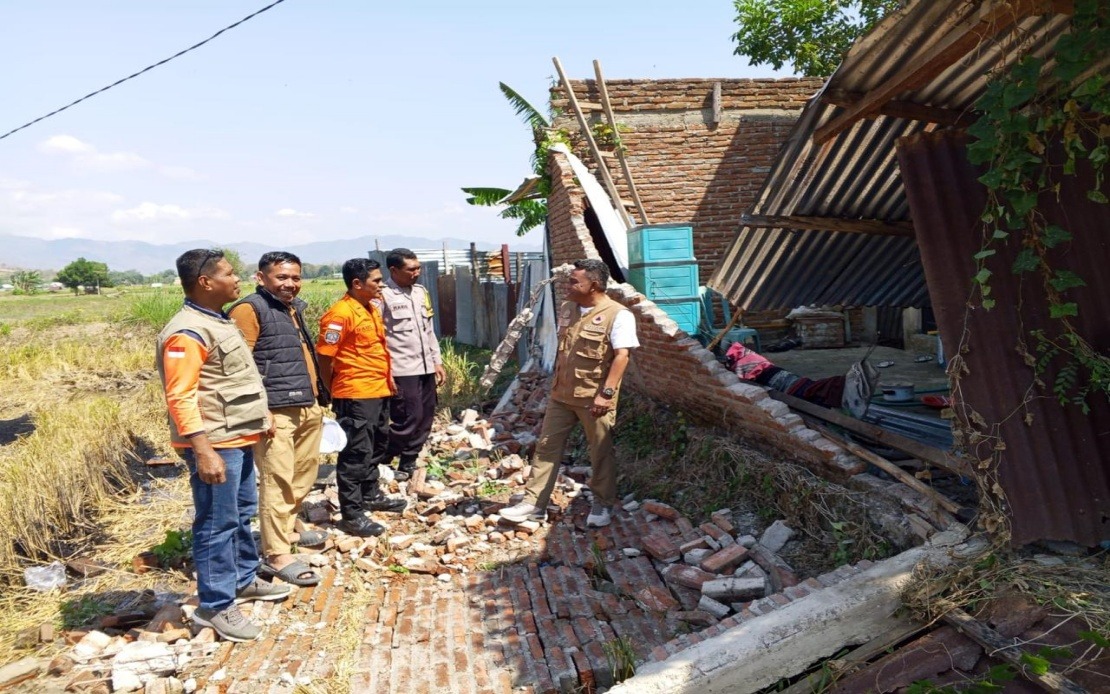
Indonesia's Flores Island has been struck by a powerful magnitude 7.7 earthquake that has claimed at least 38 lives, with rescue operations intensifying as authorities work to locate residents believed trapped beneath damaged structures throughout the affected areas in East Nusa Tenggara.
The seismic event occurred at 4:58 am local time on Saturday, with its epicentre located approximately 30 kilometres offshore from Mbay at a depth of 15 kilometres beneath the sea bed. The substantial magnitude and shallow focal depth combined to generate considerable ground shaking across a wide area, triggering immediate evacuation responses and overwhelming emergency services with the scale of casualties and infrastructure damage.
According to Suharyanto, chief of the National Disaster Management Agency (BNPB), the casualty figures continued mounting throughout the immediate aftermath, with two individuals in critical condition and eleven more sustaining injuries ranging from moderate to minor. Approximately 2,000 residents had independently fled their homes and the immediate disaster zones by the time officials conducted their first formal assessment.
The initial response to the earthquake included a tsunami warning issued by relevant maritime authorities, though this alert was subsequently cancelled at 7:31 am following detailed sea-level monitoring that indicated no dangerous waves had developed. This decision brought some relief to anxious populations along coastal areas, allowing rescue efforts to concentrate on land-based emergency response without the additional complication of tidal complications.
Physical destruction across Flores has been extensive and multifaceted. Dozens of residential dwellings have been reduced to rubble or rendered uninhabitable, whilst several community health centres serving local populations sustained structural damage that compromised their ability to provide medical assistance during the crisis. Beyond these facilities, landslides triggered by the earthquake have blocked multiple road routes, effectively isolating several communities and complicating access for rescue convoys attempting to reach affected settlements. Transportation infrastructure including airport terminals and port facilities also sustained damage, though runway surfaces remained intact, preserving at least one avenue for delivering emergency supplies and personnel via air transport.
Rescue and recovery operations have involved coordinated deployment of multiple Indonesian agencies and military units. Personnel from the National Search and Rescue Agency (Basarnas), the Indonesian military forces, and police units have been mobilised to systematically search damaged buildings where survivors may remain trapped, whilst simultaneously coordinating evacuation efforts for those requiring immediate assistance. Authorities have acknowledged that comprehensive casualty and damage assessments would take considerably longer, with figures expected to evolve substantially as rescue teams penetrated deeper into remote settlements and as medical facilities processed incoming injured persons.
The government response has extended beyond immediate rescue operations to encompass critical infrastructure restoration. The Public Works Ministry has directed personnel and heavy equipment to affected regions with the specific mandate of clearing landslide-obstructed roads, thereby reopening transport corridors essential for moving relief supplies and enabling emergency vehicles to access isolated populations. Two helicopters and one fixed-wing aircraft have been deployed by BNPB to supplement ground-based logistics, particularly for reaching areas inaccessible by conventional road transport.
Distribution networks for emergency supplies have been activated rapidly throughout the disaster zone. Food supplies, potable water, portable shelter materials including tents, electrical generators, and other essential items are being systematically delivered to displaced communities gathered in temporary collection points. The scale of the operation reflects the Indonesian government's recognition that 2,000 evacuees represent merely the immediate wave of displaced persons, with many additional residents requiring assistance in returning to functional accommodation and resuming normal activities.
For Southeast Asian observers, the Flores earthquake underscores the region's persistent vulnerability to seismic activity generated by its location atop the Pacific Ring of Fire. Indonesia's geological situation, straddling multiple tectonic plate boundaries, creates recurring earthquake hazards that present both immediate humanitarian challenges and longer-term development considerations. The incident also demonstrates the practical limitations of earthquake prediction technology and the consequent necessity for robust emergency response systems and public preparedness protocols.
The disaster carries implications for disaster management frameworks across the broader Southeast Asian region. As nations like Malaysia, Thailand, and the Philippines face similar seismic and geological hazards, Indonesia's response patterns—both successes and shortcomings—provide instructive lessons regarding inter-agency coordination, community evacuation protocols, and the critical importance of maintaining adequate stocks of emergency supplies positioned strategically across vulnerable regions. The integration of air transport into disaster response, as demonstrated through BNPB's helicopter deployment, represents particularly valuable methodology for island nations and regions with challenging terrain.
The restoration of normal conditions in Flores will necessarily extend well beyond the immediate rescue phase. Infrastructure reconstruction, addressing psychological trauma experienced by survivors, investigating structural failures in collapsed buildings to inform future building code improvements, and implementing longer-term community recovery programmes will occupy authorities for months. The earthquake serves as an unwelcome reminder that despite technological advances and scientific knowledge, geological forces remain capable of overwhelming human infrastructure and generating catastrophic human suffering with minimal warning.

